








One of the key questions asked in former President Donald Trump’s impeachment trial is whether he knew that his vice president was in mortal peril on Jan. 6. There are only two possible answers: Either he knew and didn’t care or he was deliberately and cruelly incurious — knowing that he could have easily asked about former Vice President Mike Pence and did not — because Pence’s safety did not matter to him as much as the ambient excitement of the insurrection apparently did.
Trump clearly knew enough to be culpable of knowing. And if he did not, it only proves the House managers’ point that he was negligent in his duty as commander in chief that day.
One of Trump’s lawyers, Michael T. van der Veen, told the Senate on Friday that the former president did not know about the danger Pence was in, which itself is so ludicrous a statement as to demand its own investigation. Trump clearly knew enough to be culpable of knowing. And if he did not, it only proves the House managers’ point that he was negligent in his duty as commander in chief that day.
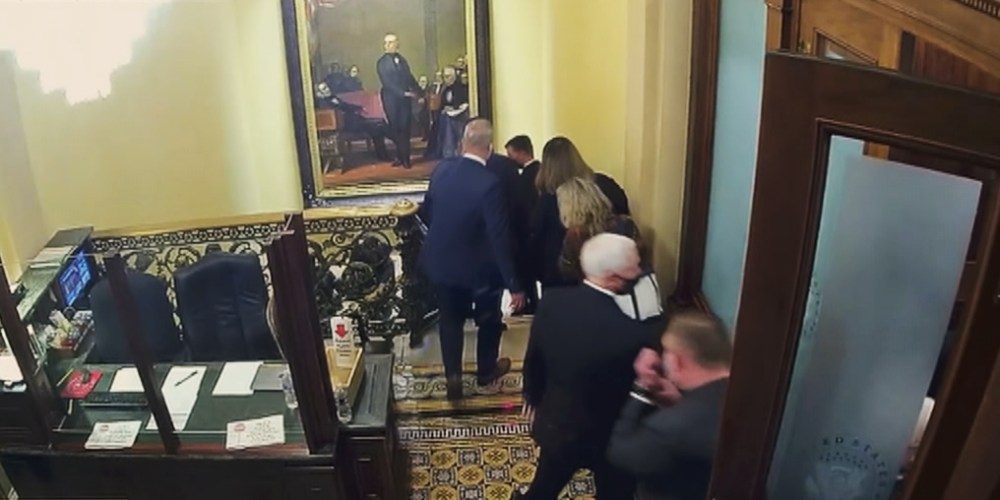
Around 2:13 p.m. ET on Jan. 6, Pence’s Secret Service detail decided to remove him from the Senate floor and take him to a shelter-in-place location below-ground. That security camera footage shown by House managers is, in retrospect, some of the most chilling captured that day. Shortly after Pence makes his way down the stairwell, his military aide, carrying a large briefcase, follows. The briefcase is the nuclear “football” — an exact copy of the one the president’s military aide was guarding at the White House that day.

That Pence had a military aide and a briefcase was a surprise to many who aren’t familiar with the command and control of strategic nuclear forces. Suddenly the import of what happened acquired a new salience: Did Trump’s inaction place not only his vice president, but the security of the nuclear deterrent in jeopardy?
Short answer: Yes. About 10 minutes after Pence was evacuated, Trump tweeted in rage, “Mike Pence didn’t have the courage to do what should have been done to protect our Country and our Constitution.”
It was, in fact, Trump whose actions had just compromised national security. Given the chaos of the moment, though, it is not inconceivable that Pence might have been separated from the military aide during the evacuation. It is horrifying to speculate about this scenario because it is reasonable to envision exactly that might have happened.
Pentagon press secretary John Kirby told reporters this week that he “would not get into discussion about specific command and control over nuclear strategic forces.” But I will.
Of everything in the briefcase, the decision book is the most valuable to adversaries.
The worst-case scenario we can set aside: No one can use contents of the briefcase to launch anything. There is no button. There is no way to transmit an emergency war order without involving the Pentagon and a number of other command centers having authenticated the user’s identity and their status as the surviving commander in chief.
So what might have happened if the football was taken by the protesters? Well, they would have had to figure out how to get into it. It does not open easily. So after a while of fiddling, whether at the Capitol or somewhere else, let’s assume an unauthorized user managed to pry it open. They would have found a satellite phone, a copy of the latest nuclear decision handbook and a few other classified documents and objects.
Of everything in the briefcase, the decision book is the most valuable to adversaries. It includes a Cheesecake-Factory-like picture menu of nuclear options that would allow an authorized user to order up massive or targeted strikes at a multitude of targets, along with annotations to show the effects of the chosen strikes, damage assessments, expected retaliation — basically, all of our most sensitive war plans and their assumptions, laid out neatly for an average person to digest as quickly as possible.
Right before Trump sent the tweet castigating his vice president, he had spoken with Sen. Tommy Tuberville, R-Ala., who said he told the president that Pence had been taken from the chamber. And we know Trump was watching television — where Pence’s emergency evacuation would have been hard to miss. But if Trump had any question about Pence’s whereabouts, he could have asked a member of his own Secret Service detail. So closely are presidents and their vice presidents joined to the nuclear football that whenever they take an elevator, advance agents ensure the military aide and a doctor are in the same chamber as the protectee. Pence’s detail, along with its counterassault team, would have immediately broadcast their emergency action to the service’s Joint Operations Center, which would have just as quickly notified the president’s agents. And the military aide would have notified the president’s Emergency Operations Center over a different frequency. Any unusual or unplanned movement of a presidential successor would be reported to the president’s chief of staff or the national security adviser as soon as possible. In short, there’s no way Trump could have been ignorant to the danger that Pence was in, no matter what his lawyers told the Senate. Nor should he have been unaware of the broader security risks. The U.S. nuclear command, control and communication architecture is as robust or as fragile as the physical security around those who must engage with it, among many other factors. On Jan. 6, Trump’s state of mind nearly let it all collapse.
Marc Ambinder
Marc Ambinder is a senior fellow at the USC Annenberg Center for Communication Leadership and Policy. A former White House correspondent and political reporter, he is the author of several books about national security, including “The Brink: President Reagan and the Nuclear War Scare of 1983.” He is a consultant for Spycraft Entertainment and lives in Los Angeles. 


