








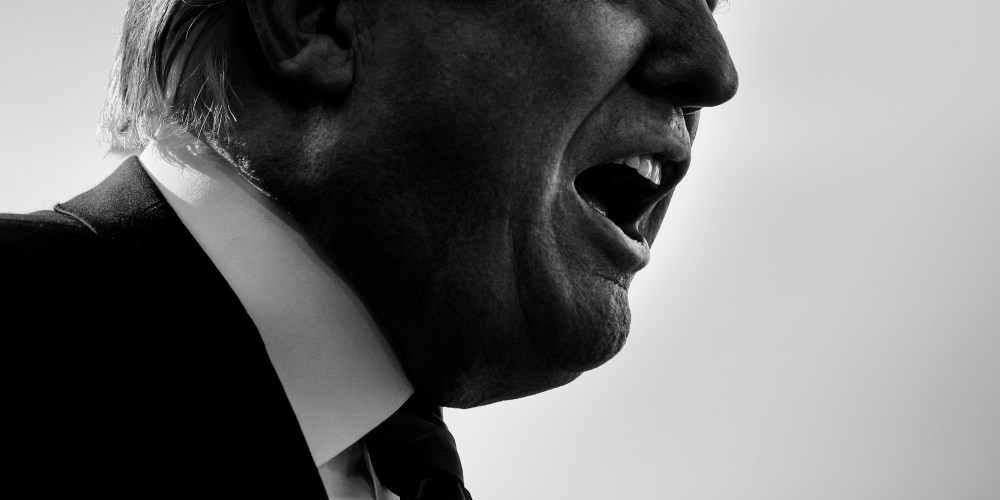
When President Donald Trump said “these people are sick” during remarks to donors before his final debate with former Vice President Joe Biden last week, he wasn’t talking about the nearly 9 million people in the United States inflicted with Covid-19 or the resurgent pandemic that seems to spread wherever he holds a rally. The people Trump was referring to as “sick” appeared to be the civil service professionals who devote their careers to serving our country. “You have a lot of people from past administrations,” he complained, “and they’re civil service. I fired some.”
The people Trump was referring to as “sick” appeared to be the civil service professionals who devote their careers to serving our country.
The comments spoke to Trump’s unprecedented assault on professionalism in the ranks of our federal government, which he now promises to accelerate should he win a second term. Specifically, they expanded on a sweeping executive order he had signed the day before to reclassify thousands of professional civil service jobs as “political,” thus permitting the president to replace professionals and experts throughout the federal government — who swear an oath to the Constitution, not to any president — with sycophants. In response, Ronald Sanders, Trump’s own appointee to the Federal Salary Council, which helps oversee the professional civil service, resigned in protest. In a letter, Sanders warned that Trump’s order was a “smokescreen” designed “to replace apolitical expertise with political obeisance.”
NEW: Ronald Sanders, a Trump appointee and chairman of the Federal Salary Council has resigned effective immediately, citing Trump’s recent exec order on federal worker classification changes as the cause.
— Brandi Buchman (@BBuchman_CNS) October 26, 2020
Background on EO: https://t.co/vBXpIPNfoY
Portion of Sanders’ letter: pic.twitter.com/eBNlR97C6B
If Trump wins, he has now ensured he’ll have the power to rapidly accelerate these damaging trends. Even if he loses, in which case the executive order would likely not be upheld by Biden, it will take years to restore the depleted ranks of experts across federal departments and agencies, from the State Department to the Centers for Disease Control and Prevention.
It’s a hallmark of the Trump administration that in four short years it has managed to degrade America’s professional and nonpolitical institutions, from our intelligence services to our diplomatic corps to the doctors and scientists in our public health agencies. The president is now sending every signal that his second term, in this regard, would be even worse.

No doubt, there could be more flexibility and discretion in reorganizing federal departments to face new crises. The interagency process can be cumbersome, a frustration felt by Trump’s predecessors. (Harry Truman famously said of his incoming successor: “He’ll sit here and say, ‘Do this! Do that!’ and nothing will happen. Poor Ike — it won’t be a bit like the Army.”)
But as Sanders warned, Trump’s reforms don’t aim to increase efficiency — rather, they aim to enable a wholesale de-professionalization of government service. It’s part of the broader story of Trump’s presidency, which shows little appreciation for the very idea of service in behalf of the American people, as opposed to service in behalf of a president’s personal interests.
No matter what, America’s public servants must know a president has their back.
I spent two years during the Trump administration in the State Department as the president’s special envoy, helping to lead the campaign against the Islamic State. I held the same position under Barack Obama, and before that, I served on George W. Bush’s National Security Council. These were not career posts: I served at the pleasure of the president, like most people in positions in the upper ranks of an administration. But it would have been impossible to get anything done, let alone competently, without depending on career professionals on my staff and in the ranks of our nonpolitical diplomatic, military and intelligence corps.
One of my colleagues in the Trump administration was Michael McKinley, a four-time U.S. ambassador and then senior adviser to Mike Pompeo, Trump’s secretary of state. McKinley quit in late 2019. Last week, he explained why, writing that the damage Trump has done to the diplomatic corps is likely to be “generational” after “the department turned its back on its own staff.”
For McKinley, the last straw was a White House campaign to denigrate Marie Yovanovitch, our career ambassador in Ukraine, after she refused to go along with a scheme to withhold security assistance from the country until it launched a fraudulent investigation of Biden. McKinley resigned when nobody at the State Department stood up for Yovanovitch, who had dedicated her professional life to serving our country since the Reagan administration. He rightly warns about “the misuse of career professionals in Washington and abroad to pursue a U.S. electoral advantage.”
No matter what, America’s public servants must know a president has their back. What holds true for Yovanovitch when facing off against Russians in Ukraine applies equally to scientists and doctors in our public health institutions (who are “idiots,” according to Trump). We count on them to tell the truth even when it may be difficult to hear or it is an unwanted intrusion for a president living in a world shaped by social media and cable news. Competent presidents seek out the truth, regularly inviting government experts into the Oval Office and asking them, in the words of President Dwight D. Eisenhower, to “lay out the facts cold and hard” before major decisions are made. It’s up to a president to create an environment for such truth-telling, which starts with showing respect for the professionals in the ranks who do the work every day. Those professionals need to know that they will not be penalized or shunned after reporting troubling facts to superiors or standing up for American values overseas. In early 2016, I was flying to Turkey with then-Vice President Biden. We had a difficult set of meetings with Turkish officials, including the president, Recep Tayyip Erdoğan, who was cracking down on dissent at home and doing little at the time to stem the flow of foreign fighters in and out of Syria. Biden’s immediate focus, however, was the U.S. ambassador, John Bass, a career diplomat who was under fire from Turkish officials for calling out the recent crackdown as contrary to democratic values. Biden understood that for an ambassador to be effective, everyone in the host country had to know that he or she spoke for the United States. So he went out of his way to make it clear — before he even met with Turkish officials — that he had Bass’ back. On the first morning of our visit, he spoke to the media about John. “He speaks for my government,” he said. “He speaks for the American people.” That is what any president should say about professionals serving our country in tough assignments, whether for those protecting us from diseases at home or those representing us in foreign capitals abroad. It could not be a sharper contrast to the current occupant of the Oval Office, who seems to have nobody’s back but his own. That should be an important consideration when voting Nov. 3.
Brett McGurk
Brett McGurk is an MSNBC columnist and MSNBC national security analyst. He was most recently a special presidential envoy coordinating the global campaign to defeat ISIS, and he has served in senior national security posts in the Bush, Obama and Trump administrations. 

