








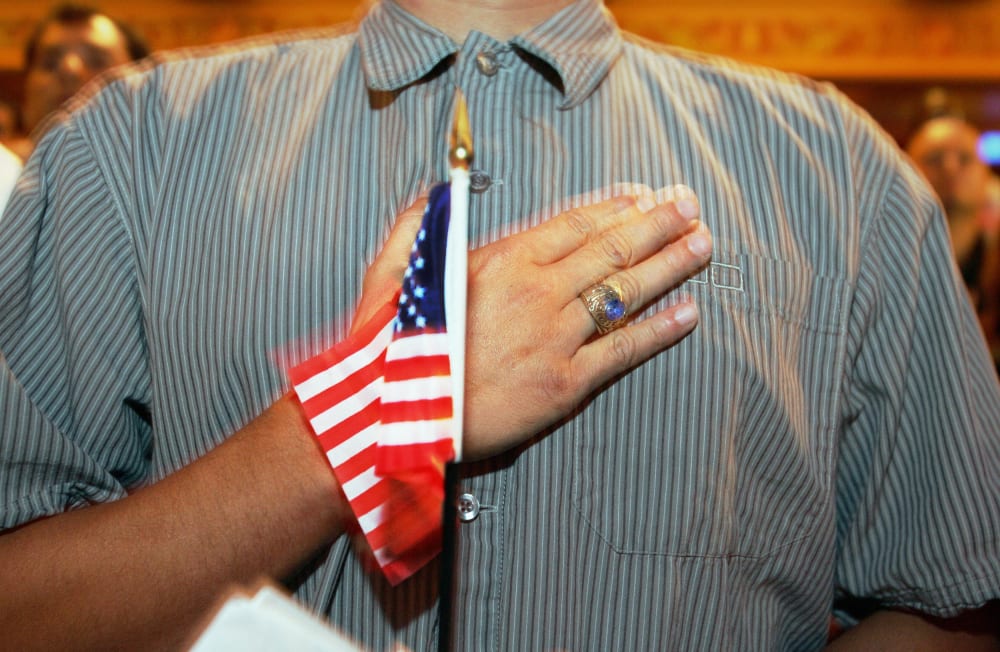
On a breezy morning this summer, a dear friend of mine became an American. Alongside people from dozens of other countries including Yemen, Togo and Russia, he, a Pakistani who had lived in the States for decades, took the oath of citizenship. After the ceremony, a group of us took photos outside the Brooklyn courthouse, strolled through some quiet streets and took shots at a mostly empty bar at 11 in the morning. Between dark jokes about how we could no longer call ICE on our newly American friend if he annoyed us too much, we reflected on the surprisingly philosophical remarks from the judge overseeing the oath of allegiance ceremony.
That judge did more than instruct those in the ceremony to raise their right hand and recite a promise to support and defend the Constitution. He delivered a full-fledged sermon on multiculturalism and what it means to become an American. He told his rapt audience that they ought to hold onto their country of origin — its culture, its languages, its food — “close to your heart” and advised them not to “let go.”
At the bar, my friends and I wondered if the judge had meant to sound political.
He promised them that becoming an American citizen was not a forfeiture of their past, but was “adding something on top of it.” He counseled the new citizens to believe they were not second-class because they were naturalized: “You’re not less of a citizen than anyone else, and don’t let any tell you otherwise. If they do, you come to me,” he said. He gushed about his own Italian ancestry, and he shared his love for his adopted son from another country. Ultimately, he argued that naturalized citizens were full Americans who had a unique ability to enrich the republic with their background — and encouraged the group to pour all of themselves into their new nation.
I cried as the judge spoke. I cried because I’m a sucker for any spirited defense of multicultural democracy, something that resonates viscerally for me as the child of immigrants who has always felt my heritage was a gift. But I also cried because the idea the judge celebrated is in peril. My friend had anxiously awaited his citizenship confirmation as ICE was arresting people at citizenship appointments. He was moving toward becoming a naturalized citizen as the president was defaming immigrants as “poisoning the blood” of America, reducing legal immigration, attempting to deport legal immigrants for political speech and overseeing a mass deportation operation that employed racial profiling.
Things seem to be getting worse. This week, President Donald Trump abruptly canceled citizenship ceremonies and, using a disingenuous security argument to effectively discriminate based on nationality, plucked select people out of line for ceremonies based on their country of origin. Trump has said he would “absolutely” denaturalize people to the extent he’s able to.
At the bar, my friends and I wondered if the judge had meant to sound political. The subtext to his comments about how nobody should let themselves be pushed around after leaving the courtroom was that it could very well happen — not just by schoolyard bullies or oddball xenophobes, but the president of the country they had just become citizens of.
Did they believe they were as American as everybody else and should be accepted as such? Or were they afraid of being targeted by the president’s supporters — or even by the president himself?
Not so long ago, things were so much different. On an idyllic summer day 14 years ago, I watched another loved one take the oath of allegiance to become a citizen: my mother. On this occasion, the judge presiding over the ceremony was far more reserved and did not preach. But the event spoke for itself. I remember feeling immense pride at the swearing in, surrounded by people from what felt like every country in the world. I marveled at how all those people wanted to be here, a place where I had begun and become a person. And this country was run by people who seemed to want all these people from all over the world to be here, to begin their life anew. It sunk in for me how radically generative and beautiful it was to live in a nation defined by immigration. Yes, I cried.

This was the Obama era: a time of record-breaking mass deportations of undocumented immigrants and coldness toward Central American refugees, but also a time of the Deferred Action for Childhood Arrivals, or DACA, initiative, a welcoming attitude toward legal immigration and excitement over the possibilities of multiculturalism. The president himself was the son of a Kenyan immigrant to the U.S. More broadly, while President Barack Obama was no immigration dove, the federal government was operating according to a good faith application of rules and held no on-the-record racist positions on desirable nationalities. The oath ceremony felt orderly and secure, a final stop on a sturdy set of train tracks. My mother had for many years played by the rules, lived her American life and applied for citizenship. The application was approved. Each party had kept its word, and my mother and America were better off for it.
The Trump administration is laying siege to the idea that citizenship is a democratic pact.
The Trump administration is laying siege to the idea that citizenship is a democratic pact, and instead positing that it should be a function of ethnic heritage. Vice President JD Vance’s dog whistle at the Claremont Institute in California in July helped underscore it. He said that “identifying America just with agreeing with the principles, let’s say, of the Declaration of Independence — that’s a definition that is way over-inclusive and under-inclusive at the same time,” and spoke of people with ancestors who fought in the Civil War as having “a hell of a lot more claim over America than the people who say they don’t belong.”
Vance insinuated a hierarchy of citizenship in which the descendants of Southern white people who waged war against the federal government had an outsized claim to the nation, suggesting Americanness is tied more to bloodlines than fidelity to the republic.
Vance’s point that being an American is about more than just a nominal agreement with its overarching principles is correct. But it’s also a strawman. Immigrants don’t just barge into the U.S., memorize what it takes to pass the naturalization test (which most Americans would fail) and then vanish into autonomous ethnic enclaves. Every generation of immigrants in American history follows the same pattern: They become participants and contributors to the nation’s economy and society — assimilating into America (especially intergenerationally) while expanding its horizons. My mother and my friend are natural examples of this dynamism. Since coming to the U.S., my mother has done work for nonprofits in education and the arts, held her ground as a fierce soccer mom, and thrown dinner parties featuring South Asian food that’s beloved by her American friends. She delights in watching ice-hockey brawls and loves matzo ball soup. My friend plunged headlong into America by going to college in the Midwest and joining a fraternity. He still watches Pakistani cricket, but he’s grown fond of jazz and obsessed with the Knicks. He has worked tirelessly as a producer and director on incisive documentaries about American culture. Both are bilingual and have large circles of friends that include people who were born in America and people who immigrated here. Maybe the judge at my mother’s naturalization ceremony didn’t feel the need to preach a sermon because the idea of “E pluribus unum” — out of many, one — wasn’t under attack. Perhaps the judge at my friend’s ceremony felt the need to insist upon that idea because he knows it is.
Zeeshan Aleem is a writer and editor for MS NOW. Sign up for his free politics newsletter by clicking the link at the top of this bio. 

