








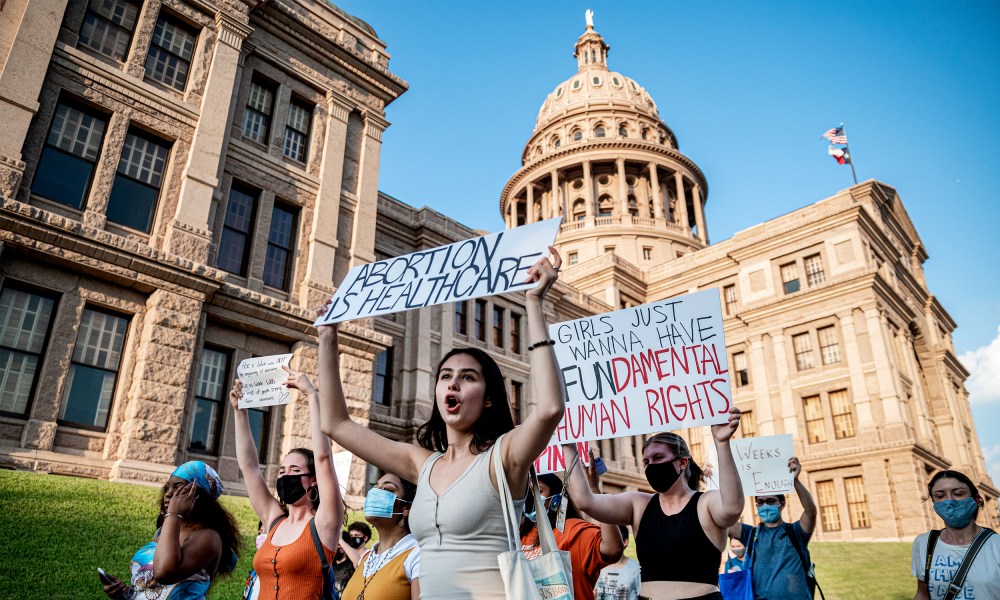
Texas has enacted the nation’s strictest abortion law, which flies in the face of almost half a century of Supreme Court precedent. A federal trial court, the 5th U.S. Circuit Court of Appeals and the U.S. Supreme Court all allowed this law to go into effect and, hence, functionally overturned the landmark decision in Roe v. Wade. With one caveat, it is now open season for states to assume we live in a post-Roe world.
It is now open season for states to assume we live in a post-Roe world.
But, first, just how bad is this law? Well, it allows any private individual to sue any other private individual who assists a woman in obtaining an abortion and awards a successful plaintiff at least $10,000 plus attorneys’ fees. The law bans abortions before many women even know they are pregnant. And there are no exceptions for pregnancies that occur as a result of rape or incest.
Texas Gov. Greg Abbott is either willfully ignorant or lying about the true consequences of the law banning all abortions after a woman is approximately six weeks pregnant.
“It doesn’t require that at all, obviously. It provides at least six weeks for a person to get an abortion,” Abbott said in response to a question about whether the law would force victims of rape to carry a baby to term. The only things that are obvious here is that this is not the case and that Abbott has never been, nor ever will be, pregnant.
When a woman is considered to be six weeks pregnant, the time of conception was approximately four weeks prior because the first day of pregnancy is considered to be the first day of the woman’s last menstrual cycle. This means the woman’s period is only about 14 days late. For women who have irregular menstrual cycles, this late or missed period is a moving target that can be difficult to chart.
If you accept Abbott’s explanation, a woman is sitting around for six weeks, aware that she is pregnant and deciding whether or not to have an abortion. If you accept reality, that woman, at best, has known she is pregnant for two weeks. And more likely, may only be aware that she is pregnant days before the deadline to obtain an abortion. Abbott’s answer that a woman has “at least six weeks” to act can only be true if a woman could obtain an abortion before conception.
“Rape is a crime,” Abbott said, “and Texas will work tirelessly to make sure that we eliminate all rapists from the streets of Texas.”
We can save for another day an inquiry as to why, if it is possible to eliminate rapists, Texas has not previously done that. But Abbott’s apparent suggestion that rape victims need not worry about Texas’ new abortion law because Texas will simply be more aggressive about prosecuting rapists is, at best, beside the point.
The point is that, thanks to the decisions of three levels of federal courts, in the short term we are almost certainly reverting back to an era in which states can ban (or almost ban) abortion if their lawmakers wish to, and the federal government will allow that to happen. Given the Supreme Court’s decision in this case, it seems pretty clear how the high court will rule in a big challenge to Mississippi’s abortion law, which bans abortions after 15 weeks of pregnancy.
But here comes the caveat: We also have state governments and state courts that can, at least in limited circumstances, put the brakes on some of these draconian abortion laws.
State courts, in addition to federal courts, can push pause on or strike down state laws. In fact, a Texas state court has already done that. A Texas trial court judge issued a temporary restraining order to prevent one anti-abortion group, Texas Right to Life, from suing abortion provider Planned Parenthood and its employees. This means the Texas law can go into effect with respect to other potential plaintiffs and defendants, just not these two. This is a limited, and perhaps temporary, remedy. But it is a remedy.
Is this really all the pro-abortion-rights community is left with? A piecemeal remedy in which individuals or groups with the resources to bring separate state actions try to push back against the rising tide of abortion bans? Maybe. Pro-abortion-rights advocates certainly hope their challenges will make their way to the Texas Supreme Court and that the court will declare Texas’ law unconstitutional under the state constitution. What about the Department of Justice? Attorney General Merrick Garland’s first concrete move was to enforce a decades-old federal law that, in part, prevents people from threatening, obstructing or injuring anyone who is trying to enter an abortion clinic to obtain services. Enforcing this federal law will not prevent Texas’ abortion law from continuing to be in effect. It will simply allow women to walk into an abortion clinic without being threatened. Once inside, she can still be denied access to an abortion. The Department of Justice could come forward with a novel argument for at least temporarily blocking Texas’ law, but this feels far from likely. Harvard Law School Professor Emeritus Laurence Tribe argued, for instance, that Garland should prosecute people who sue to enforce Texas’ abortion law under federal civil rights laws that prevent people from depriving others of rights protected under the Constitution. These federal civil rights powers were designed to stem white terrorists from thwarting Reconstruction and, later, the civil rights movement. It is not clear they apply in this case. The best chance to at least temporarily block this abortion law may run through state courts. But wait, what about Congress? Couldn’t Congress pass a law that essentially codifies the Roe v. Wade decision that found women have a constitutionally protected right to obtain an abortion? Sure, in an alternate universe in which Democrats have enough votes in both the House and the Senate to do so, they could. Guess what, though? That federal law could still be challenged as beyond the scope of Congress’ authority. For now, the best chance to at least temporarily block this abortion law may run through state courts. Individuals or groups with deep pockets will be forced to play a game of whack-a-mole and challenge these laws as they apply to specific groups, like anti-abortion organizations. This is not a solution; it is a limited remedy. This is not the moment for limited remedies. We know what is going to happen as a result of the federal courts blessing Texas’ abortion law. It won’t stop all abortions after six weeks of pregnancy. It will instead force those women who have the ability to leave the state to do so. It will lead other women to take matters into their own hands and potentially put their own health at risk. That is, it will exacerbate inequalities between women with and without resources. Of course, the women who lack resources shouldn’t hold their breath for help from the state of Texas once the child is born. Texas will force women to have children but not help women and families care for them.
Jessica Levinson is a Loyola Law School professor and MS NOW columnist. 

