








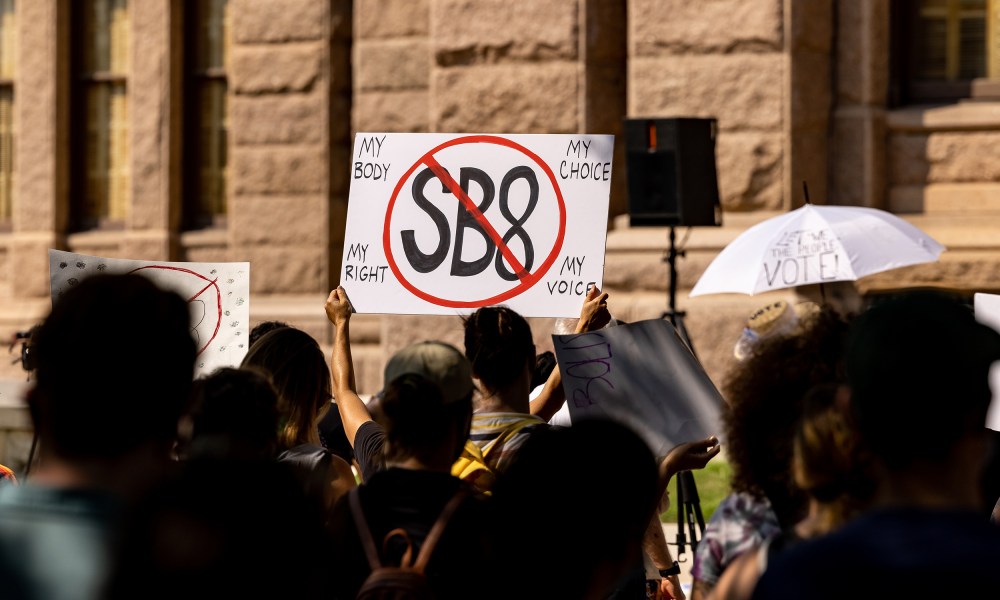
Just before midnight on Sept. 1, when the Supreme Court voted 5-4 to allow Senate Bill 8 — Texas’ ban on virtually all abortions after about the sixth week of pregnancy — to go into effect, it provoked an especially harsh dissenting opinion from the three progressive justices, penned by Sonia Sotomayor.
Before long, we won’t have one Constitution; we’ll have 50.
“Presented with an application to enjoin a flagrantly unconstitutional law engineered to prohibit women from exercising their constitutional rights and evade judicial scrutiny,” she wrote, “a majority of Justices have opted to bury their heads in the sand.”
Sotomayor’s trenchant critique may be applied with equal force to Republican members of the Senate Judiciary Committee — who spent most of Wednesday’s hearing (for which I served as one of the witnesses) about the Supreme Court’s ruling (and the Texas law more generally) criticizing abortion, criticizing the Supreme Court for recognizing a constitutional right to pursue a pre-viability abortion in 1973 and criticizing Democrats for seeking to continue to protect that right. But lost in the shuffle was the far more ominous precedent that S.B. 8 sets for our legal system — one in which all of our constitutional rights, and not just the right recognized in Roe v. Wade, mean little more than what the 50 state legislatures want them to mean.
By way of background, what makes S.B. 8 different from decades of other efforts by Republican-led legislatures to restrict abortion access are the procedural traps it deliberately creates. The law can be enforced only by private citizens, not the state — not to turn private citizens into bounty hunters (that turns out to be only a secondary effect), but because that structure makes it harder for abortion providers to challenge the constitutionality of the restrictions. It also ensures a paucity of proper defendants.
The law allows for potentially endless litigation against the providers, for which they are barred from recovering their costs or fees even if they win every single case on the merits (which they will, because the substance of the abortion restriction is patently unconstitutional). In other words, what’s important about S.B. 8 is not just the substantive ban on virtually all abortions after the sixth week of pregnancy (when many don’t even know that they’re pregnant), but the cynical procedural traps it creates — a measure that its supporters openly concede is a transparent attempt to frustrate meaningful judicial review.

Critically, though, nothing about S.B. 8’s procedural machinations is unique to abortion. If Texas can use this legal Rube Goldberg device to frustrate judicial review of the constitutional right the Supreme Court recognized in Roe, California can use it to frustrate judicial review of the constitutional right the Supreme Court recognized in Heller (to keep and bear arms for private self-defense). New York can use it to frustrate judicial review of the constitutional right the Supreme Court recognized in Citizens United (to establish First Amendment protections for corporate political donations). And so on.
Before long, we won’t have one Constitution; we’ll have 50. As Chief Justice John Roberts — no friend of abortion rights — put it in his opinion dissenting from the court’s refusal to block S.B. 8, “The consequences of approving [Texas’] action, both in this particular case and as a model for action in other areas, counsel at least preliminary judicial consideration before the program devised by the State takes effect.” And yet, those consequences were no never mind to the five justices in the majority.
What makes SB8 different from decades of efforts by Republican-led state legislatures to restrict abortion access is the procedural traps it deliberately creates.
At least the justices who refused to block S.B. 8 on Sept. 1 went out of their way to avoid endorsing it. The cryptic order instead stressed that the providers “have raised serious questions regarding the constitutionality of the Texas law at issue” and insisted that “we do not purport to resolve definitively any jurisdictional or substantive claim in the applicants’ lawsuit.” Senate Republicans, in contrast, couldn’t help themselves. Tom Cotton of Arkansas, for instance, complained that the providers’ suit was itself “frivolous.” And Ted Cruz of Texas insisted that the Legislature “made a perfectly reasonable decision” when it effectively deprived millions of Texans of their federal constitutional rights — in a growing number of cases, permanently.
Of course, those who believe Roe was wrongly decided may soon get their way. The Supreme Court is set to hear oral arguments Dec. 1 in a case about Mississippi’s ban on virtually all abortions after the 15th week of pregnancy, in which the state has directly asked the justices to overrule Roe. My view is that there are compelling reasons the court need not and should not take that step, but at least that would be the system working the way it’s supposed to — in which the Supreme Court has the last word on the meaning of the Constitution and hands down major interpretations only after carefully considering matters and conducting plenary review. Indeed, that case (Dobbs v. Jackson Women’s Health Organization) only underscores what’s wrong with S.B. 8. If the Supreme Court is deciding Roe’s fate through the constitutionally appropriate channels, there’s even less justification for insulating abortion restrictions from judicial review. As I mentioned, I was one of the witnesses at Wednesday’s hearing. And as I tried to explain, notwithstanding the heated debate over abortion, “a universe in which [Republican lawmakers are] comfortable with state legislatures’ cutting off the enforcement of constitutional rights that are still on the books won’t end with abortion. And a world in which our constitutional rights are nothing more than the whims of 50 state legislatures is not a federal system. It’s not a system with the rule of law. And frankly it’s not a system that is going to be sustainable in the long term.” Justice Oliver Wendell Holmes Jr. — a Civil War veteran who knew of what he spoke — put it even more bluntly in referring to the Supreme Court’s role in a 1913 speech: “I do not think the United States would come to an end if we lost our power to declare an act of Congress void. I do think the Union would be imperiled if we could not make that declaration as to the laws of the several states.” One would think that, if there were any point of constitutional law on which conservatives and liberals could agree, it would be that one. Wednesday’s hearing drives home that the fate of even this elementary principle now stands in doubt.
Steve Vladeck
Steve Vladeck is a professor of law at Georgetown Law, whose teaching and research focus on federal jurisdiction, constitutional law and national security law. He is co-editor-in-chief of the Just Security blog (@just_security) and co-host of "The National Security Law Podcast" (@nslpodcast). 

