








You can expect the U.S. government to wage a war. That is what our government does best. Sometimes it feels like that is all it does.
It’s how the U.S. government has described its actions against viruses, poverty, drugs and an assortment of other inanimate nouns. War is so overused it feels like the only metaphor around. But how else to describe the invasion of alien elements and their unwelcome occupation of local territory?
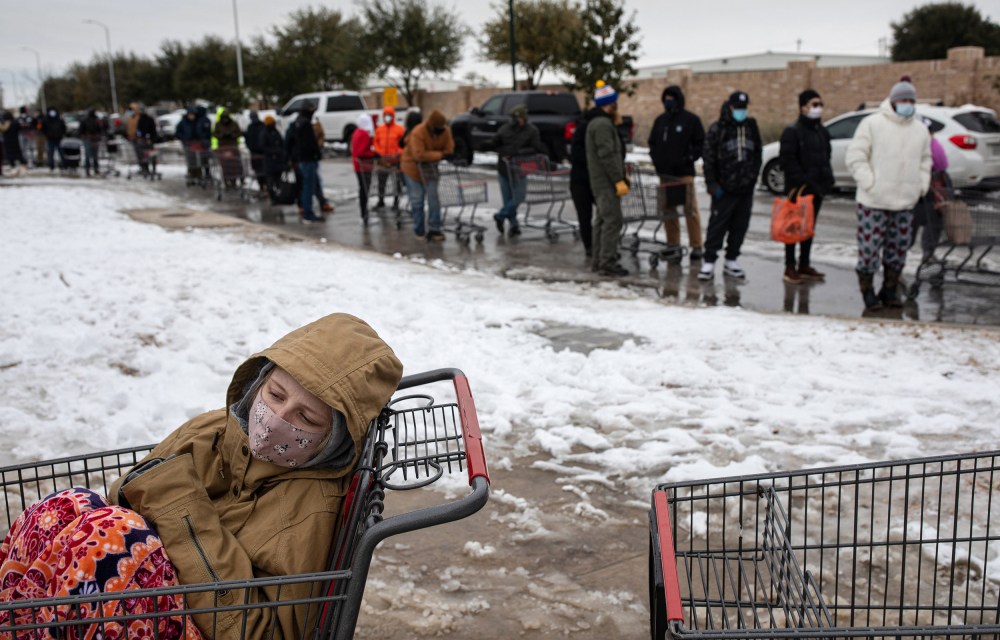
When the Big Freeze came to Texas, the state’s leaders duly girded themselves for battle. But they weren’t the ones that rescued the Texans who found themselves besieged and waiting for rescue, huddled in collapsing houses as infrastructure failed. Instead, the people of Texas worked to save one another.
The stewards of Texas — its guardians by law — went on television to shadowbox a foe of their own invention. They went to war against the specter of green energy.
It was the only option. Their leaders were otherwise occupied, busy fighting not against the ice, or the snow, or the failure of the state’s independent power grid; not against the undrinkable water, still affecting millions as of Monday; or the burst pipes or the flooded houses or the hypothermia that killed dozens; nor the carbon-monoxide poisonings or house fires started by desperate people listening to the howling in their blood to just get warm.
No, the stewards of Texas — its guardians by law — went on television to shadowbox a foe of their own invention. They went to war against the specter of green energy.
From Gov. Greg Abbott — who went on Fox News and blamed renewable fuels for the catastrophe — down to the mayor of one Texas town who resigned after castigating his constituents for demanding water, power and warmth, the state failed to actually help its citizens.

They preferred to tilt at wind turbines that provided a fraction of the power that failed freezing families across the state. Even as new injuries and deaths were revealed by thawing roads, they waged their culture war against the foes of fossil fuels. Their principal enemy was a Democratic congresswoman from New York, the face of as-yet-hypothetical environmental legislation, who was busy raising $5 million in aid for their state.
Hospitals evacuated, waterless and frigid; those in the state’s care shivered in reeking, frozen jails, but the supply of televised hot air was inexhaustible. The culture war could not be abandoned even for a day or an hour. Its dour warriors did not stray from their posts.
Those who were left behind while the great men raged live in Texas’ cities and towns, large and small. And the best of them recognized that the only way to win the war was not to wage war at all. Against an elemental force and a state that failed them, they recognized that the best way to survive was to band together, and practice mutual aid — supporting one another with what little they had.
Against an elemental force and a state that failed them, they recognized that the best way to survive was to band together, and practice mutual aid — supporting one another with what little they had.
Families, friends and neighbors piled into one each other’s houses; those with heat shared it, as did those with water, making the difficult choice between weathering a storm and risking a plague. Mutual aid groups organized by leftists reached the rest of the country on the last percentages of their dying phones, seeking donations on Venmo and Cashapp for hotel rooms for those without light, for food and water as pipes ran dry and groceries spoiled.
Mutual Aid Houston, a self-described “tiny group of 9 organizers,” says they have distributed $197,000 in direct cash aid from thousands of donors. Volunteers traversed icy roads to fill community fridges with continual infusions of free groceries. Feed the People Dallas raised thousands of dollars to relocate all the members of a homeless encampment in Fort Worth to hotels during the storm, and delivered microwaves, soup and groceries, skidding along frozen roads. The Democratic Socialists of America Houston distributed pallets of water by the truckful. “We’re going to figure out how to keep each other alive,” Anna Maria, one of the organizers for Mutual Aid Houston, told The Texas Tribune. It’s fitting, then, that the term “mutual aid” should have a frigid place as its origin. The Russian anarchist Pyotr Kropotkin drew his observations of the phenomenon in 1902 from his study of animals in Siberia who, facing scarcity of resources in the extreme cold, tended toward cooperation rather than competition for survival. Among humans, Kropotkin theorized, the law of mutual aid is folded into higher moral sentiments. “It is the conscience — be it only at the stage of an instinct — of human solidarity,” he wrote. “It is the unconscious recognition of the force that is borrowed by each man from the practice of mutual aid; of the close dependency of every one’s happiness upon the happiness of all.” Texas may have warmed back up to its normal temperatures, but across the state, homes are still waterlogged, scant belongings beginning to molder. The flow of mutual aid hasn’t stopped, though; it keeps pace with need. Like the anarchist organizers who jury-rigged solar power grids for villages in Puerto Rico when the island’s electrical authority neglected them for nearly a year; like the community fridges across the country that have fed the unhoused and the needy since the pandemic’s beginning, as we approach its anniversary in the United States; Texans are finding alternative sources of power in the bonds between one another, in the state’s absence. Texas may be an extreme case, with its decadeslong policies of deregulation and isolationism enabling a rickety, unweatherized power grid. But throughout the country, the very notion of interdependence, of common good, has eroded over decades of austerity, false scarcity and the cruel, parsimonious bureaucracy of means testing. The measures being considered on the federal level run contrary to the eagerness with which community members rush to help one another, offering open hands to the afflicted. Nearly a year into the pandemic, a change in presidential administration has thus far largely meant a change in rhetoric from callousness and denial to a pageantry of candlelit mourning. The measures being considered on the federal level run contrary to the eagerness with which community members rush to help one another, offering open hands to the afflicted. The process is slow and sclerotic, the direct aid impossibly inadequate, though the need is mounting, and despair mounts swiftly on despair. The nation’s reserves of cash seem to remain open only to the machinery of war. A state carved out from within like a hollow-point bullet delivers little but pain, and what is given is too little, and too slow. In the void, we rescue one another, knowing the survival of each rests on the survival of all.
Talia Lavin
Talia Lavin is a freelance writer whose work has appeared in The New Yorker, The Washington Post, GQ, The Village Voice, The New Republic and many more publications. She is the author of the books "Culture Warlords: My Journey Into the Dark Web of White Supremacy" (Hachette Books, 2020) and "Wild Faith: How the Christian Right is Taking Over America" (October 2024). Her newsletter, The Sword and the Sandwich, is featured in Best American Food and Travel Writing 2024. 

