








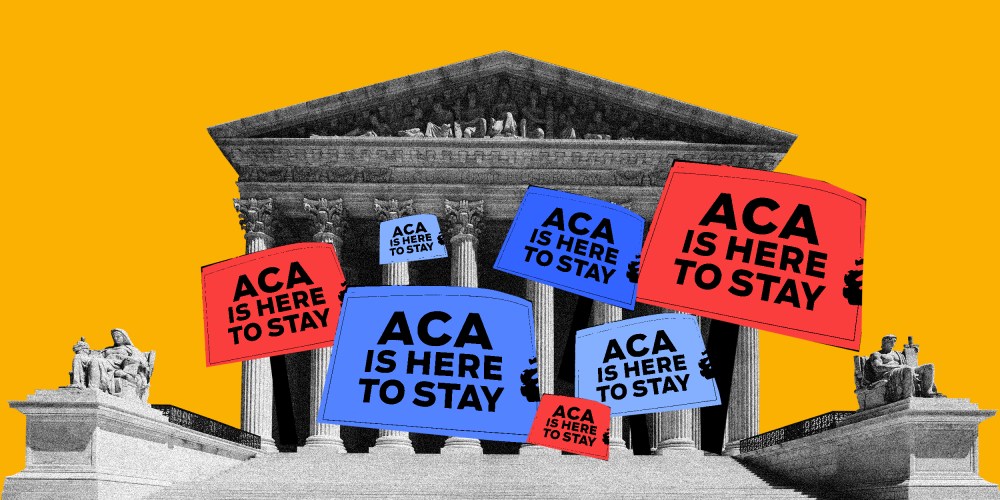
The Supreme Court’s much-awaited decision regarding the fate of the Affordable Care Act (ACA) shows us so much of what plagues politics today: When the ability of tens of millions of Americans to obtain health insurance comes down to a decision by five people, something is broken in our country.
This legal punt will likely retain the status quo, and decrease any political motivation to pass additional health care reform.
And yet, it did, since that is the number of Supreme Court justices needed to form a majority in a decision.
Former President Barack Obama’s crowning legislative achievement, the ACA lives to fight another day — but only because seven members of the court punted on the bigger issues raised by the case and tossed it based on a procedural hurdle, called standing. This legal punt will likely retain the status quo, and decrease any political motivation to pass additional health care reform.
Congress passed the ACA three administrations ago, in 2010. Broadly, the program was designed to expand affordable health insurance to more Americans. A key portion of that law was the individual mandate, which required that most Americans either purchase health insurance or pay a penalty. Almost as soon as Obama signed the law, Republicans challenged it in court.
Nearly a decade ago, in 2012, the Supreme Court ruled on that challenge and narrowly upheld the law. The court upheld the individual mandate on the grounds that it acted like a tax — if you don’t buy health insurance, you pay the government money. If the individual mandate amounts to a tax, then it is a proper exercise of Congress’ authority to levy taxes. So far, so good for the ACA and the individual mandate.

But Congress took steps in 2017 to indirectly invalidate the individual mandate. As part of a tax reform law, Congress eliminated the penalty contained in the individual mandate. This created a problem in that if the Supreme Court upheld the individual mandate because the penalty looked like a tax and then they eliminated the penalty for failing to buy health insurance, it no longer looks like a tax.
Just days after the 2020 election, the Supreme Court heard oral arguments in this case, the latest big challenge to the ACA. The case raised two big legal questions: First, the court was asked whether the individual mandate, which requires that most Americans purchase health insurance, is in fact illegal as written. And second, the court was asked whether the rest of the ACA could stand if it was indeed illegal. We won’t get answers to either of those questions today because the court punted.
The Supreme Court’s legal punt is very much in keeping with the political punt we have seen from our elected branches when it comes to health care in our country.
Instead, on Thursday the court concluded that the plaintiffs lack standing to sue, which means federal courts can only hear “cases and controversies,” and that they can’t issue advisory opinions.
One way to make sure that a suit is a true case or controversy is to ensure that the people or groups who sue have something called standing. As Justice Stephen Breyer, the author of the majority opinion today, explained, standing requires that plaintiffs allege “personal injury fairly traceable to the defendant’s allegedly unlawful conduct and likely to be redressed by the requested relief.” The keys to unlocking the doors to a federal court include proving that you have a real, concrete injury, and that if you win your case, your injury will (at least in part) be rectified. The court concluded that neither the individual plaintiffs nor the states that sued were legally injured by an individual mandate that carries with it no monetary penalty.
The Supreme Court’s legal punt is very much in keeping with the political punt we have seen from our elected branches when it comes to health care in our country.
We have known for four years now that there are looming legal questions regarding the ACA.
Congress has seen this particular challenge to the law coming, but despite the popularity of the ACA, it’s had little realistic chance of crafting a legislative solution. The political reality is that there was little to do while Donald Trump was president and/or Republicans controlled the House. Trump and the majority of Republicans were long hostile to the ACA. This left the law vulnerable and, as a result, left many vulnerable people waiting for answers about their ability to obtain health insurance. In the five months since President Joe Biden took office with a Democratic majority in both the House and the Senate, he and his team have been focused on the health crisis created by the pandemic. (Although even in nonpandemic times, five months is not that much time to craft and enact a major piece of legislation.) Democratic control of the White House, the House and the Senate does not actually mean that Democrats get to implement their agenda; because of the filibuster, most pieces of legislation need 60 votes to pass the Senate. So even though Biden is in the White House, Rep. Nancy Pelosi is the speaker of the House, and Sen. Chuck Schumer is the leader of the Senate, the political realities are stacked against any real reform in the area of health insurance. So although it’s been five months since Biden took in office, politically it makes sense that he waited for this Supreme Court decision. Now the wind is likely firmly gone from the sails of any efforts to implement reform on the federal level. The court, by relying on a procedural hurdle, has allowed the ACA to stand. We seemed destined to see the status quo continue. It’s the sad reality that now will likely not be the moment for Congress passed and Biden signs comprehensive health care reform. If the pandemic has reminded us of anything, it is that one of the biggest dividing lines of inequality in our country is who can and cannot obtain quality health care.
Jessica Levinson is a Loyola Law School professor and MS NOW columnist. 


