









For most of the country, the next few weeks are the best parts of summer, when it’s warm enough to go to the beach but lacking the oppressive heat of the later months. But for Senate Democrats, these next few weeks are due to be rough going.
The caucus is performing the legislative version of repeatedly running headfirst into a wall — and it’s not entirely clear that a payoff is waiting at the end.
As of Tuesday, there are a little under six workweeks for the Senate to get anything done before the monthlong August recess. (The Senate also has a two-week break for the Fourth of July, naturally.) Most of that time is going to be spent getting very little done on the floor, absent confirming new federal judges.
That won’t be for lack of trying, though, part of a strategy that Senate Majority Leader Chuck Schumer, D-N.Y., hopes can blunt the sting of failure — or at least make it clear who’s really to blame for the lack of progress.
As of Tuesday, there are a little under six workweeks for the Senate to get anything done before the monthlong August recess.
Early this month, Schumer tried to bring the Paycheck Fairness Act to the floor for debate. The House-passed bill would have made it easier for employees to discuss their salaries with one another and require employers to share more information about pay scales with their workers, including showing why any gap between pay for men and women has nothing to do with their genders. But it won’t even get a debate thanks to Republicans — all 50 GOP senators voted against Schumer’s motion to proceed.
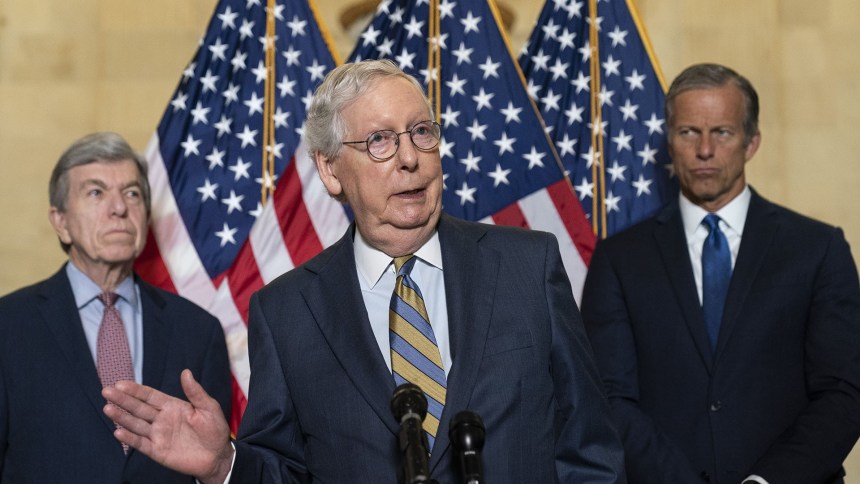
The outcome wasn’t a surprise; in fact, it had been entirely factored into the Democrats’ plan. As things stand, the Senate’s rules require 60 affirmative votes to overcome a filibuster. In a Senate split 50-50, there’s no way to even debate bills without 10 Republicans on board, let alone pass them. It’s clear that Senate Minority Leader Mitch McConnell, R-Ky., is devoted to blocking the Biden administration’s agenda, just as he was committed to head off the Obama administration a decade ago.
The action on the Paycheck Fairness Act was the GOP’s second filibuster this year, after it blocked a bipartisan Jan. 6 commission to investigate the attack on the U.S. Capitol. Next up on the sacrificial altar is S.1, the For the People Act, the Democrats’ election and campaign finance overhaul measure. (Sen. Joe Manchin, D-W.Va., has come out against the bill, but it would at least be likely to get a debate without the filibuster’s rules.)

And there’s more to come in the next few weeks, when Schumer is likely to push votes on: the Equality Act, which would enhance LGBTQ rights at the federal level; the Protect the Right to Organize Act, which would update workers’ rights and boost unions; and Manchin-backed legislation to expand background checks for gun sales.
For the most part, it will be an impressive show of Democratic unity for a caucus that has been noted for its chronic disarray in the past. And each of the bills addresses issues that have widespread support, including the right to collectively bargain and stronger gun sale background checks. The For the People Act, in particular, has the support of two-thirds of Americans, according to a Data for Progress poll from January and another from the Southern Poverty Law Center conducted last month.
“Each vote will be building the case to convict the Republican Senate leadership of engaging in political gridlock for their advantage, rather than voting for the agenda the American people voted for in 2020,” Sen. Ed Markey, D-Mass., told The New York Times this month. The hope from Democratic leadership is that the obviously partisan votes will either convince more of their colleagues — namely, Manchin and Sen. Kyrsten Sinema, D-Ariz. — that abolishing the filibuster is necessary to get anything done or build public pressure on an obstructionist GOP to allow bills to move forward.
The downside of this plan is that none of the bills due to come are expected to get anywhere close to the 10 Republican votes needed to open debate, dimming the hopes to pressure a few moderates to flip. Without a total reversal from Manchin and Sinema on getting rid of the filibuster, don’t expect a lot of big wins for Democrats to come out of the Senate and land on President Joe Biden’s desk this summer. “Shining a spotlight on Senate Republicans’ commitment to gridlock and obstruction by forcing them to filibuster popular bills is an important step and it’s encouraging to see Leader Schumer take it,” Eli Zupnick, a spokesperson for Fix Our Senate, a coalition of organizations pushing filibuster reform, told me in an email. “But it won’t be enough for Senate Democrats to hold a few votes and then give up on massive chunks of President Biden’s popular agenda — they are going to have to eliminate the filibuster as a weapon that Sen. McConnell can use to continue his partisan gridlock.” And therein lies the biggest risk to Schumer’s strategy. Highlighting GOP obstruction on the Senate floor is great — as long as voters realize that’s what’s happening. People are watching to see whether their votes last year deliver the change that was promised from a Democratic majority. I’m worried that most Americans, who aren’t experts on Senate rules, will only see headlines about Democrats losing out on their big priorities. And it’s easy to see that depressing a segment of voters at exactly the wrong time. Don’t expect a lot of big wins for Democrats to come out of the Senate and land on President Joe Biden’s desk this summer. The action on the Senate floor has to be accompanied by a nationwide messaging campaign from Schumer, his leadership team and the Democratic Senatorial Campaign Committee to make it clear that these predestined flops don’t reflect a lack of will from his members. Likewise, as Democratic senators head back home over the Fourth of July break, they need to be speaking with every local media outlet they can about all the popular proposals that Republicans are blocking. That goes double for the August recess — every single town hall, public forum and chance meeting where a Democrat appears should be all about the GOP’s obstruction. Because when this long, sad summer ends, it’s going to be on to the next looming crises for Democrats, as Congress has to dodge a government shutdown and raise the national debt limit. Schumer and his team need to make sure this heartache was all worth it.
Hayes Brown is a writer and editor for MS NOW Daily. 


