








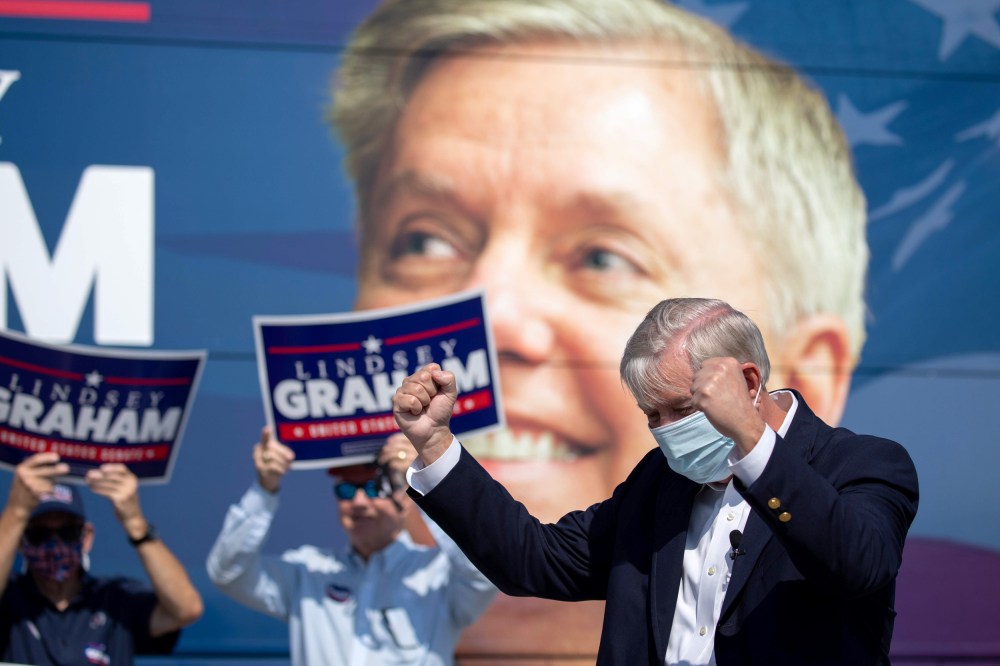
For many Americans stuck in this weird post-election holding pattern, the days are running together. But while it’s easier than ever to lose track of time, someone needs to remind Sen. Lindsay Graham, R-S.C., that the election is over — and he won. He doesn’t need to keep acting like President Donald Trump has any power over him anymore.
Trump’s campaign is still doing everything it can to manufacture fraud in Arizona, Pennsylvania, and Georgia, searching for something — anything — to prove Democrats tipped the scales in President-elect Joe Biden’s favor. In each of those states, Biden’s lead is in the thousands and projected to be insurmountable, a moot point given the relative weakness of the cases Trump lawyers have brought to various state and federal courts.
But Graham has still allegedly decided to wade into the mess. Georgia Secretary of State Brad Raffensperger claimed in an explosive interview with the Washington Post on Monday that Graham asked “whether Raffensperger had the power to toss all mail ballots in counties found to have higher rates of nonmatching signatures.”
That would include discarding valid ballots whose signatures did match their corresponding voters, potentially disenfranchising thousands of Georgians based on the thinnest logical thread possible. Raffensperger, who was endorsed by Trump in 2018, doesn’t have that power and he told The Post that he was stunned that a fellow Republican would make the suggestion.
There’s still no need for him to stick his neck out at this point. He could just sit there and eat his food.
Raffensperger repeated those claims to the Wall Street Journal as well, noting that “he had staffers with him on that call” as witnesses. Graham told the Journal on Monday evening that he’d simply wanted to understand how signatures were verified and that the Georgia official had done so well.
“I’m surprised to hear he characterized it that way,” Graham said of Raffensperger’s statements. He also said on Tuesday that he’d been in touch with officials in Arizona and Nevada to learn more about how they verified mail-in ballots.
The question that I have, though, is why on Earth is Graham even getting involved in this? The prevailing theory while watching his transformation from party maverick to number one Trump fan has been that it was mostly a show, an act to shore up his position ahead of the 2020 elections. He successfully averted a challenge from the right in the South Carolina primaries, and despite polls showing a tight race, beat his Democratic opponent, Jaime Harrison, by about ten points on Election Day. Mission accomplished for Mr. Graham. Meanwhile, Trump’s legal cases are being shredded in court daily and the president’s attempts to rally his base has so far been more light than heat. This weekend’s “Million MAGA March” only drew a few thousand people to the nation’s capital, the faithful seemingly unpersuaded to make the journey despite Trump’s promised drive-by appearance. Even the president’s own staff doesn’t really seem to see any way that that claims of election fraud will change the outcome of the race. (One aide told NBC News that it’s likely Trump will eventually “say something like, ‘We can’t trust the results, but I’m not contesting them.’”) There’s no way Graham benefits from playing Trump’s number one fool. It doesn’t track that more Republicans will turn out to vote in Georgia’s runoff Senate elections in January if they’re convinced the whole thing is rigged. And there’s no way to remove Graham from his perch again until 2026’s election cycle. If he thinks that not backing Trump’s claims hurts his chances at re-election that far down the road, there’s still no need for him to stick his neck out at this point. He could just sit there and eat his food. The only remaining option is that after four years of sucking up to Trump to retain his seat, this is the real Lindsay now. My dude is lost in the sauce and this conspiratorial mien that was once an act has become his actual persona.
Hayes Brown is a writer and editor for MS NOW Daily. 

