








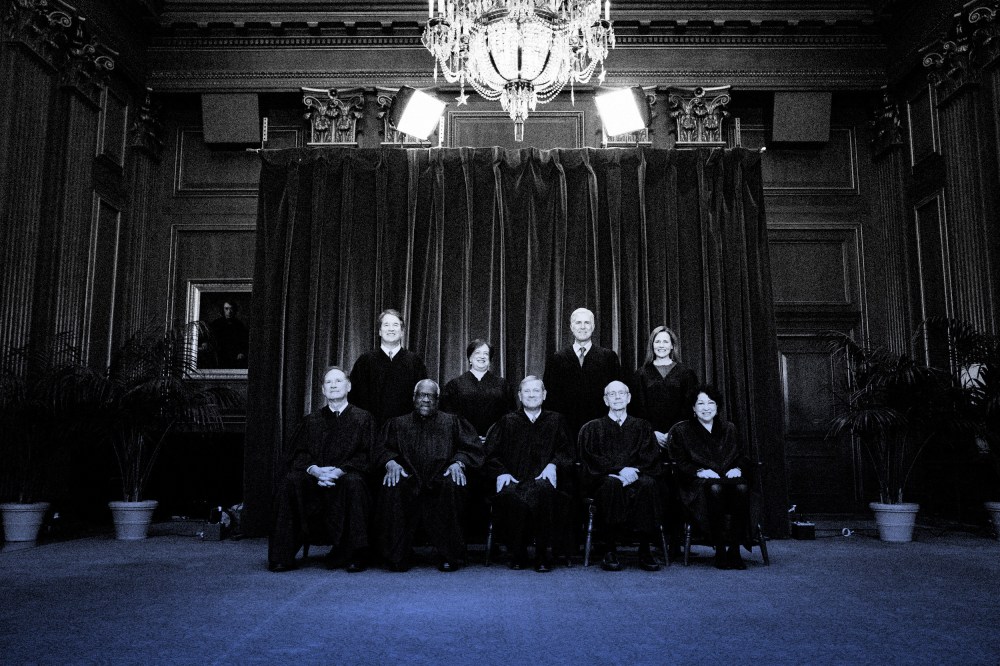
There’s a seat on the U.S. Supreme Court that’s been vacant since Justice James Moore Wayne died on July 5, 1867. Can President Joe Biden nominate someone — Merrick Garland, perhaps — to fill it? Do Democratic appointees already have a 3-2 majority on the court because four justices appointed by Republican presidents (Justices Clarence Thomas, Samuel Alito, Neil Gorsuch and Amy Coney Barrett) hold seats that Congress lacked the power to create in the first place?
The size of the court has always been a political hot potato.
The answer to both of these questions is a resounding “no.” But they’re the necessary implications of the latest conservative effort to hide policy objections behind constitutional arguments.
This time around, it’s an op-ed in the New York Post written by Daniel L. Schmutter, who argues against Democratic proposals to add seats to the Supreme Court on the grounds that the Constitution doesn’t allow Congress to “manipulate the size of the court to shift the balance of judicial power.”

Even if that were true (and it isn’t), shifting the balance of judicial power had quite a lot to do with every previous change to the size of the Supreme Court — in 1801, 1802, 1807, 1837, 1863, 1866 and 1869. If all of those measures were likewise invalid, then we’re stuck with the six seats Congress initially created in the Judiciary Act of 1789 — one of which is currently vacant.
Let’s start with the new argument. As Schmutter correctly noted, the Constitution is silent as to the number of justices on the Supreme Court (it requires at least one, a chief justice). From that, the author likewise correctly concluded that Congress’ power to change the size of the court must be tied at least in part to the so-called necessary and proper clause, which, as Chief Justice John Marshall held in the landmark case McCulloch v. Maryland, gives Congress the power to carry out the Constitution’s ends (like having a Supreme Court) through whatever means it deems appropriate that are not otherwise forbidden by the founding charter.
The new constitutional argument against adding seats to #SCOTUS: Once Congress created 6 seats in 1789, it lacked the power to add/subtract:https://t.co/Wv4x3Qmpgp
— Steve Vladeck (@steve_vladeck) April 30, 2021
(P.S. On this verkakte view, only the Chief, Breyer, Sotomayor, Kagan, & Kavanaugh hold validly created seats.) pic.twitter.com/Dscv2Y9tpp
But where the op-ed author read McCulloch as “strongly suggest[ing] that when evaluating a claim of congressional power under the Necessary and Proper Clause we must examine motive and intent,” that is literally the opposite of how McCulloch is understood.
As a unanimous Supreme Court explained 80 years ago in describing Congress’ regulatory powers, as long as the statute is objectively consistent with the Constitution, Congress’ motive and purpose “are matters for the legislative judgment upon the exercise of which the Constitution places no restriction and over which the courts are given no control.”
On this view, Barrett’s seat was unconstitutionally created in 1807. Ditto Alito’s seat in 1837.
But let’s play along for a minute (after all, some of the justices who decided that case may not have lawfully held their positions). Imagine that the author is correct and that statutes reforming the size of the Supreme Court to alter the balance of judicial power are illegitimate. There goes the Judiciary Act of 1801, in which a lame-duck, Federalist-controlled Congress took away a seat to try to prevent incoming President Thomas Jefferson and the Democratic-Republicans from filling it.
Ditto the 1802 statute that restored the sixth seat. Congress expanded the court in 1807, 1837 and 1863 as it added new circuit courts, but a big part of why it passed those statutes when it did was to take advantage of political circumstances. Then there are the 1866 and 1869 episodes. In 1866, radical Republicans in Congress, locked in battle with Democratic President Andrew Johnson, reduced the size of the court to seven seats. And the Republicans likewise restored the court to nine seats in April 1869 — as soon as a Republican was once again president.
Each of these episodes is a story unto itself. The larger point is that the size of the court has always been a political hot potato; that didn’t start in 2016. Ultimately, either none of these statutes were unconstitutional (which is the correct answer) or they all were. And if they all were, then the only valid seats on the Supreme Court are the six that Congress initially created in 1789: the center seat (held by Chief Justice John Roberts) and five seats for associate justices. Four of those seats are currently held, respectively, by Justices Stephen Breyer, Sonia Sotomayor, Elena Kagan and Brett Kavanaugh. The fifth was held most recently by Wayne (it was one of the seats Congress purported to eliminate in 1866) and is therefore currently vacant. The Constitution deserves better than bad faith arguments that would actually produce the opposite of their intended effect. Meanwhile, on this view, Barrett’s seat was unconstitutionally created in 1807. Ditto Alito’s seat in 1837, Gorsuch’s seat in 1863 and Thomas’ seat in 1869. On second thought, perhaps this isn’t such a bad idea, after all. Sarcasm aside, there’s a broader point here: Increasingly, we’re seeing conservatives use constitutional arguments the way the Scottish writer Andrew Lang famously described drunks using lampposts: “for support, not illumination.” Just in the last three months, conservatives flocked to arguments that it’s unconstitutional for the Senate to conduct an impeachment trial of a former president (it isn’t); that it’s unconstitutional for Congress to make (most of) the District of Columbia a state (it really isn’t); and now that it’s somehow unconstitutional for Congress to do something it’s already done seven times in American history: alter the size of the Supreme Court. The weakness of these arguments leaves the impression that the goal is not to persuade but rather to provide cover for what are, in the main, political objections. There’s nothing wrong with political objections to some (or all) of these efforts; I have some myself. But the Constitution deserves better than bad faith arguments that would actually produce the opposite of their intended effect.
Steve Vladeck
Steve Vladeck is a professor of law at Georgetown Law, whose teaching and research focus on federal jurisdiction, constitutional law and national security law. He is co-editor-in-chief of the Just Security blog (@just_security) and co-host of "The National Security Law Podcast" (@nslpodcast). 


