








The “bipartisan blue-ribbon commission” has a reputation for being the mechanism presidents and Congress use to make sensitive issues disappear. That reputation is well earned. Led by experts or retired, ambitionless politicians, these panels tend to conduct themselves dryly and exhaustively, thereby exhausting their participants. And when they do produce a set of findings and maybe even some proscriptive recommendations, those conclusions are often ignored — without political consequence.
Senate Republicans chose instead to filibuster the proposal — a move that reveals the GOP’s broader dilemma.
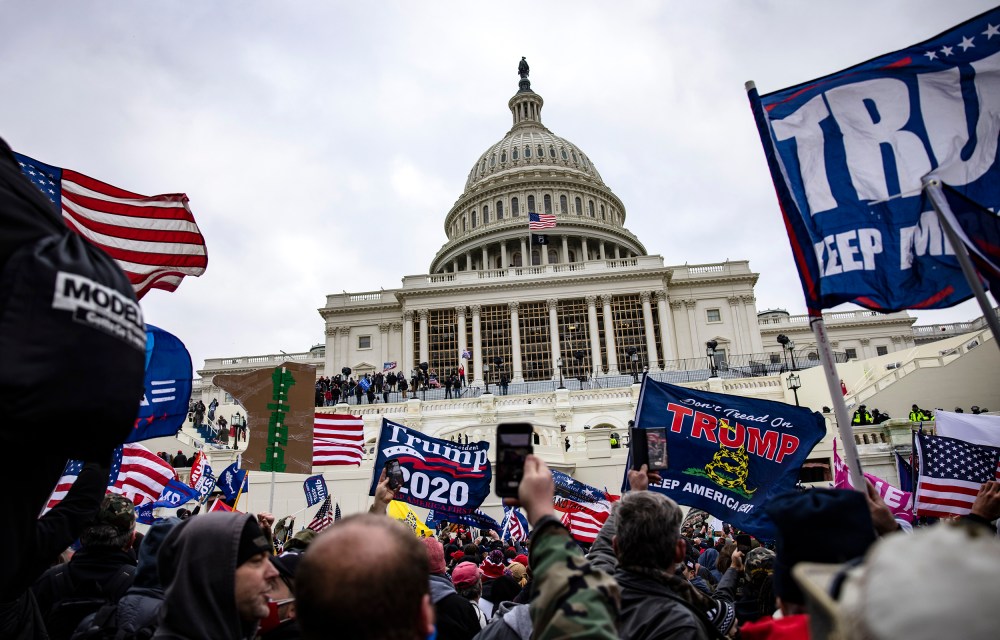
The proposed commission investigating the events of the Jan. 6 riot would likely have followed this pattern. And yet, Senate Republicans chose instead to filibuster the proposal — a move that reveals the GOP’s broader dilemma. Its members are no doubt sincere in their desire to proceed with the business of opposing Democratic governance ahead of the midterm elections. But as much as they might want that terrible coda of Donald Trump’s presidency to go away, it and the narrative that inspired the rioters are becoming part of the party’s very identity.
It’s not at all surprising that Senate Republicans successfully blocked the commission. Its findings, whatever they may have been, would no doubt implicate the party’s most prominent members in some level of misconduct. It is a little surprising that the opposition was not, however, unanimous. Thirty-five House Republicans supported the measure, bucking party leadership. Another six Senate Republicans broke from Senate Minority Leader Mitch McConnell of Kentucky to join Democrats backing a commission, including Ohio Sen. Rob Portman, who voted with most of the GOP to acquit Trump of wrongdoing in February.
The Republicans who broke ranks did so partly out of conscience and in deference to an obligation to posterity, but also because the political risk associated with this committee was less severe than the alternatives. These Republicans sought to break free from the hostage crisis currently forcing the party to wallow in revisionist accounts of the past. They failed.

The reasons given by Republicans who opposed this committee fall flat. Some contend the proceedings would have been so partisan that their findings would have been unreliable. Others contend there is little to be learned from spelunking further into this painful moment in the country’s history. Neither excuse is convincing.
Republican lawmakers, led by Rep. John Katko of New York, had already successfully convinced House Speaker Nancy Pelosi, D-Calif., to concede to demands for things like partisan balance and restricted subpoena power requiring signoff from both Democratic and Republican committee chairs. That’s about as bipartisan as you get in Congress today.
As for what we do not yet know about Jan. 6, we don’t know what we don’t know. But we are going to find out soon enough. Subsequent private investigations of the events of Jan. 6 — and there will subsequent investigations — are almost certain to be more partisan because they will proceed without Republican input. That will help the GOP dismiss those conclusions off-handedly, leading us to conclude that the proposed commission’s partisanship wasn’t the problem so much as its independence.

We don’t yet have a full accounting of events, and a commission would help stitch together the evidence prosecutors are wielding against the more than 450 people who have been charged so far in connection with the attack. It would presumably confirm or dispel the notion that groups like Oath Keepers and Proud Boys coordinated their efforts prior to the day’s events. It could identify where the weapons, including a mysterious set of pipe bombs, came from and what role they were intended to play in the siege. And it would hopefully establish what the president was doing in the roughly three hours that elapsed between the time National Guard assistance was requested and when it was deployed, as well as the reason for the delay.
It is folly to think this information won’t come out eventually. If lawmakers don’t tug on these threads, enterprising reporters and citizen journalists will — and their findings will be presented far more sensationally and be even harder to ignore. And of course, Democrats still retain the option of pursuing a far more partisan investigation led by the majority party in the House.
Democrats have largely internalized the notion that congressional committees of this sort are fruitless partisan exercises that exist only to advance partisan political objectives. That impression is owed, in part, to their experience as the minority on the House Select Committee on Benghazi. They remember the top lines — Hillary Clinton cleared of wrongdoing — but they dismiss the fact-finding process that uncovered details with farther-reaching consequences. Among them, the Obama administration’s obstruction of the probe, Clinton’s chief of staff’s strong-arming of the Accountability Review Board and the discovery of a secret, private email server that eventually produced a criminal probe into Clinton’s conduct that hounded her throughout the 2016 campaign.
Republicans, too, seem to have forgotten the political consequences of the Benghazi probe. If they hadn’t, they would have worked more diligently to avoid inviting them.
But then, maybe Republicans just don’t think they can stop what’s coming. They know full well that their political careers will be imperiled if they challenge Trump’s dominance of the party or the conspiracy theory to which he and so many of his voters are wholly devoted. The idea that the 2020 presidential election was marred by fraud and malfeasance pulls in donor cash at rates that compensate for the revenue lost when the party’s high-dollar contributors resolved to punish GOP lawmakers who objected to certifying 2020’s election results. The more actively these politicians entertain that falsehood, the more they have been rewarded by Republican donors. These Republicans likely flatter themselves with the notion that they have the dexterity to thread an unthreadable needle; that they can cleverly corroborate (or, at least, avoid invalidating) their voters’ worst suspicions about the election without inflaming passions to the point of violence or the kind of despondency that cost Republicans Georgia’s two U.S. Senate seats. Whatever their rationalizations may be, the result has been the incorporation of Trump’s version of events into the party’s DNA. That’s why the only people who are ever told to “move on” from the events of Jan. 6 are those who want to get to the bottom of them. Historical revisionists don’t want to “move on” from the events with which they are consumed. Their very identities are wrapped up in a cultish belief that they alone have cracked the case. By shutting down the commission, Republicans passed on the opportunity to exert some control over the coming events. Even if House Democrats opt against a select committee, the investigations will continue, as will the trickle of new information surrounding the mysteries of Jan. 6. Republicans won’t be able to dismiss these new details, deferring instead to the definitive conclusions an autonomous commission will one day reach. That definitive account of the day’s events is not forthcoming. The Democratic Party will use the commission’s bloody tunic to undermine the GOP’s post-Trump imaging effort. Moreover, the Democratic Party will use the commission’s bloody tunic to undermine the GOP’s post-Trump imaging effort. They will pound the table, chipping away at the GOP’s effort to rebrand itself as a generic vehicle of opposition and reminding voters of all the reasons so many voted against it in 2020. The Republicans who sought to empower this commission believed that the long-term political risk it would present to the party outweighs the short-term risk of alienating those who so desperately want to believe they are the victims of a vast plot. They were overruled by their colleagues who could not stomach that outcome, even if it invites political peril further down the road. So in a way, only a handful of our elected representatives really want to move on from Jan. 6. For Republicans, it’s a lucrative fundraising vehicle and a source of cohesion within a party riven by ideological conflict. For Democrats, the GOP’s myopia about that day could help them blunt the losses expected in the midterms. Everyone benefits from the death of a Jan. 6 commission. Everyone, that is, except us.
Noah Rothman
Noah Rothman is the associate editor of Commentary Magazine. 

