








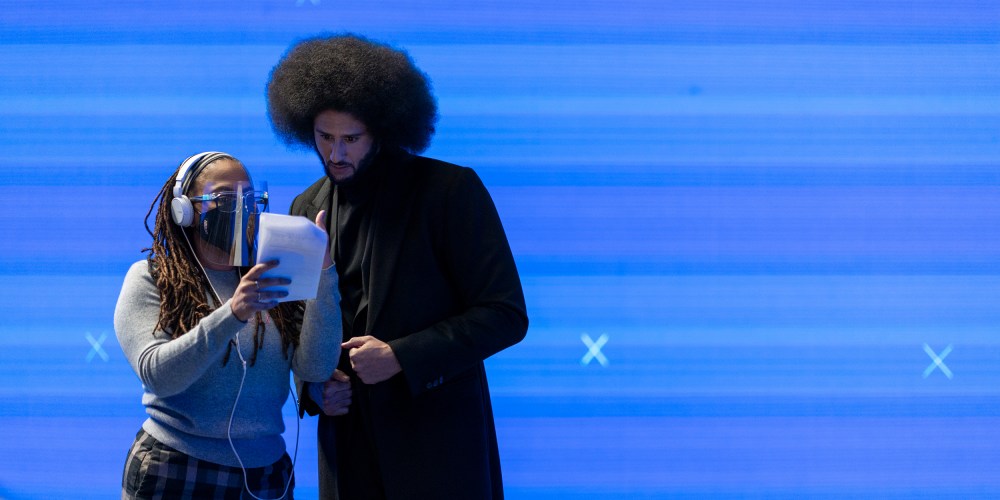
With much fanfare, “Colin in Black and White,” a new show about Colin Kaepernick, premieres Friday on Netflix. Created by Kaepernick and acclaimed filmmaker Ava DuVernay, the show, according to Netflix, “chronicles Kaepernick’s coming of age story, tackling the obstacles of race, class, and culture as the Black adopted child of a white family.”
This will not be a story about a quarterback leading a team to the Super Bowl or later taking a knee during the national anthem.
In other words, this will not be a story about a quarterback leading a team to the Super Bowl or later taking a knee during the national anthem, confronting the entire power structure in the country’s most profitable sports league and then being blackballed. The story instead is about a biracial adoptee in suburban California and the beginning of his journey toward becoming all those things.
Each of the six episodes is narrated by Kaepernick himself. The former NFL quarterback is profoundly media averse (even social media averse) but now, like athletes from Tom Brady to Naomi Osaka, he is controlling the message, just like a football coach who scripts the first 20 plays of a game.
It is no wonder that in an email interview with the Los Angeles Times Kaepernick wrote of the project, “I want Black and brown communities, particularly youth, to know we will face racism, we will face white supremacy, we will face oppressive systems, but we have the power to overcome them and the power to change them.”
“I want them to know we don’t have to accept the status quo, and ultimately, I want them to be their full selves and to stand firmly in their full power,” he wrote.
It would be remarkable if he and DuVernay were able to achieve such a lofty goal with Kaepernick’s biography. His story is one of adoption, suburban wealth and a personal reckoning with the realities of racism while being raised by a white family.
We’ve had great examples of sports biopics that focus on athletes who played a role in their era’s freedom struggles, including “42” about pioneering baseball player Jackie Robinson and “Ali” about three-time heavyweight boxing champion Muhammad Ali. In those films, we get to see the subjects’ childhoods through the prism of the injustices that surrounded them. In this series, we should look to see how DuVernay and Kaepernick accomplish that, especially since this work will remain focused on Kaepernick’s upbringing and — unlike the above-mentioned films — won’t focus on his political awareness as an adult.
It remains to be seen if there’s an audience for this kind of intensive bio, but my hope is that this is just the beginning. I would like to see a work about the entirety of the social justice movement of the last five years in DuVernay’s capable hands. I’d like to see her depiction of Kaepernick demonstrating without flinching for four straight months during the 2016 NFL season. I’d like to see her depicting Kaepernick somehow playing some of the best football of his life despite the scrutiny, the boos and the death threats. I’d like to see DuVernay and Kaepernick then give dramatic treatment to the courage displayed by the hundreds upon hundreds of younger athletes who, inspired by his actions, took a knee during the playing of “The Star-Spangled Banner” in protest of police violence and racial inequity.
This latter subject is of particular interest to me, as the book I just wrote, “The Kaepernick Effect,” is less about Kaepernick than the countless young people he inspired. In their stories, you can see the blueprint of a movement that led to the summer of 2020 when the police murder of George Floyd resulted in the largest protests in this country’s history. In their stories, you can also see the harbinger of the backlash and violence that has become a hallmark of the post-Donald Trump era as white supremacist organizations grow and go to war over what they often misrepresent as critical race theory. I hope those young people’s stories merit equal treatment in a forthcoming biographical series because it is important that we not see the last five years as being encapsulated by one individual. The push for a racial reckoning has been a collective, grassroots movement that also included the professional athletic fields of the United States. We need artistic works that emphasize widespread participation in these protests, or the actual history will fall prey to celebrity culture, passivity will rule the day and people will wait for the next “great person” (usually “great man,” in history’s telling) to come down from Planet Hero and save the day. The reality of social movements is always more messy, often more dramatic and certainly more empowering. DuVernay did a brilliant job in “Selma” of showing that the people we know as great leaders — including Martin Luther King Jr. and John Lewis — depended on grassroots protesters turning out en masse and that those grassroots protesters created the conditions that allowed a figure like King to rise. Kaepernick is not King, of course, but like the civil rights leader, he was a part of a movement, not the founder of it. We should appreciate the effort to bring Kaepernick’s coming-of-age story into our living rooms. But there’s so much more to his story and to the stories of the people Kaepernick inspired. So let’s hope there’s a sequel.
Dave Zirin
Dave Zirin is sports editor of The Nation. He is the author of 11 books on the politics of sports, including "The Kaepernick Effect." He is also the host of the "Edge of Sports" podcast. 


