








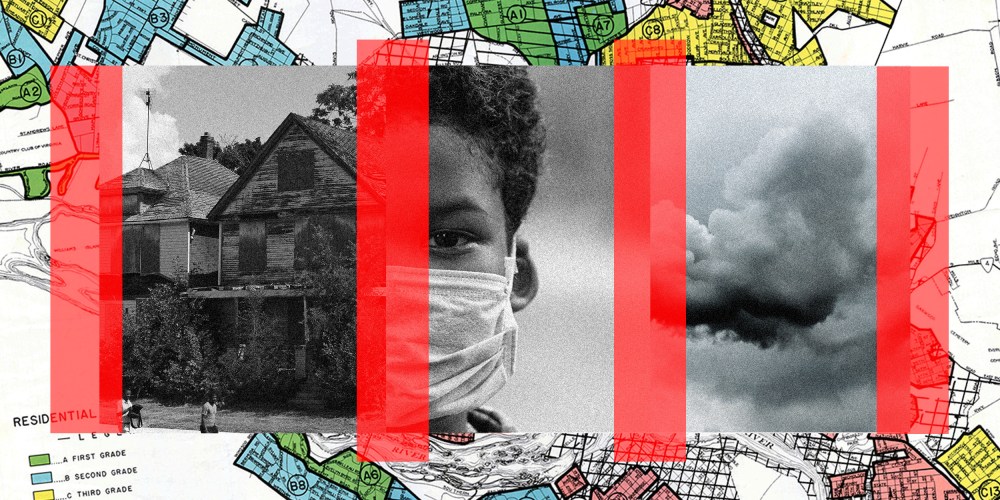
Despite the wave of laws challenging the teaching of “critical race theory,” a recent study that found a link between past “redlining” practices and air pollution is yet another reminder of how much the past is directly tied to the present. The lingering effects of past discrimination are far more pronounced and devastating than many Americans imagine. The link between institutionalized housing discrimination and air pollution illustrates why it’s so necessary to teach this generation and future generations about racism. It is deeply embedded within American institutions.
Despite laws challenging the teaching of “critical race theory,” a link between past “redlining” and air pollution is another reminder of how much the past is tied to the present.
According to the study published in the Environmental Science & Technology Letters Journal, what might appear to be happenstance — higher levels of air pollution in Black communities and others of color — is, in fact, the result of decadeslong discriminatory housing and investment practices. Researchers Haley M. Lane, Rachel Morello-Frosch, Julian D. Marshall, and Joshua S. Apte compared maps produced by the Home Owners’ Loan Corporation (HOLC) in the 1930s with modern-day air pollution level estimates in those communities and found that neighborhoods that were redlined during the 1930s are exposed to higher pollution levels.
The HOLC, established in 1933, provided refinancing for home mortgages at lower rates. As historian Thomas J. Sugrue details in “Sweet Land of Liberty,” the HOLC’s program, combined with the establishment of the Federal Housing Administration in 1934, resulted in a significant expansion of home ownership in the United States. But despite the HOLC helping double the percentage of Americans who were homeowners, Black Americans were largely unable to benefit. Federal appraisers, working with local lenders, penalized neighborhoods with Black residents and federal agencies denoted those areas with red on their color-coded maps.
Redlining helped deepen housing segregation, and even after the 1968 Fair Housing Act and the Equal Credit Opportunity Act of 1974, housing discrimination in the U.S. remains a persistent problem and, as the new study shows, it’s a problem that endangers the public’s health.
“Black communities were zoned throughout the 20th century next to hazardous industrial sites,” according to Andre Perry, senior fellow at the Brookings Institution and author of “Know Your Price: Valuing Black Lives and Property in America’s Black Cities.” “Because of housing discrimination,” he added, “many of these areas are still populated by Black and other disenfranchised communities.”
As for the new study, renowned scholar Robert D. Bullard, dubbed the “father of environmental justice,” views its conclusions as significant, but not surprising. “It builds on the growing body of findings documenting that America is segregated, and so is pollution,” he told me. The body of work Bullard mentions includes his own groundbreaking research on solid waste sites in Black communities in Houston. He found that “82 percent of garbage disposed in solid waste facilities from the 1930s to 1978 was dumped in Black neighborhoods, even though Black residents comprised only 25 percent of the population during that period.” This explains why the researchers of the new study found a correlation between past housing discrimination and air pollution. Even as the authors make clear the many factors to consider, they acknowledge that the HOLC grade reveals disparities that are “substantially larger.” And despite the reduction in air pollution levels in the past few decades, people of color are still at a greater risk of exposure to higher levels — most often associated with their place of residence. Earlier studies, as well this most recent study on air pollution, underscore the links between redlining and environmental racism. They demonstrate how both factors worked in tandem to harm Black communities and others of color in the United States — then and now. As Bullard told me, “Redlined neighborhoods not only have more air pollution, but are also more prone to flooding, urban heat islands and Covid-19 deaths.” “Redlining steals health and wealth,” he added. “It was bad for America in the 1920s, and its continuing effects are harmful in the 2020s today.”
Keisha N. Blain
Keisha N. Blain is an award-winning historian and writer. She is a professor of Africana studies and history at Brown University and has written extensively about race, gender and politics in national and global perspectives. Her most recent book is “Until I Am Free: Fannie Lou Hamer’s Enduring Message to America.” 


