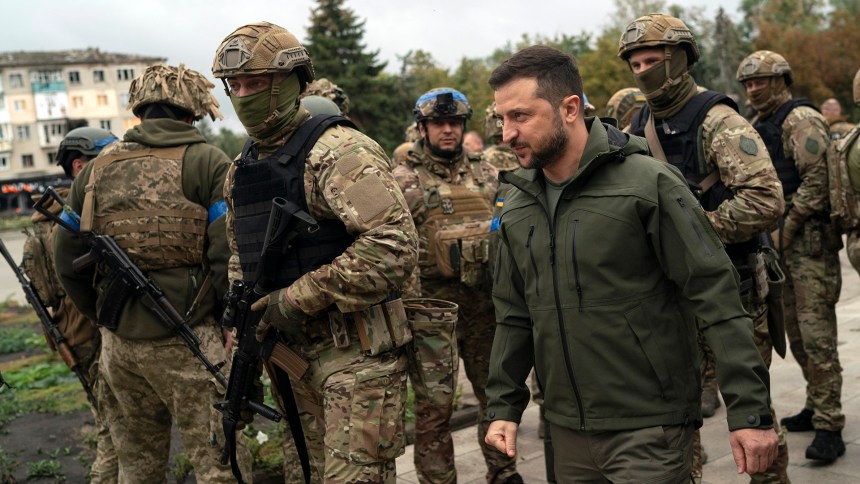
Over the last two weeks, the Ukrainian military has once again proved its mettle. Many American observers had predicted that it could not possibly win an offensive campaign against Russian troops, but it has done just that. The war is not at all over, but Russian forces have suffered another humiliating defeat, and President Vladimir Putin is facing possible unrest at home.
But despite the Ukraine military’s recent success on the battlefield, the country’s economy is in understandably rough shape after nearly seven months of war. Now, as the U.N. General Assembly brings together leaders from around the world, it is the perfect time to start thinking about what it will take for Ukraine to support itself once the conflict has ended.
Despite the Ukraine military’s recent success on the battlefield, the country’s economy is in understandably rough shape after nearly seven months of war
In particular, it would be wise for American and European powers to arrange for more extensive economic support for Kyiv — particularly for Ukraine’s currency — in addition to providing the weapons that have been a top priority and have helped shape the current state of the war.
As the economist Adam Tooze has explained, the war has had immediate, devastating effects on Ukraine’s economy. Most obviously, fighting in several big cities has caused significant physical damage and hugely disrupted trade and production, and in a few cities like Mariupol, total devastation. (In their recent retreat, Russian forces retaliated by shelling civilian power plants, causing temporary blackouts.) Provinces where fighting is ongoing made up around 30% of Ukraine’s pre-war GDP and contain much of its mineral resources. The total hit to GDP this year will see Ukraine’s overall economy shrink by one-third. (For context, America’s economy shrunk by 4.3% during the depths of the Great Recession.)
A recent report estimates that should Ukraine win the war, the reconstruction bill over the medium term will be something like a quarter-trillion dollars. But more immediate concerns are pressing, particularly regarding its currency, the hryvnia.

In addition to physical damage, the war caused an enormous population flight of perhaps 17% of Ukraine’s people. Many are now working remotely, putting a strain on Ukraine’s balance of payments—that is, the difference between money flowing out of the country and money flowing into it. When remote workers are paid in hryvnia and spent abroad, that worsens the hryvnia’s position relative to other currencies (mainly the dollar and the euro).
More importantly, Ukraine (as often happens in wars) has resorted to funding much of the war effort by having its central bank buy government debt — that is, by printing money — because it has no other option. This unsurprisingly is fueling high and rising inflation, measured at about 24 percent in August. While the global inflationary environment is contributing to that pressure, should the war persist, true hyperinflation is a real possibility.
The U.S. has already spent a tremendous amount on Ukraine — around $40 billion in total, though most of that has come in the forms of military weapons and equipment (mostly built by American defense contractors, one should note). Just $8.5 billion has gone to direct budgetary support. That’s highly welcome help, and far more than any other country has contributed, but not enough even to cover two months of Ukraine’s $5 billion monthly budget deficit. Its total deficit for 2023 is predicted to be about $38 billion.
Several big creditors — the U.S., the U.K., Canada, France, Germany and Japan — also recently agreed to a repayment freeze on their Ukrainian debt through 2023, and possibly for another year after that. Private creditors have already granted it a two-year freeze.
That is all to the good and will prevent an immediate collapse of the Ukrainian economy — but more could be done. The simplest and most straightforward solution would be for the U.S. Federal Reserve to open a “swap line” with the Ukrainian central bank, which would allow it to trade hryvnia for dollars at a set price — essentially granting it a limited authority to print dollars. Doing so would require no additional increase to the federal budget. At most, stabilizing Ukrainian purchasing power might slightly increase global inflation. This idea may sound strange, but it’s actually quite common during emergencies. During the 2008 financial crisis, the Fed singlehandedly saved the banking systems of the eurozone, U.K., Switzerland and Japan with something like $10 trillion in swaps they needed to prevent galloping bank failures and currency crises. If Europe can get hundreds of billions of dollars to stave off a crisis caused by the idiotic misbehavior of their own bankers, surely Ukraine can get a far smaller amount to help fight off imperialist aggression. By the same token, government creditors in the U.S. and Europe could simply forgive a big chunk of the debt rather than freezing repayments for a time. Far better to set Ukraine on a path to economic prosperity — and maximum production of badly needed food — rather than squeeze it for future debt payments it might not be able to produce anyway. Ukraine clearly isn’t the only country that deserves major and sustained economic assistance — Afghanistan, Yemen, Pakistan and other crisis-plagued countries immediately come to mind. But there is a particular history here. When Ukraine’s economy was crushed after the financial crisis, Western institutions offered a completely pitiful loan coupled with requirements for crushing austerity that would have only deepened the crisis. This pushed Ukraine’s president at the time, Viktor Yanukovych, toward accepting a Russian loan instead. The drift toward Moscow helped spark a revolution, toppling the Yanukovych government, which prompted Russia to seize Crimea and start a brushfire war in the Donbas. It’s impossible to say that the current war would have been prevented entirely had Kyiv gotten the assistance it needed from the West. Putin’s motivations appear to be classic Russian chauvinism and nationalism. But this time, rather than leaving Ukraine to fend for itself, let’s do the right thing from the start.
Ryan Cooper
Ryan Cooper is managing editor of The American Prospect. His work has appeared in The Nation, The New Republic and The Washington Post. He is the author of the book "How Are You Going to Pay for That: Smart Answers to the Dumbest Question in Politics."