








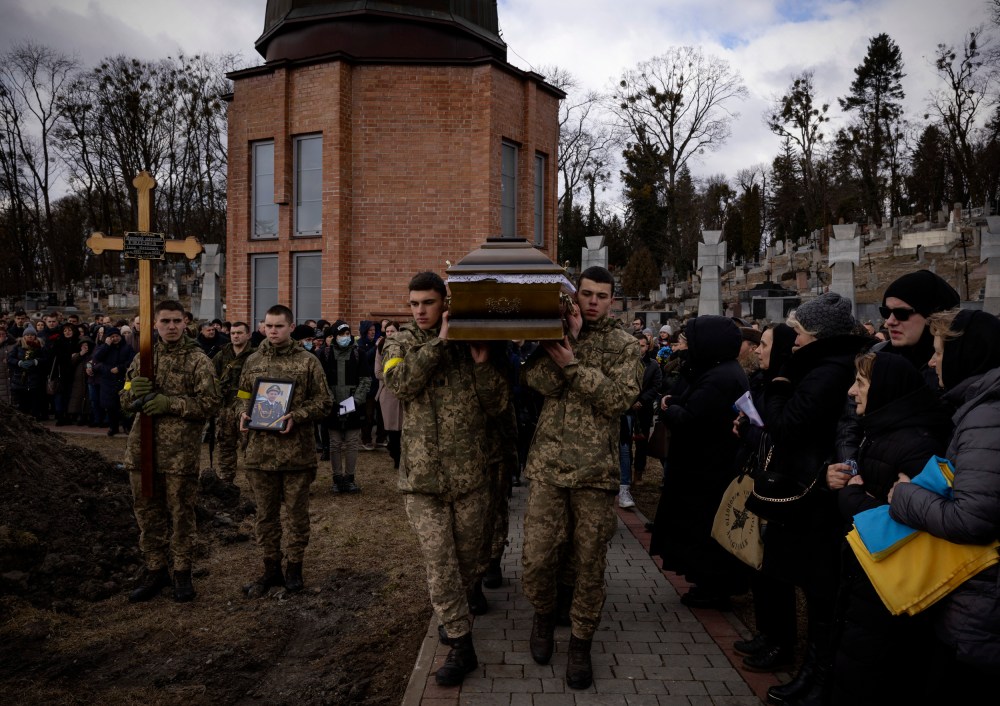
While the precise scope of Russian President Vladimir Putin’s military operation in Ukraine is unclear, experts like Thomas Graham, a former senior director for Russia on the National Security Council staff between 2004 and 2007, believe he’s seeking regime change and the destruction of Ukraine’s military infrastructure in a bid to bring Kyiv back under the influence of Moscow.
But reports documenting a deepening bitterness toward Putin across Ukraine are a reminder that the fury and suffering he’s generating with his brutal invasion could undermine his plans to control the country.
According to a recent New York Times report, the “one overriding emotion gripping Ukraine right now … is hate.” It said:
Billboards have gone up along roadsides in gigantic block letters, telling Russians in profanity-laced language to get out. Social media posts in spaces often shared by Russians and Ukrainians have been awash in furious comments.
The article described how the backlash against the invasion — which has targeted civilian infrastructure, appears to be using indiscriminate cluster bombs and has already displaced millions of Ukrainians — is not just driving hatred of Putin, but hatred of Russian society more broadly.
“Yuri Makarov, the chief editor of the Ukrainian national broadcasting company and the head of a national literature and arts award committee, said the war had driven a deep wedge between the Ukrainian and Russian societies that will be hard to heal,” the Times reported. “Russians, he said, have become Ukrainians’ ‘collective enemies.’”
This kind of shift in national sentiment undermines the idea that this invasion could serve as a straightforward way for Moscow to bring Kyiv back under its control after years of Kyiv drifting toward Western influence. Instead, it’s looking like the operation could backfire by intensifying anti-Russian attitudes and laying the groundwork for a potential long-term insurgency.

Experts like Ben Judah, a senior fellow at the Atlantic Council, have noted that Putin appears to be surrounded by yesmen who may want to confirm the assumptions that underlie his own worldview. That may have included an unwillingness among his advisers to point out that some of his assumptions about Ukrainian identity and Russia’s ability to intervene militarily without much resistance were out of touch with reality.
“I think, in general,” Graham told me in an interview shortly after the invasion began, “senior people in the Kremlin underestimate the degree of unity among the Ukrainian people at this point — and that’s Ukrainian speakers and Russian speakers.” “They have underestimated the consequences of their annexation of Crimea and what they’ve done in the Donbas over the past eight years and how that has changed attitudes towards Russia,” he added, referring to Russia’s support for separatist rebels in Ukraine’s southeastern region since 2014. Ukraine has a mix of Ukrainian and Russian speakers, with the eastern regions of the country being more Russian-speaking and historically more receptive to or susceptible to Russian political influence. But it seems that Putin is providing a stronger force for fostering a more coherent and strongly held Ukrainian national identity than could’ve ever emerged from within the country itself in the short to medium term. As civilians organize resistance, take up arms or leave the country out of fear, we could be seeing the birth of the very kind of united anti-Russian sentiment and action that Putin constantly seemed to fear before his invasion. He may have just created his own worst nightmare.
Zeeshan Aleem is a writer for MS NOW. Sign up for his newsletter. 

