








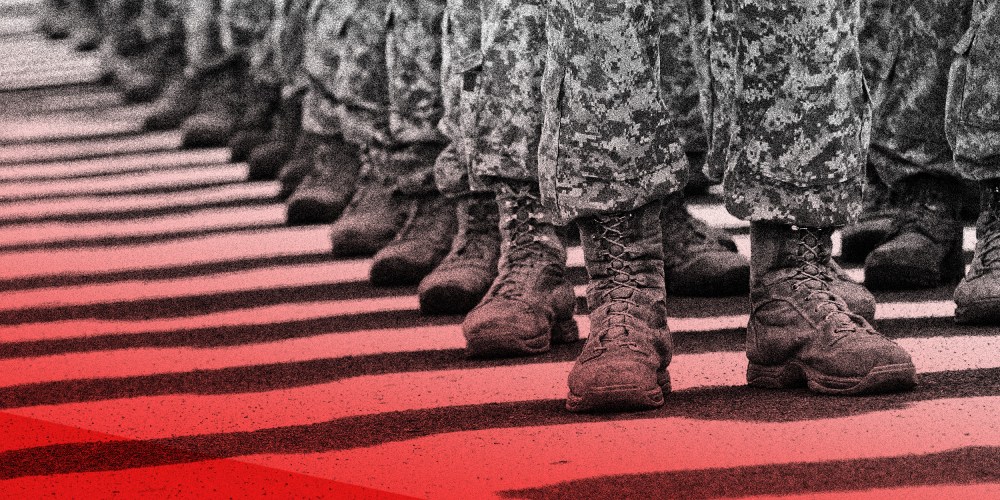
We learned the disappointing news last week that Sen. Angus King, I-Maine, joined with all the Republicans on the Senate Armed Services Committee to request that the Department of Defense halt its efforts to combat extremism in the military. According to Roll Call, in a report accompanying the Senate’s National Defense Authorization Act, the committee expresses the view that “spending additional time and resources to combat exceptionally rare instances of extremism in the military is an inappropriate use of taxpayer funds, and should be discontinued by the Department of Defense immediately.”
Sen. Angus King joined Republicans on the Senate Armed Services Committee to request that the Department of Defense halt its efforts to combat extremism in the military.
The committee’s request doesn’t legally tie the Pentagon’s hands. Even so, it is a misguided and partisan move that ignores the evidence showing a growing threat from active military and veterans engaging in extremist violence.
At least 102 (or 13%) of the 843 people federal law enforcement officials arrested on suspicion of being involved with the Jan. 6, 2021, attack on the U.S. Capitol have military experience. That number includes 91 veterans and a mix of active duty and reserve members, National Guard, and two individuals who were in basic training. U.S. Air Force veteran Ashli Babbitt was shot and killed that day, the only person to die at the hands of U.S. Capitol police, while trying to breach a set of locked doors inside the Capitol.
The presence of people with military experience at the Capitol that day is part of a broader trend of rising engagement in criminal extremist activity committed by active duty military or veterans, including terrorist plots and attacks. The percentage of domestic terrorist attacks and plots committed by active duty or reserve military rose from zero in 2018 to 1.5% in 2019, then jumped to 6.4% in 2020 before dipping to 5.2% in 2021. Since January 2020, there have been at least nine incidents in which active duty or former military members have been charged with criminal offenses related to violent extremism or supremacist groups and ideologies.

It’s important to note that people with military experience commit a small minority of all extremism-related crimes. The vast majority of active duty troops and veterans are law-abiding citizens with no history of extremist engagement. But any level of participation in extremism by active duty military personnel or veterans is especially concerning and potentially more dangerous because of the tactical and weapons training they have received, in addition to their combat experience, access to weapons and potential access to confidential information. Extremist groups prize such experience and the legitimacy military personnel and veterans lend to their cause. That’s why several extremist and anti-government militia groups in the U.S. actively recruit veterans and former law enforcement officials.
The Department of Defense responded to Jan. 6 swiftly and with a multifaceted approach. Within a month, Defense Secretary Lloyd Austin issued an unprecedented stand-down across the Defense Department to address extremism. The Defense Department also launched a counterextremism working group and revised its instructional guidance to provide clarity on what constitutes “active advocacy” or “active participation” in extremist ideology or organizations, which the military prohibits. And it developed a special subcommittee to bolster support and oversight of the insider-threat issue.
Any level of participation in extremism by active-duty military personnel or veterans is concerning.
These efforts represent a sea change in U.S. efforts addressing the problem of extremist and supremacist activities in the armed forces, an issue that has been the subject of six congressional inquiries since February 2019. But those efforts are only the start of what needs to be a more comprehensive strategy to mitigate the problem. A May 2022 report by the Defense Department’s Inspector General describes the variety of ways the department collects data on extremist-related issues as “not interconnected.” This makes it challenging, the report argues, to develop a “DoD-wide understanding” of extremism across the armed forces.
This is not only a U.S. problem. In Germany last week, a military officer who led a double life posing as a Syrian refugee was sentenced to five-and-a-half years in prison for plotting a far-right terrorist attack. His case brought into sharp perspective the dangers involved with “insider threats,” that is, when highly trained members of the armed forces radicalize and plot extremist violence. After hoarding guns and ammunition — some stolen from the German military — the officer planned a series of assassinations of “refugee friendly” politicians and prominent anti-racist activists. Upon his arrest, his fingerprints showed he was registered as a refugee in the state of Bavaria and had been receiving state benefits for over a year. Prosecutors believe he intended to have the attacks blamed on a Syrian refugee. The case forced German officials to think of far-right extremism within the military and security services as something other than an isolated problem of a few bad apples. It helped lead to investigations documenting over 1,400 cases of right-wing extremism in the German police and intelligence services over four years. We need the same level of attention in the U.S. through a comprehensive and nonpartisan approach that includes a clear assessment of the scope of the problem across all active duty and veterans communities, with data-sharing across agencies and full transparency to the public on the scope of the problem. We also need significant investments in education and training during basic training and at the time of separation to civilian life to equip active duty members and veterans alike with the skills to recognize potential outreach and propaganda from extremist groups who wish to exploit them. Extremist ideas and groups cannot be left to operate unchecked within the very organizations charged with protecting the population. The Senate Armed Services Committee’s messaging betrays its own mission. We must treat extremist engagement in the military and veterans’ community like the serious threat to national security that it is.
Cynthia Miller-Idriss is an author and expert on extremism. 


