








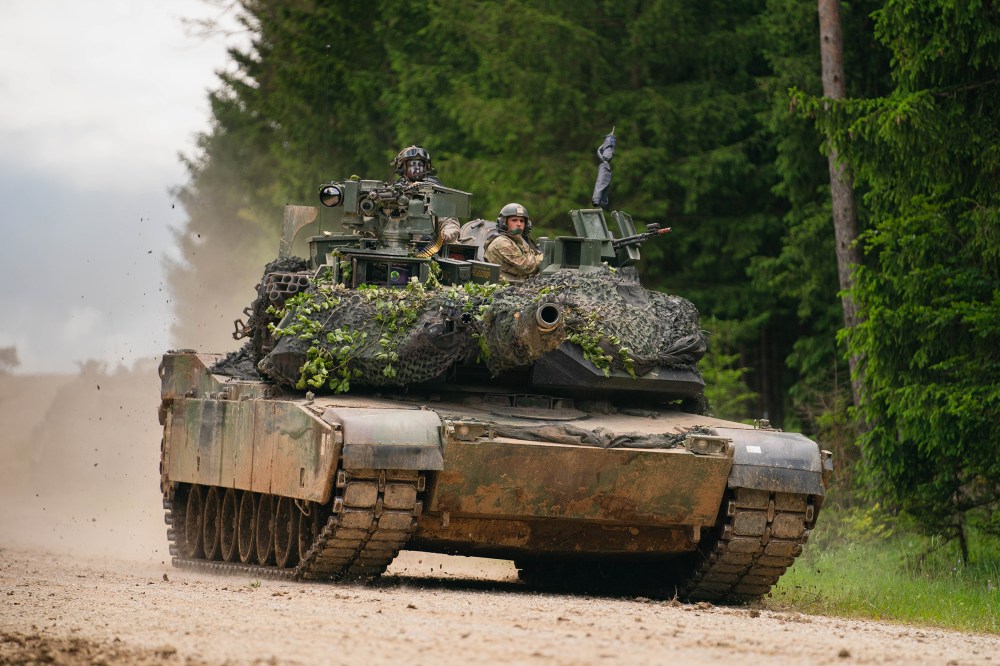
Within hours of President Biden announcing his decision to give Ukraine a battalion of 31 M1 Abrams main battle tanks, reports from NBC and others news outlets confirmed what already seemed likely: the transfer was done at least in part to appease German Chancellor Olaf Scholz, over the objections of skeptical Pentagon officials including Secretary of Defense Lloyd Austin. Just a few days earlier, these officials had argued the Abrams tanks were more logistically demanding and complicated than Germany’s Leopard 2 versions.
Just a few days earlier, these officials had argued the Abrams tanks were more logistically demanding and complicated to operate than Germany’s Leopard 2 versions.
For nearly a year, Scholz had stubbornly refused to supply Ukraine with Germany’s Leopard 2 , while also blocking their transfer from other European countries. German officials indicated they would only offer their tanks to Ukraine in concert with the United States, to diffuse the Kremlin’s wrath. (Germany has now pledged to send Ukraine over a dozen Leopard 2s as a “first step.”)
The Leopard 2 and Abrams are fairly similar in capability, coming in various models weighing 60-70 tons. Both are bigger and better protected than Russian tanks, with far more sophisticated sensors and fire control systems. But a Leopard 2’s diesel engine consumes fuel at almost half the rate the Abrams’s gas turbine does. And according to a U.S. Army armor officer I interviewed, it can be more easily repaired in the field. Ukraine’s military doesn’t have the U.S. Army’s huge logistical capacity, so these are nontrivial problems.
Above all, I think military logisticians hate having to divide resources supporting multiple small vehicle fleets that do the same thing but require different spare parts and training programs. From that point of view, training for and supplying just one type of Western tank in Ukraine would have been more efficient.
Thus, it’s easy to spin Biden’s flip-flop on tanks into yet another story of American military assistance inefficiently allocated to impractical weapons for political reasons. But that perspective, while understandable, is short-sighted.
First of all, the materials, means and political objectives of war are intertwined. If “giving” 31 less fuel-efficient U.S. tanks is the price of persuading Germany to allow Ukraine to potentially receive hundreds of more convenient vehicles, that is a sensible trade. And the later delivery date for M1s will allow Ukraine to focus on integrating Leopard 2s first.

We can’t just wish away inconvenient political constraints. Persuading Berlin to end its self-imposed bottleneck is a big win, as it accelerated Ukraine’s potential for launching successful offensives and also prevented potential ruptures had Poland followed through on threats to donate its German tanks without permission, undermining important existing arms control norms.
This is the reality of managing security coalitions — some arms take on symbolic importance exceeding their material value. Sometimes concessions must be made to keep allies on the same page.
And despite their limitations, the new tanks should prove useful, as they will be the latest model outfitted with digital systems, reinforced side/rear armor and multiple advanced thermal sights, allowing the commander and gunner to engage multiple enemies in rapid succession.
Ukraine may use its M1s differently than the U.S. Army would, possibly reducing the salience of certain logistical issues.
Furthermore, Ukraine may use its M1s differently than the U.S. Army would, possibly reducing the salience of certain logistical issues. Ukraine is in the best position to evaluate whether or not additional Abrams tanks make sense, as it is not always easy to predict which arms will succeed in foreign service.
For example, during World War II, the P-39 Airacobra fighter plane was disliked by many Allied military pilots for its poor high altitude performance and swiftly retired. But it was reportedly loved by Soviets fliers who received P-39s via the Lend-Lease military assistance program.
Looking beyond the realistically limited influence a single tank battalion can generate in a conflict involving hundreds of battalions, the integration of M1s into Ukraine’s military lays the groundwork for sustaining an alternate pipeline of Western tanks.
Yes, Leopard 2s are more numerous and immediately available to Ukraine in Europe, and we can expect to see some enter combat this spring. But production of the latest Leopard 2A7 model is proceeding so slowly that Poland gave up on expanding its Leopard 2 fleet, and is instead purchasing 1,000 tanks from South Korea. And European armies may eventually balk at donating too many Leopard 2s when tensions are high and replacements are slow to come. Meanwhile, the U.S. reportedly is sitting on over 3,500 obsolete Abrams tanks in storage it could remanufacture to modern standards if needed. Poland is also receiving a reported 366 M1s for its own military and hosts a school to train M1 operators and repair depots to support that fleet. Thus, neighboring Ukraine could use those facilities too — and as Poland receives South Korean tanks, it may eventually pass along some of its Abrams. Thinking long-term is important, due to the Kremlin’s apparent belief it can still win by dragging out the war long enough to outlast Western assistance. And even should hostilities end in 2023, Ukraine would still have to invest heavily in modernizing its armed forces due to high risks of renewed war with Russia. For now, it’s important to keep expectations realistic. More and better tanks by themselves aren’t game changers. They must be fielded in coordination with artillery, mechanized fighting vehicles carrying infantry into battle, and air defenses. And that’s difficult to pull off. The public must also be prepared for the reality that Western tanks, though better armored, will inevitably suffer losses that will be hyped by Russian propaganda. The public must also be prepared for the reality that Western tanks, though better armored, will inevitably suffer losses that will be hyped by Russian propaganda, much as ISIS and Houthi rebels did in the mid-2010s. Indeed, Russia’s information warriors are ahead of the game, circulating fake reports of destroyed American tanks and fighting vehicles well before any arrived in Ukraine. In a conflict of this scale, there’s simply no such things as a costless victory, especially when Ukraine lacks the air superiority advantage which enabled sweeping U.S. ground wars in Iraq. Nonetheless, if Ukraine receives enough Western tanks and supporting fighting vehicles to equip multiple mechanized brigades, it improves Kyiv’s odds of launching successful offensives that liberate more Ukrainian territory. And according even to some Russian analysts, Western tanks pose dilemmas to Russian commanders who must decide where to position their more limited anti-tank assets effective at range against them. The White House’s policy reversal shows the kind of flexibility and responsiveness to political circumstances we should expect from our elected officials. And while this arms package may not have been preferred by the Pentagon, and will not have a near-term impact, it will deliver useful materiel that opens future options to help Ukraine’s defense against Russian invasion.
Sébastien Roblin
Sébastien Roblin writes about the technical and historical aspects of international security and conflict for The National Interest, War is Boring and other publications. He tweets @sebastienroblin. 


