








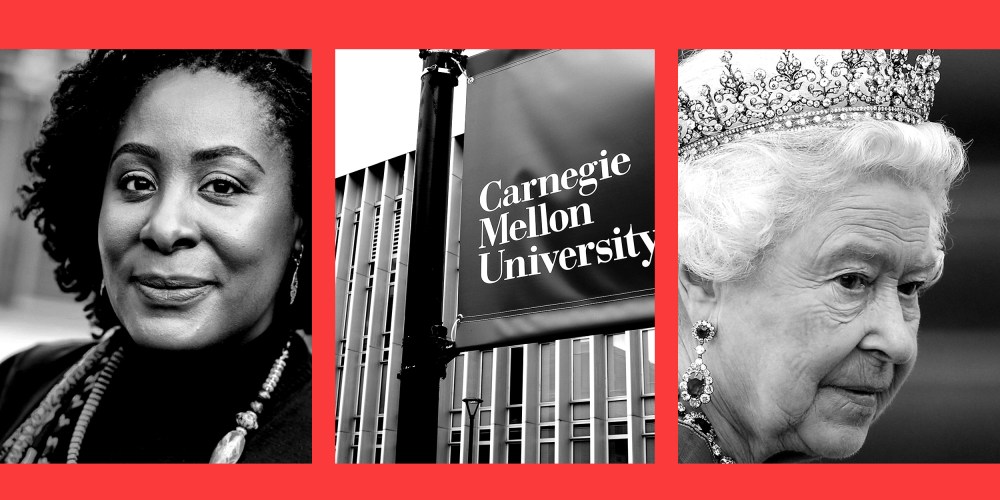
After learning Thursday that Queen Elizabeth II was on her deathbed, a Carnegie Mellon University professor, Uju Anya, sent out a contentious tweet: “I heard the chief monarch of a thieving raping genocidal empire is finally dying. May her pain be excruciating.” The tweet went viral and garnered even more attention — and pushback — after Amazon founder Jeff Bezos quote-tweeted Anya’s comment and said he didn’t believe she was “working to make the world better.”
This kind of back and forth is par for the course on Twitter. But then something a little more unusual — and troubling — happened. Anya’s employer, Carnegie Mellon, issued a statement:
We do not condone the offensive and objectionable messages posted by Uju Anya today on her personal social media account. Free expression is core to the mission of higher education, however, the views she shared absolutely do not represent the values of the institution, nor the standards of discourse we seek to foster.
Universities almost never issue statements like this because the very premise of a university is to serve as a bastion of independent thinking and provide a forum for intellectual free-for-alls. A university would never be presumed to endorse any of its scholars’ individual beliefs, which is key for academia as a space for provocation to thrive. So in effect, this statement was a condemnation and implicitly a signal to other academics at the university that they should watch their mouth on certain matters. While the motivation behind the unusual statement is unclear, it underscores how vulnerable public intellectuals are to controversy-driven social media pile-ons.
It underscores how vulnerable public intellectuals are to controversy-driven social media pile-ons.
It is vital to embed Anya’s tweet — which was deleted by Twitter because it violates Twitter’s rules against wishing harm on other users — in a broader context. In a follow-up tweet to her ultra-viral one, she wrote, “If anyone expects me to express anything but disdain for the monarch who supervised a government that sponsored the genocide that massacred and displaced half my family and the consequences of which those alive today are still trying to overcome, you can keep wishing upon a star.”
Anya told NBC News in a subsequent interview that her perception of the British monarchy was heavily shaped by Britain’s role in the suffering of her family during the brutal Nigerian civil war after Nigeria’s decolonization and independence from Britain. She explained that her family had been displaced during the war and that some of her relatives had been killed. “I take deep offense at the notion that the oppressed and survivors of violence have to somehow be deferential or respectful when their oppressors die,” Anya said to NBC News.

None of this means one must approve of the sadism in Anya’s first tweet. It’s not something I would tweet, in part because of a personal moral commitment to not take satisfaction in the pain of others, even if the pain is warranted. But what’s undeniable is that it stems from a place of personal hurt and political opposition to the imperial history and legacy of the British monarchy. Even if one found Anya’s statement distasteful, it’s also critical to recognize how distasteful the whitewashing of the British empire has been in the official British narratives celebrating Elizabeth’s life. Beneath the comment about suffering, Anya’s tweet stakes out a position on politics and history, something scholars are expected to do.
Carnegie Mellon felt the need to distance itself from this, and it’s not clear why. Anya’s tweet and some of her responses to the pile-on could be described as rude or mean-spirited, but scholars and thinkers of all kinds are rude or mean-spirited all the time — and often while defending heinous ideas. And yet these exchanges, whether online or in some other form of public correspondence, don’t typically elicit condemnations from the universities that employ them. It’s possible that the strange condemnation was an attempt to keep a patron happy without directly punishing Anya. So what happened? There are two possible explanations, and they’re not mutually exclusive. One is that the pile-on that ensued after Bezos criticized the tweet caused a panic among the university’s administrators. Since the death of Elizabeth was a massive news story and the tweet was going viral, the university’s administrators seem to have succumbed to public pressure to sanction Anya in some way, out of a desire to defend the university’s reputation. As I’ve described at length before, the tendency of organizations to cave to spontaneously formed social media mobs is a terrible thing for a culture of free speech, and it’s a labor issue, too. There is always the option of trying to wait out the mob, which often dissipates as quickly as it forms. Another explanation is that Amazon is currently donating millions of dollars to the university, and administrators may have feared that the money — or any future donations from Amazon or Bezos — might be jeopardized. It’s possible that the strange condemnation was an attempt to keep a patron happy without directly punishing Anya. Either way, the episode exposes how social media continues to reshape speech norms. It is a great thing that people can publish their thoughts more easily and have their opinions travel much farther than before. But that exact phenomenon also makes the capacity for costly blowback more powerful than ever before. Ironically that risk unravels some of the very benefits of having these platforms in the first place.
Zeeshan Aleem is a writer for MS NOW. Sign up for his newsletter. 

