








Some time after I received my B.A. in English literature, my alma mater sent a T-shirt proclaiming its status then as the sixth most selective school in the nation. I’d love to tell you I was immediately turned off by the message that the percentage of applicants a university rejects is proportional to the quality of the education it provides. But it took me a while to acknowledge the awfulness of implying that exclusivity fosters learning, to say nothing of the sadness of boasting, “We’re number six!”
It took me a while to acknowledge the awfulness of implying that exclusivity fosters learning.
In the weeks since President Joe Biden announced his plan to forgive up to $20,000 in student loan debt for qualified borrowers, we’ve seen critics attack those with such debt as high-class and out-of-touch with the typical American. We’ve also seen a report that nearly half of adults who studied the humanities regret that choice.
About two weeks before Biden’s debt-relief announcement, Education Secretary Miguel Cardona said in a speech he gave at the Education Department that “many institutions spend enormous time and money chasing rankings they feel carry prestige.”
And many ambitious high school seniors and their families are going to spend more and take on more debt than they should because one of the characteristics of ambition is wanting to be on a campus that ranks near the top.
That Columbia University, a consistent top-10 on U.S. News & World Report’s ranking of colleges, was suspected by one of its professors of getting to the number two spot by submitting incorrect data, validates Cardona’s concern about clout chasing. Columbia didn’t submit data this year and fell to number 18 in the rankings released Monday.
Princeton University, ranked number one on the list released Monday, admits only 4% of the ambitious, overachieving and practically perfect teenagers seeking entrance. It costs $57,000 a year to go there, which, believe it or not, is less than it now costs to attend the school that awarded me my degree.
As Cardona said in that early August speech, “Too often, our best-resourced schools are chasing rankings that mean little on measures that truly count: college completion, economic mobility, narrowing gaps in access to opportunity for ALL Americans. That system of ranking is a joke!”
My parents, both of whom were employed by the state of Mississippi, blessed my decision to attend the school I did and had faith that any degree I got from there would catapult me into a kind of economic comfort they didn’t enjoy. Their faith was rewarded. I am better off financially than they ever were. But the confluence of all the stories about student debt, graduate regret and an unhealthy fixation on rankings remind us that for many Americans, college can be just as much a trap as it is a trampoline.
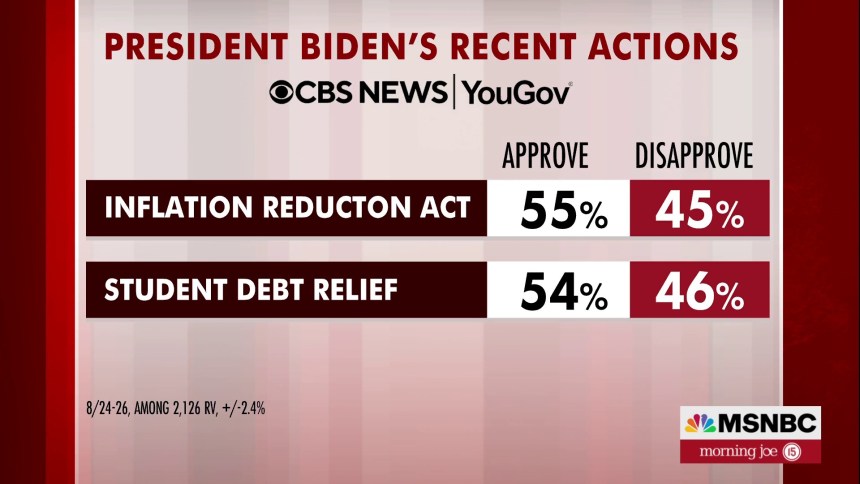
To repeat the points I made when Tim Ryan, an Ohio Democrat running for Senate said forgiving student debt “sends the wrong message to the millions of Ohioans without a degree working just as hard to make ends meet,” the argument that people with student loan debt are well off is specious, and the argument that they must have degrees ignores data that show a third of Americans with student loan debt don’t.
The response to Biden’s student loan forgiveness plan shouldn’t be that it’s unfair to people who either didn’t go to college or don’t have debt; the response should be: We need to make college more affordable, free even, but Biden’s campaign promise of two years of free community college was not included in his social spending plan this year.
When we combine the number of people who have debt but no degree with the number of people who, according to a 2021 survey conducted by the Federal Reserve, studied fields they wish they hadn’t, the result is an uncomfortably large group of Americans who may believe they’ve been had. Despite the rush of Republican politicians who got their jokes in about gender-studies majors, they’re not going to stop sending their children to school. And that’s a shame, because a growing sentiment against college is likely to make the promise of social mobility even more out of reach. Despite the rush of Republican politicians who got their jokes in about student loan forgiveness benefiting gender-studies majors, you can rest assured that they’re not going to stop sending their children to school. Because they know that, despite whatever demagoguery they’re selling, a degree has value. An education — which is separate and distinct from a degree — also has value. And despite reports that humanities majors are the most unhappy with their choice, an education in the humanities is also valuable. Even though the value of such isn’t always expressible in dollars and cents, we’re seeing the devaluation of such education playing out in the erosion of our democracy. For what are our current media-illiteracy, political polarization, book-censoring, science-doubting, lie-believing crises if not symptoms of America’s foolish rejection of the liberal arts? Yes, we need scientists and engineers. Our crumbling infrastructure is one testament to that. But our crumbling democracy is just as clear a sign that we need people who can read and process complex, nuanced information, people who aren’t so easily tricked, say, into believing that a guy hawking pillows is sitting on secret data that proves corruption in the last presidential election. Granted, given how expensive college has become, given the enormous amount of debt families take on while there, it’s becoming increasingly hard to make the argument that students should study English or history or foreign languages or any course of study that doesn’t overtly promise to be lucrative. But the more we abandon such study, the more fragile our democracy becomes. The amount of money its graduates donate to their alma mater is another particularly useless metric that factors into how high U.S. College News & World Report ranks a university. But that’s not a measure of educational quality but a proxy for wealth. And if you’re out here in 2022 conflating wealth with education, then the education you require is a bit more elementary.
Jarvis DeBerry is an opinion editor for MS NOW Daily. 


