








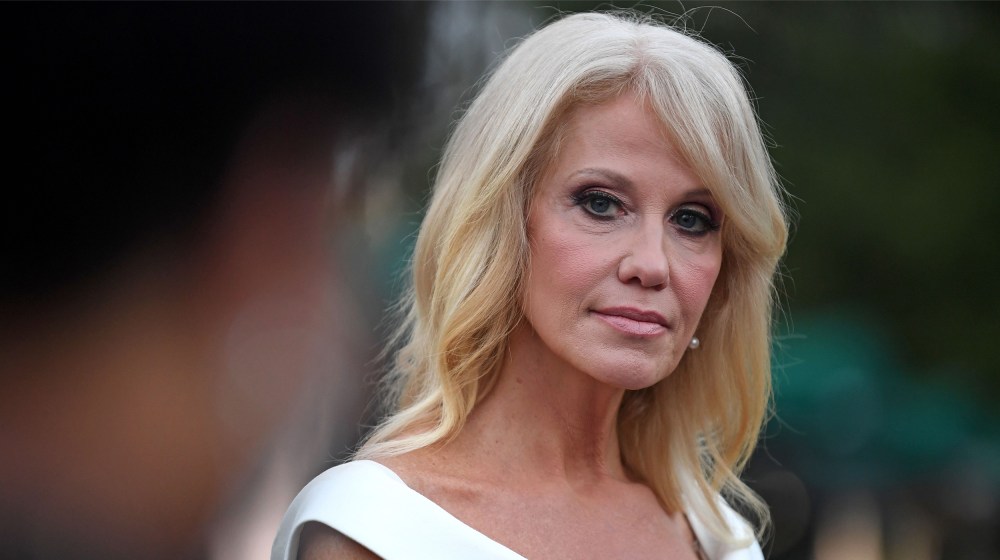
When former Trump White House counselor Kellyanne Conway entered the new administration in 2017, she quickly came under pressure to sell her polling firm to comply with conflict-of-interest rules. According to a new story in Politico, though, Conway may have solved this issue by swapping one ethical problem for another. Citing “previously unreported financial documents reviewed by government ethics and finance experts,” Politico reports that Conway may have sold her firm with the assistance of conservative judicial activist Leonard Leo. The revelations raise fresh questions about the complex network of dark money groups controlled by Leo, and whether he and Conway may have violated ethics laws by conducting the sale while both were advising the president on judicial nominations.
For more than three decades, Leo, the co-chairman and former executive vice president of the Federalist Society, a right-wing legal powerhouse, has played a central role in the long, deliberate and ultimately successful campaign for right-wing control of the court. During the Trump administration, he was known as the president’s “judge whisperer,” supplying the White House with a list of his preferred choices for judgeships. According to Politico, the documents appear to show that Leo helped finance the 2017 purchase of Conway’s company by Creative Response Concepts, Inc., a conservative public relations firm that, according to Politico, simultaneously “was also bringing in millions of dollars from dark money groups to promote Leo’s picks.” Neither Conway nor Leo responded to Politico’s requests for comment.
The arrangement at least creates the appearance that Leo and CRC bought access to Trump.
According to state corporation records in Virginia, where CRC is located, the company ceased using the name Creative Response Concepts, Inc. in 2020, and has since used the names CRC Advisors, CRC Strategies, CRC Public Relations, and CRC Advisors, Inc. As Axios reported in early 2020, Leo stepped down from his daily Federalist Society duties to help run CRC Advisors, Inc., through which he planned “to funnel tens of millions of dollars into conservative fights around the country.” The association between Leo and Creative Response Concepts president Greg Mueller dates back to the judicial confirmation battles of the George W. Bush era. Leo and Mueller helped lead a “war room” of activists “acquainted with each other through Catholic and conservative public causes,” according to an article in the conservative Catholic magazine Crisis, which described Mueller as “the group’s public-relations maestro.” The war room shepherded through the confirmations of Chief Justice John Roberts in 2005 and Justice Samuel Alito in 2006.
In Politico’s story, conservative lawyer Ed Whelan downplayed Conway’s influence over Trump’s judicial nominations. And according to Brett Kappel, a lobbying and government ethics lawyer who also reviewed the documents obtained by Politico, it may not be a clear ethics violation if Conway was not advising the president on court nominations at the moment she sold the firm.
But if, as Politico reports, Leo used one of his dark money organizations to finance CRC’s purchase of the polling firm, the transaction raises a host of ethical red flags. Conway, one of Trump’s closest White House advisers, relieved herself of pesky questions surrounding her continued ownership of her firm and likely received a tidy payday. (She had previously reported the firm’s value at between $1 million and $5 million.) The arrangement at least creates the appearance that Leo and CRC bought access to Trump. The worst-case scenario of the ethical conflicts would make even the most jaded D.C. insider blanch: Leo and CRC bailed Conway out, Conway helped convince Trump to adopt Leo’s list of judges, and CRC helped wage a public relations campaign in support of their confirmations, a political win for Trump.
The success of Leo’s planned right-wing takeover of the courts was in turn crucial to Trump’s political fortunes. His promise of Supreme Court nominees that would overturn Roe v. Wade was key to the Christian right’s ongoing fealty to Trump’s scandalous campaign and presidency. In office, Trump literally answered their prayers, cementing and then expanding the court’s conservative majority. This year alone, the court ended the right to abortion, continued its march toward eviscerating the separation of church and state, and signaled openness to further expanding the rights of conservative Christians at the expense of LGBTQ rights. But Leo has broader ambitions than securing right-wing control of the high court, and he has a stunning amount of money at his disposal. Beyond his newly formal alliance with Mueller and CRC, in 2021 Leo received a $1.6 billion donation from Chicago businessman Barre Seid. The avalanche of cash gives Leo an even greater ability to manufacture support for his radical right-wing views before both the court and the public. Organizations funded by Leo’s largesse have weighed in on crucial cases involving elections, affirmative action and LGBTQ nondiscrimination laws, ProPublica reported last week. In one example, six different organizations funded by Leo filed amicus briefs in 303 Creative v. Elenis, a case argued earlier this month, in which a Christian web designer claims a Colorado civil rights law barring discrimination against LGBTQ people violates her free speech rights. The success of Leo’s planned right-wing takeover of the courts was in turn crucial to Trump’s political fortunes. And Leo’s targets go well beyond Roe. In a 2017 speech to a conservative group, he specifically criticized both Griswold v. Connecticut, the 1965 decision striking down laws criminalizing the sale of contraception, and Obergefell v. Hodges, which legalized same-sex marriage in 2015. In a recent speech to the Federalist Society, William Pryor, chief judge of the 11th Circuit Court of Appeals, ridiculed concerns over Leo’s dark money network. Pryor’s own nomination by Bush in 2004 was nearly derailed over his extreme views, including his belief that laws criminalizing sodomy should stand, even though the Supreme Court had already invalidated such laws in 2003’s Lawrence v. Texas. His confirmation a year later was an early sign of this right-wing campaign’s future success. Now the Supreme Court is controlled by justices who are similarly intertwined with that campaign. The need for vigorous investigation, oversight, transparency and accountability is urgent. A corrupted Supreme Court is a danger to democracy.
Sarah Posner
Sarah Posner is the author of "Unholy: How White Christian Nationalists Powered the Trump Presidency, and the Devastating Legacy They Left Behind." 


