








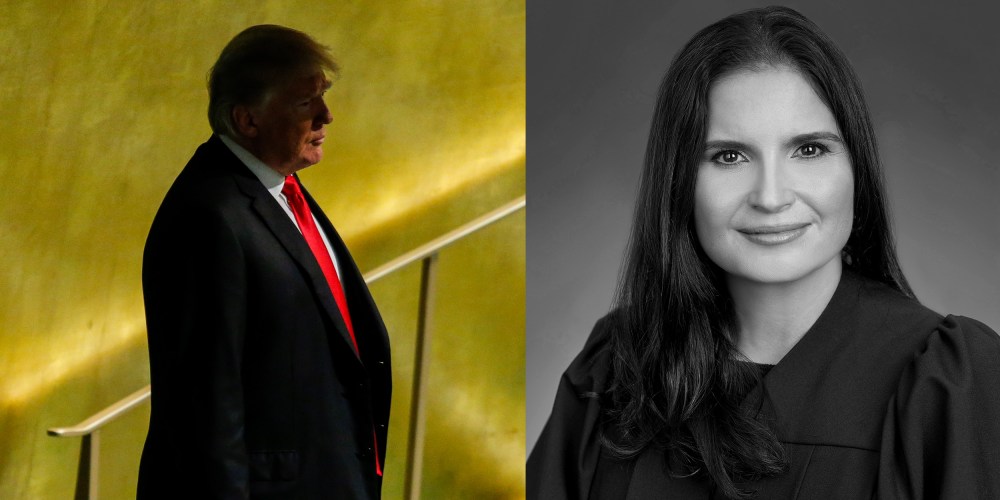
The criminal investigation into secret and sensitive government documents found at former President Donald Trump’s Florida home, Mar-a-Lago, is as politically charged as they come. Not only is the Department of Justice investigating a former president and the acknowledged leader of the Republican Party, but it is also investigating a possible future presidential candidate. Thus, it’s vitally important that the public have no suspicion that those refereeing the case between Trump and the DOJ are being persuaded by their politics or personal ambitions.
It’s important that the public have no suspicion that those refereeing the case between Trump and the DOJ are being persuaded by their politics or ambitions.
That’s why U.S. District Judge Aileen Cannon, who was appointed by Trump only two years ago, should recuse herself and not rule on Trump’s request for a special master to review the documents the FBI seized during its Aug. 8 search of Mar-a-Lago. But there are no signs that she’ll do so. On Saturday, the judge announced her “preliminary intent” to grant Trump’s motion. Tuesday night, the DOJ responded by adamantly opposing Trump’s request.
The DOJ argued that “the government has an urgent interest in continuing its review of these materials, both for purposes of its criminal investigation and to assess potential national security risks caused by improper storage of classified records.” DOJ lawyers added, “Appointment of a special master would undoubtedly delay both processes—including because a special master would likely need to obtain a security clearance and specific authorization from relevant entities within the Intelligence Community to review particularly sensitive materials.”
Trump has a history of filing motions intended to slow down court cases, hoping such slowdowns would benefit him. And that appears to be his goal here.
To be clear, calling for Cannon’s recusal is in no way an attack on the character of this former federal prosecutor and clerk for a U.S. Court of Appeals judge. But this is not a case dealing with a decision by the Trump administration. It involves Trump personally, as the caption of the case — Donald J. Trump v. United States of America — makes clear. A judge shouldn’t be hearing a highly sensitive, politically charged case such as this one when the party before her put her on the bench.
As is the usual practice with federal district cases, Cannon was randomly assigned Trump’s case. But if fate had resulted in a judge then-President Barack Obama appointed hearing it, we know Trump would have screamed about it.
After all, Trump himself encouraged Americans to think of federal judges as beholden to the presidents who appointed them. In 2018, when a federal judge entered a restraining order against his administration’s new asylum policies, Trump attacked him as “an Obama judge.” The argument was that he was biased against Trump because Obama had appointed him.

When Chief Justice John Roberts responded that there is no such thing as “Obama judges or Trump judges, Bush judges or Clinton judges,” Trump shot back, “Sorry Chief Justice John Roberts, but you do indeed have ‘Obama judges,’ and they have a much different point of view than the people who are charged with the safety of our country.”
In 2016, Trump the presidential candidate had leveled an even worse attack against the federal judge handling a class-action lawsuit against the now-defunct Trump University. Trump demanded his recusal because he was “An Obama pick. Totally biased-hates Trump.” Trump said that since the Indiana-born judge was of Mexican heritage, he should recuse himself because “I’m building a wall.”
It goes without saying that if Obama were being investigated in connection with potential crimes and a judge appointed by Obama were handling a motion made by Obama that could slow down the DOJ or even prevent the DOJ from having access to certain documents, Trump would be going ballistic, calling the court “rigged.” So would his GOP and media allies.
Trump himself encouraged Americans to think of federal judges as beholden to the presidents who appointed them. The federal law and ethical rules that apply to judges also make a compelling case that the 41-year-old Cannon should recuse herself. The controlling federal statute provides, “Any justice, judge, or magistrate judge of the United States shall disqualify himself in any proceeding in which his impartiality might reasonably be questioned.” It’s fair to say that given that Trump appointed Cannon, her “impartiality might reasonably be questioned.” The Code of Conduct for United States Judges also advises that a “Judge Should Avoid Impropriety and the Appearance of Impropriety in all Activities.” The official commentary to this ethical rule warns: “An appearance of impropriety occurs when reasonable minds … would conclude that the judge’s honesty, integrity, impartiality, temperament, or fitness to serve as a judge is impaired.” The rationale is that “Public confidence in the judiciary is eroded by irresponsible or improper conduct by judges.” That last line is the key. Cannon’s recusal would be in service to public confidence in our judiciary. If Cannon rules in favor of Trump’s motion, won’t millions of Americans, rightly or not, believe she was influenced by the fact that Trump appointed her? That would further erode the belief that our judiciary is blind to politics and favoritism. There’s also another wrinkle here. Cannon is only 41 years old, which is young for federal judges. She has plenty of time to be elevated to the U.S. Court of Appeals or even the U.S. Supreme Court by a future GOP president. Add to that, Trump may be running for president in 2024. If she makes rulings in his favor, and he wins, would he reward Cannon for those favorable rulings by elevating her? Again, I’m not suggesting Cannon would rule in a way to help her future judicial career, but even the possibility of that is a concern. There are nearly 30 federal district judges in the United States district for southern Florida, where Cannon is a judge, most with far more experience than Cannon. For example, the chief judge of this district, Cecilia M. Altonaga, was appointed by President George W. Bush in 2003. Altonaga has nearly 20 years of experience on the court, 10 times more than Cannon. Or the chief judge could randomly choose a non-Trump-appointed judge to preside over the case. A judge Trump appointed handling a case this sensitive involving Trump personally is a recipe for disaster. If Cannon rules in Trump’s favor on any disputed issue, it could further erode confidence in our judiciary. That would be especially dangerous given that trust in our institutions, in part because of Trump, is at an all time low.


