








A congressional select committee investigating the pandemic recently released a report on Covid outbreaks in the meatpacking industry early in the pandemic, and it turns out that company executives knew that the workers were catching Covid-19 and dying. In response, they enlisted the help of the Trump administration in preventing local health departments from requiring safety measures to keep their plants open, insulating themselves from legal accountability and starving their workers back onto the job.
When corporate profits — or capitalists’ control of their workforces, especially diverse ones — are on the line, then Donald Trump and his goons have their backs, always.
It’s an illustration of the fundamentally fraudulent nature of Trump-style “populism.” He and his party might rail against “globalist” bankers, corporate fat cats or slanted trade deals and occasionally might even make some token policy gesture in that direction. But when corporate profits — or capitalists’ control of their workforces, especially diverse ones — are on the line, then Donald Trump and his goons have their backs, always.
Trump’s whole 2016 campaign, recall, was about reclaiming American greatness that had been stolen by corrupt Washington elites. We “are transferring power from Washington, D.C., and giving it back to you, the American people,” he claimed in his inaugural address. “For too long, a small group in our nation’s capital has reaped the rewards of government while the people have borne the cost. … Politicians prospered — but the jobs left, and the factories closed.” Trump’s critique had some bite to it, to be fair, but in power he let foxes into every regulatory henhouse, from agriculture to the environment to finance, and his most obvious personal priority was lining his own pockets.
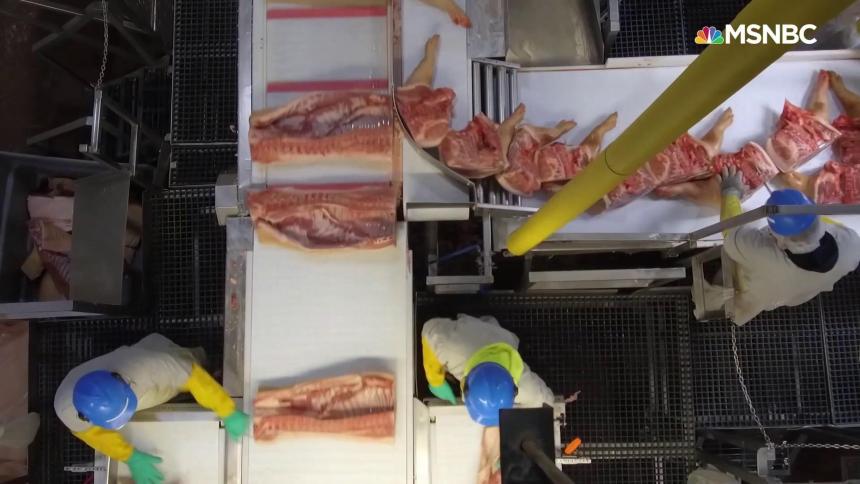
A truly awful context to the meatpacker story is that it likely would have been possible for these companies to have remained open without turning their operations into Covid factories. Meatpacking facilities were perfect for spreading the coronavirus because they’re heavily air-conditioned; the virus is more stable in cooler temperatures, and the A/C recirculates any virus-containing air to every corner of the building. But countervailing steps could have been taken.
It was understood early in the pandemic that outdoor areas were dramatically safer than indoor ones. With lots of air flowing past, virions are quickly dispersed to safe concentrations. It was also known by March 2020 at the latest that masks work to slow the spread — and the better the mask, the better the protection. It has also been possible to buy air filtration devices that capture virion-scale particles for decades.
A sensible company that actually cared about its workforce would have considered these facts and taken a few relatively simple steps. First, it would have fitted its climate control units with high-grade filters and where possible routed some outdoor air into the facility rather than recirculated it. Second, it would have placed HEPA (high efficiency particulate air) filters in all locations where workers congregate. Third, it would have obtained N95 masks for all workers and required that they be worn inside at all times. Fourth, it would have set up regular tests, plus paid sick leave, so infected workers would stay home and not spread the virus to others.
But these meatpacking companies didn’t do any of that, even though they knew for a fact that their facilities were hot spots for the virus. Instead, when local health departments were considering requiring just some of these measures, the companies ran to the Trump administration and whipped up a fake fear of meat shortages to forestall protective regulations — and they succeeded. Trump invoked the Defense Production Act in an order literally drafted by Smithfield and Tyson, two of the biggest meat companies, which overruled most local regulations and also protected the companies from legal liability over getting their workers killed.
There’s some Trumpian populism for you: when the vice president serves as an unpaid HR manager for corporate behemoths.
The effort wasn’t at all subtle. “Now to get rid of those pesky health departments!” one lobbyist told a Koch Foods executive, according to Congress.
In addition, the companies successfully lobbied the Labor Department to issue rules clarifying that workers wouldn’t be eligible for the CARES Act super-unemployment benefits if they quit or were simply scared to go to work. Indeed, then-Vice President Mike Pence personally hectored meat workers at a news conference, telling them that “we need you to continue … to show up and do your job,” referring to “incidents of worker absenteeism.” There’s some Trumpian populism for you: when the vice president serves as an unpaid HR manager for corporate behemoths. Sure enough, meatpacking facilities, where workers are commonly immigrants and about 69 percent are nonwhite, have been some of the deadliest places during the pandemic, and workers also spread the virus around their communities. One study found that the presence of a meatpacking plant increased case numbers in U.S. counties by about 160 percent. Now, some of the above steps would have been difficult. Masks were in short supply early in the pandemic, along with high-grade filters and much other equipment. But it wasn’t impossible. The Texas supermarket chain H-E-B managed to do much of it by developing a pandemic plan and keeping a stockpile of supplies. But this simply isn’t how most American executives behave. Instead of thinking ahead and writing up strategies to protect the health and safety of their employees, executives tend to view working-class workers as a lazy rabble that must be coerced into work and then discarded whenever they fall sick or die. That especially holds when that workforce is disproportionately nonwhite. And in a pinch, pseudo-populists like Trump will be right there behind the business class, politely asking whether there’s any way they can help get those workers get enveloped again in the coronavirus fog.
Ryan Cooper
Ryan Cooper is managing editor of The American Prospect. His work has appeared in The Nation, The New Republic and The Washington Post. He is the author of the book "How Are You Going to Pay for That: Smart Answers to the Dumbest Question in Politics." 

