








Sometimes you must sacrifice a little fish to land a giant whale.
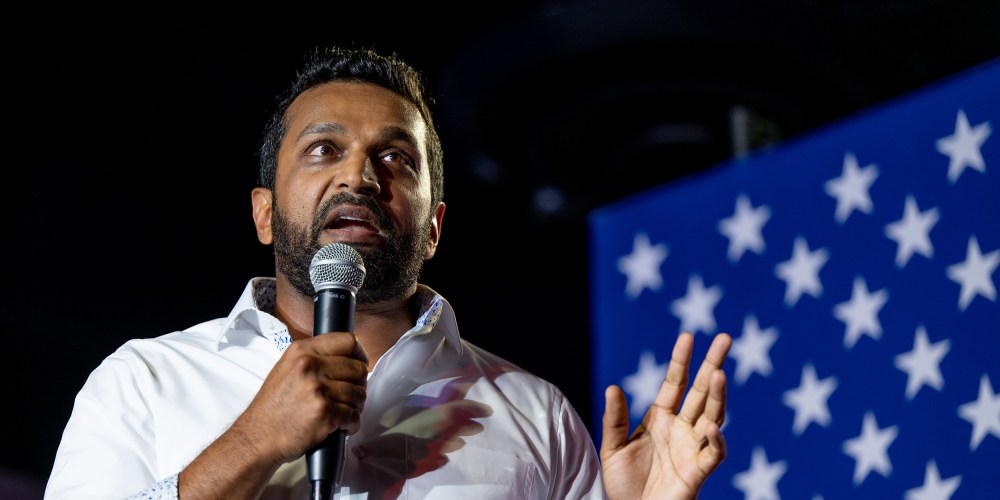
That seems to be the Justice Department’s strategy in granting immunity to Kash Patel, an aide to former President Donald Trump, in its investigation into the government documents seized at Mar-a-Lago. In addition, The Wall Street Journal reports, “Other Trump associates involved in the Mar-a-Lago documents matter also have been offered some form of immunity,” including Trump lawyer Christina Bobb, citing “people familiar with the matter.” The report indicated that Bobb declined the immunity offer because she said she didn’t need it. But more generally, immunizing witnesses suggests DOJ is now focusing on hauling in its catch.
It appears that DOJ took the rare move of then challenging Patel’s assertion of the Fifth Amendment.
According to reports, Patel testified before the grand jury in Washington last month and repeatedly invoked his Fifth Amendment right against self-incrimination to avoid answering questions. It appears that DOJ took the rare move of then challenging Patel’s assertion of the Fifth Amendment, which requires reasonable grounds to believe that the answers could expose the person to criminal prosecution, but Judge Beryl Howell agreed with Patel. If DOJ wanted his testimony, they would have to provide immunity.
Immunity can override the Fifth Amendment right by removing the consequences of potentially incriminating testimony. To compel a witness to testify, the government obtains a compulsion order from the court, which, by statute, provides a witness with what are known as use immunity and derivative use immunity. Use immunity means that the government may not use a witness’s statements against them in a criminal prosecution. For example, if a defendant says he robbed a bank and buried the money in the backyard, the government may not use that statement against him. Derivative use goes one step further, prohibiting even indirect use of the statement. That is, in addition to forgoing use of the statement, the government is also prohibited from digging up the money unless another source can tell them where it is buried. And if a defendant later challenges the government’s evidence as violating the order, the burden is on the government to prove that it had another source for the evidence.

Granting use and derivative use immunity in a high-profile case can be fraught. In the Oliver North prosecution, for example, the congressional committee investigating the Iran-Contra scandal granted North immunity, and he testified in detail about the scheme. He was later charged in a criminal case for obstructing Congress, among other offenses. Even though prosecutors argued that they had used evidence at trial that was independent of North’s congressional testimony, a federal appeals court reversed his conviction. The court found that government could not prove that its witnesses had not been influenced by North’s immunized testimony during its extensive media coverage. Proving the independent source of evidence is thus a sometimes-impossible standard to meet.
Because of the North scenario, granting use immunity to Patel and others does not technically preclude the government from charging them, although doing so does greatly reduce the likelihood that they will.
Why do it? Because Patel may indeed be useful in building a case against Trump.
One defense Trump has raised is that he declassified the documents before taking them to his home. Patel has publicly stated that “Trump declassified whole sets of materials in anticipation of leaving government that he thought the American public should have the right to read themselves.” He further stated that he himself is an eyewitness: “I was there with President Trump when he said ‘We are declassifying this information.’” Those statements indicate that Patel has testimony that help determine the validity of Trump’s claim.
But declassification is not much of a defense in this case. In its search warrant application for the Mar-a-Lago property, DOJ was careful to avoid any statute that required classification as an element. Trump could potentially be prosecuted under any or all of those statutes — mishandling government documents, obstruction of justice, and the Espionage Act. So there are several reasons, ultimately, why Patel’s testimony does matter. So there are several reasons, ultimately, why Patel’s testimony does matter.
One reason is that Trump designated Patel in June 2021 as one two “representatives” liaising with the National Archives over access to his presidential records. We now know that the timing of that designation shortly followed the service of a grand jury subpoena for the return of the missing records and a visit from DOJ’s chief of counterintelligence. It would seem that Patel could answer a number of important questions not only about declassification, but about the events surrounding the retention of documents. Did Trump know that the documents rightfully belonged to the government? Did he willfully violate the law? Did he deliberately conceal them when he received a subpoena for their return? Truthful answers to all of these queries would provide important evidence about Trump’s knowledge and intent. DOJ may also be trying to lock Kash’s story down. Sworn testimony attesting to one version of the facts now makes it more difficult for a witness to tell a different version later. If he changes his description of the events, he can be impeached with the transcript from the prior testimony. If Patel testifies to facts in his grand jury testimony that are inconsistent with any defense Trump may use if he is charged, it will be harder to retreat from it at trial. Giving up the prosecution of Patel and other witnesses who may have engaged in wrongdoing all but eliminates the ability to hold them accountable under the criminal law. That’s not a decision any prosecutor takes lightly. And it suggests DOJ has assessed that sacrificing their convictions is necessary to reel in a more egregious offender.
Barbara McQuade is a former Michigan U.S. attorney and legal analyst. 

