








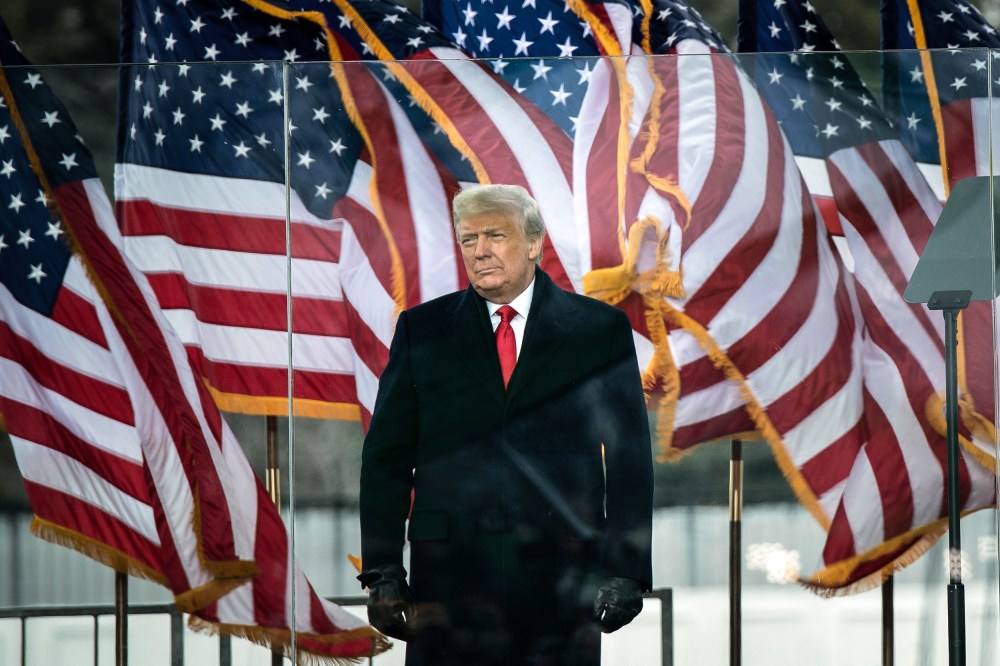
Conventional wisdom regarding the Supreme Court’s decision Monday allowing Donald Trump to remain on the Colorado state primary ballot is that this is a big victory for the former president. And the decision does allow Trump’s presidential campaign to continue. But we’d argue that this perspective misses a key part of the ruling — and one that is far less positive for the GOP front-runner.
We’d argue that this perspective misses a key part of the ruling — and one that is far less positive for the GOP front-runner.
The Supreme Court had every opportunity to exonerate Trump for his actions during the insurrection on Jan. 6, 2021, and it did not. The justices did not substantively take issue at all with the Colorado Supreme Court’s decision that Trump engaged in insurrection for the purposes of the 14th Amendment. We believe he is still constitutionally disqualified from holding office under Section 3 of the amendment. What the court did do is remove one of the enforcement mechanisms.
The court’s opinion overturning the Colorado high court’s decision hinged on a technical point of law. It determined that states cannot enforce disqualification under the 14th Amendment for federal officeholders absent congressional legislation authorizing them to do so. “Because the Constitution makes Congress, rather than the States, responsible for enforcing Section 3 against federal officeholders and candidates, we reverse,” concluded the justices in their unsigned “per curiam” opinion.
Our organization, Citizens for Responsibility and Ethics in Washington (CREW), and a remarkable bipartisan team of attorneys represented the six Republican and unaffiliated voters who brought the suit. We think the court’s decision on states’ ability to enforce the Constitution is clearly wrong on the text and the history. But, particularly since the whole purpose of this litigation was to vindicate this country’s continuing status as a nation of laws, we will of course accept the court’s ruling.
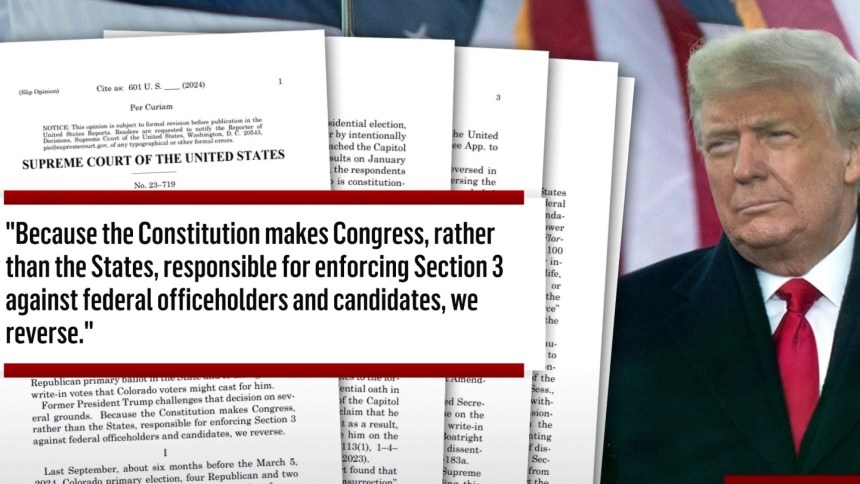
But we urge Americans and legal experts alike to look at the court’s decision closely. What the court did not do was overturn, or even substantively dispute, the determination that the Jan. 6, 2021, attack on the Capitol was an insurrection and that Donald Trump incited that insurrection. This is not an exoneration.
Let’s think about what that means. The 14th Amendment says that any officeholder who swore an oath to support the Constitution and then engaged in insurrection is disqualified from office. Every court, indeed every decision-making body, that has substantively considered whether January 6 was an insurrection and whether Donald Trump engaged in that insurrection has concluded that it was and he has. That includes the House January 6 Select Committee, the Colorado trial court, the Colorado Supreme Court, Maine’s Secretary of State and, most recently, an Illinois trial court judge.
The Supreme Court did not address this key issue, and we contend that this silence is important. It is hard at this point to escape the conclusion that Trump engaged in insurrection. Nor did the court find that presidents are exempt from the Section 3 provision or accept the argument advanced by Trump’s legal team that it should adopt a Trump-only exception for presidents who never held previous office.
Of course, exonerating Trump would have been more difficult than the tack the court took because it would have meant reviewing and questioning the extensive trial record in the case, but Trump’s legal team urged the court to do exactly that, and we think the court’s failure to accept that invitation is very telling.
Based on the evidence we both watched live on television, relived during the House’s Jan. 6 committee hearings and litigated during the Colorado trial, Trump is constitutionally disqualified from office. That is significant.
All the Supreme Court held was that the enforcement mechanism our clients pursued — going to state court to remove him from the ballot under state law — doesn’t work. Now the task is to find a different way to enforce this key constitutional provision.
Let’s be clear here. We are still facing an existential threat to the continued viability of democracy in the United States. Trump tried to keep himself in power after losing an election, he has since doubled down. He has defended insurrectionists, threatened the Constitution and declared his intention to move the country in authoritarian directions. And yet institution after institution has looked the other way and failed to act. The court on Monday joined an inauspicious list of institutions that have failed to meet the moment. The court on Monday joined an inauspicious list of institutions that have failed to meet the moment, declining to directly use the tool the Constitution provides to protect our republic. But the court did not clear Trump, and the door remains open for Americans to find other ways to effectuate this safeguard. The court clearly points to Congress as the body it believes should enforce this provision. So what can Congress do? It can pass enforcement legislation. But unfortunately, the current partisanship and obstructionism of Republican representatives especially makes such legislation unlikely. If Congress does not act, then it will be up to regular Americans. It is crucial for the American people to understand that Trump did incite insurrection, that every court and decision-maker that has looked at the issue has agreed, that the Supreme Court didn’t find differently, and that Trump is therefore not allowed under the Constitution to serve as president. That’s not good news for Trump. But now the hard work begins.
Noah Bookbinder
Noah Bookbinder is the executive director of Citizens for Responsibility and Ethics in Washington. He is a former federal corruption prosecutor.
Donald K. Sherman
Donald K. Sherman is executive director and chief counsel of Citizens for Responsibility and Ethics in Washington. Before joining CREW, he was an oversight and ethics lawyer in the House, the Senate and the Obama administration. He also was chief oversight counsel to the late Rep. Elijah E. Cummings on the House Oversight Committee. 

