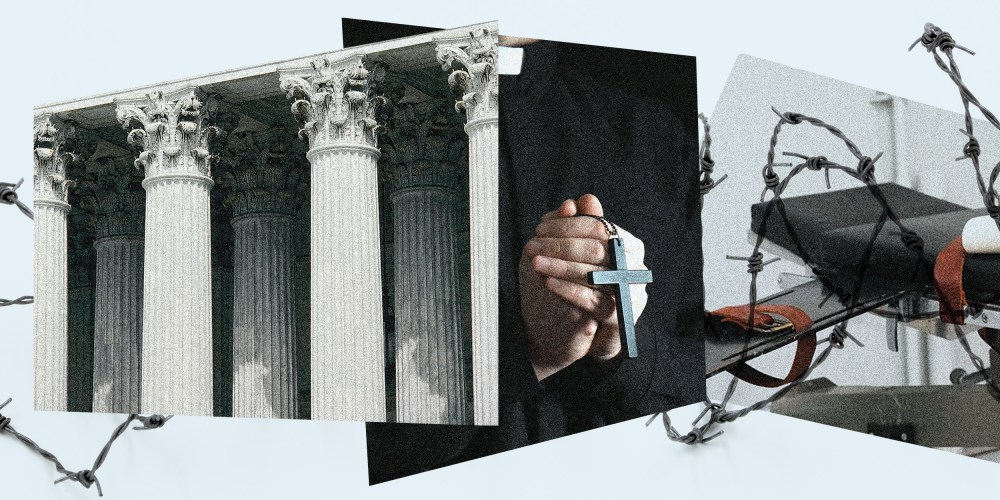
Last week, the Supreme Court signaled how protective it will continue to be of those who claim that their genuinely held religious beliefs require or prevent them or others from taking an action. And the answer is: very.
If the court will give credence to the beliefs of a death row inmate, it is easy to imagine how protective it would be of a law-abiding baker who doesn’t want to make a wedding cake for a same-sex couple.
The fact that eight of the nine members of this Supreme Court sided with a religious objector is not surprising, although the fact that the religious objector is a death row inmate who murdered a convenience store clerk might be. But this case could have implications well beyond death row. Look for the court to conclude that anti-discrimination laws and health and safety laws must give way in the face of religious objections.
Following this decision, discrimination laws may apply to everyone — except those who claim their religious beliefs prevent them from providing goods or services to members of the LGBTQ community, for example. And if the pandemic gets worse again and a state decides to prevent groups of 15 people or more from gathering indoors, a government decision could apply to everyone except those who claim that the decision tramples on their right to worship.
The death row inmate in question for this case, John Henry Ramirez, murdered Pablo Castro in 2004 by stabbing him 29 times. For that crime, he will be put to death in Texas. Ramirez’s argument was not about whether he will be put to death; it was about how he will die. Ramirez argued that under a federal law called the Religious Land Use and Institutionalized Persons Act he has the right to have his spiritual adviser not only in the death chamber, but to have that adviser put his hands on Ramirez and to audibly pray.

The court had yet to rule on the open legal question of whether prisoners have a right to anything more than having their spiritual advisers present in the execution chamber. Nine other states asked the court to side with Texas, saying in part that states must be allowed to determine their own protocols for executions without federal interference.
Under the act, Ramirez had to show that Texas’ prison policy put a substantial burden on his sincerely held religious beliefs. Next, the burden shifted to Texas to demonstrate that its policy, which prevents spiritual advisers from audibly praying and touching those being put to death, is the narrowest way to achieve a strong governmental interest, in this case of being able to securely conduct an execution without interference and effectively respond to any emergencies.
If there is one game that Chief Justice Roberts likes to play, it is the long game.
Chief Justice John Roberts, writing for the eight-person majority, agreed that Ramirez carried his burden and found that there were other ways that Texas could achieve its goals while providing Ramirez religious accommodations. Only Justice Clarence Thomas dissented from the court’s opinion. He thought Ramirez’s argument amounted to little more than a delay tactic.
Ramirez’s case followed a duo of seemingly inconsistent rulings by the court in 2019 regarding the rights of death row inmates to have access to their spiritual advisers in the death chamber. First, the court ruled that a Muslim death row inmate did not have the right to have his imam present in the execution chamber; Christian spiritual advisers were allowed in the chamber. But the following month, the court ruled that a Buddhist death row inmate had the right to a Buddhist spiritual adviser in the execution chamber.
One way to square these rulings is to conclude that the court is concerned about the rights of some religious objectors but not all religious objectors. Another is that the court was simply correcting an incorrect decision. In any case, most signs point to this being a court that will continue to be protective of the rights of religious objectors, even when those objectors are some of the most heinous actors in our society. It is easy to see how the court’s conclusion could stretch beyond the death penalty context. Here we have eight members of the court who believed that Ramirez demonstrated he had sincerely held religious beliefs that should likely lead to Texas providing him with an accommodation, despite some of the justices’ initial concerns about the consequences of ruling in favor of Ramirez. If the court will give credence to the beliefs of a death row inmate, it is easy to imagine how protective it would be of a law-abiding baker who doesn’t want to make a wedding cake for a same-sex couple. And a future case brought by a religious objector outside the death penalty context is likely to pick up support from Thomas. This means we can easily count five votes in favor of a religious objector If there is one game Roberts likes to play, it is the long game. Roberts is a conservative jurist, but he will often take pains to draw detailed blueprints throughout cases before actually arriving at a new legal conclusion. The Ramirez decision provides a key part of the blueprint for the court’s future decisions. The court was not wrong to conclude that Ramirez is likely to succeed on his claims that Texas was going to violate his religious rights under federal law. But the court might be if it stretches this solicitousness for religious rights into other areas. Religious freedom is a bedrock principle of our country. But merely asserting that one has sincerely held religious beliefs should not provide a get-out-of-legal-requirements-free card. Those rights must be weighed against, and sometimes give way to, other considerations, like freedom from discrimination and basic protection from health and safety threats.
Jessica Levinson is a Loyola Law School professor and MS NOW columnist.