








The racism from white science fiction and fantasy fans is getting tiresome.
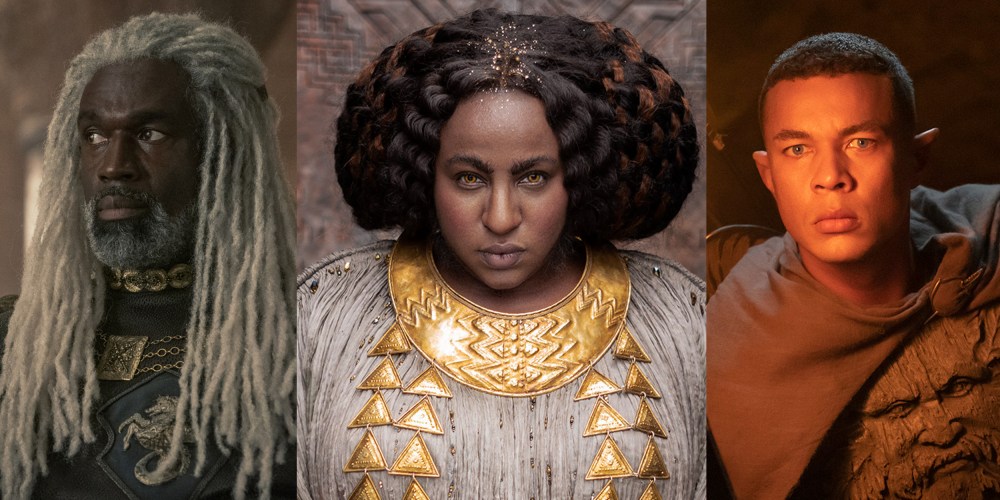
It’s almost a trope: A new interpretation, a reboot, a sequel or a prequel is planned and white fanboys spew outrage about a character who, in their minds, doesn’t look enough like white people. The most recent outrage over “The Lord of the Rings” prequel, “The Rings of Power,” has people asking what is at once the funniest question and the saddest one: Do Black elves exist?
A new interpretation, a reboot, a sequel or a prequel is planned and white fanboys spew outrage about a character who doesn’t look enough like white people.
Joining angry “The Lord of the Rings” fans are viewers equally upset that the “Game of Thrones prequel,” “The House of Dragon,” which, with its casting of Steve Toussaint as Lord Corlys Velaryon has disrupted their ideas of who ought to portray brave knights, elves, kings, queens and heroes. Black, brown and LGTBQ people appearing in heroic roles has ruined these imaginary fantasy worlds of magic and make-believe. Seeing Velaryon’s son Laenor Velaryon (played by Black actor Theo Nate) ride a dragon into battle this week must be really setting them off.
They’re flaming the shows online, whining about the creators’ original visions, and in so doing, reminding us that some of our fellow white Americans don’t think people who don’t look like them, or love who they love, belong — even in a pretend society. These are likely the same people who complained when Ta-Nehisi Coates was rumored to be writing a Black Superman. Never mind that Superman was never white. He’s a space alien from Krypton, people!
Whether it’s Stars Wars franchise actors Daisy Ridley and Asian American Kelly Marie Tran being attacked for not being Mark Hamill or Harrison Ford, or naysayers telling a Puerto Rican actor, “You can’t be an Elf. There are no Black Elves. There are no Latino Elves” in the “Lord of the Rings,” such trolls typically try to hide their hatred by arguing that such casting dishonors the source material. But rarely have these casual racists actually read the source material. They’ve simply internalized what they saw in on-screen adaptations made by white producers who turned to white casting directors to find white actors to appeal to a white audience.
Remember when they were all a-Twitter when “The Hunger Games” movie cast the beautiful Amandla Stenberg, who’s Black, as Rue? Or when “Star Wars” fans booed John Boyega being cast as Finn, a Black stormtrooper, in “Star Wars: The Force Awakens”? In “The Hunger Games” books, Rue is said to have “dark brown skin and eyes.” And before Finn takes off his helmet in “The Force Awakens,” we’d never been shown the face or race of any stormtrooper.
There doesn’t seem to have been as many complaints, at least not from the type of people complaining now, when white actors didn’t look like the source material. Think of Elizabeth Taylor’s infamous turn as Egypt’s Cleopatra. Check J.K. Rowling’s early descriptions of Hermione Granger, and see if it matches the beautiful Emma Watson, the actor who was cast to play her.
There don’t seem to have been as many complaints when white actors didn’t look like the source material.
There’s no reasoning with these racists. They’re even attacking the creators, the ones who know what they were envisioning when they wrote the material. Check out the criticism aimed at iconic writer Neil Gaiman for his decision to cast Kirby Howell-Baptiste, a Black actress, as Death in the television adaptation of “The Sandman.” The character was drawn as a white Goth-like woman in his comic book. In the new adaptation, another character, Desire, is nonbinary.
Gaiman, in his classic acerbic and no-nonsense style, told the racists, sexists and bigots what to do with their opinions.
“I spent 30 years successfully battling bad movies of Sandman,” he wrote before adding that he doesn’t care about “people who don’t understand/haven’t read Sandman whining about a nonbinary Desire or that Death isn’t white enough. Watch the show, make up your minds.”
As for “The Rings of Power,” executive producer J.D. Payne noted that author J.R.R. Tolkien simply described elves as being “creatures of dull and lumpish nature that had no more language than beasts” without reference to skin color. Executive producer Lindsey Weber stated that while they were “up for criticism,” they were “not up for racism.” Whoopi Goldberg said it the best on The View: “Are you telling me Black people can’t be fake people, too?” As a writer of a Finn novel, “Star Wars: The Force Awakens – Finn’s Story,” a couple of Black Panther novels for Marvel and a Superman comic book story, I’m acutely aware of how important these stories are to people. But I’m also always cognizant that these are fictional worlds, filled with fictional people who do fictional things. Anything can and does happen, and anyone can be the protagonist, not just the American stereotype of the blond, blue-eyed savior. Criticism of these casting choices illustrates the difficulty parts of white America have accepting that the rest of us are not only part of the world, but lead characters and not just subservient sidekicks. If you can imagine dragons and knights, swords and sorcery, demons and angels, hobbits and elves, space aliens and interdimensional travelers, then you should be able to imagine some of them as Black, Latino, female or nonbinary. Do Black elves exist? No. Do any elves exist at all? No. Then why should their skin color matter to you? If it does matter, then you have more to worry about than dragons and hobbits, my friend.
Jesse J. Holland
Jesse J. Holland, an award-winning author, professor and journalist, teaches journalism at the School of Media & Public Affairs at George Washington University and was a longtime congressional, Supreme Court and White House reporter with The Associated Press. He is the author of two African American history books about Washington, D.C., and has written for major entertainment franchises, including Lucasfilm’s "Star Wars," DC Comics’ "Superman" and Marvel’s "Black Panther." 


