








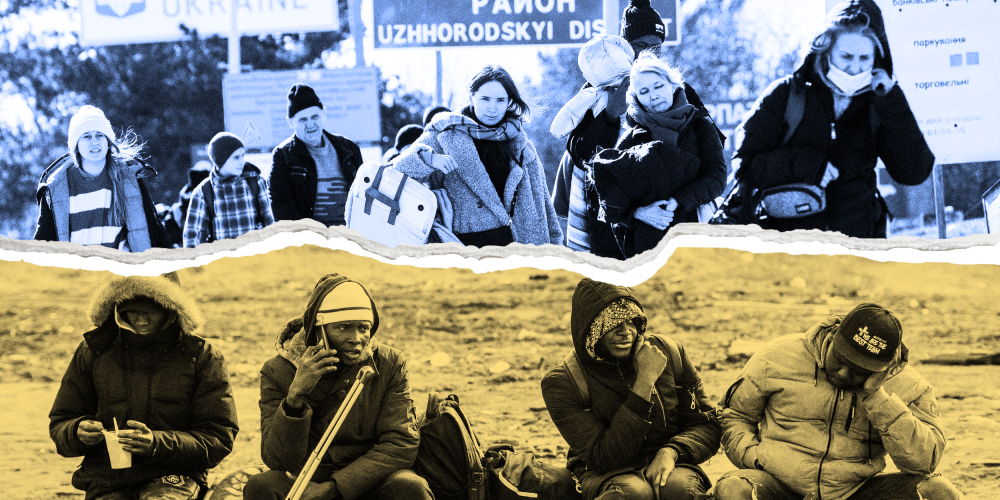
For more than a week now, the world has watched in horror as the Russian invasion of Ukraine unfolds. The viral videos of young men and older women grasping government-issued assault rifles crystalized an image of a Ukrainian people ready to play the spoiler of David to Russia’s mighty Goliath. Videos of women assembling Molotov cocktails to firebomb advancing Russian troops were praised as valiant expressions of heroism, resourcefulness and, most important, of a people determined to rightfully resist a foreign occupation.
“I’m ready to die for Ukraine.”
— CNN (@CNN) February 28, 2022
A 73-year-old Ukrainian man tells CNN’s @jimsciutto while waiting in line to enlist in the citizen’s army, known as the Territorial Defense Force. He is just one of many Ukrainians volunteering in the fight to defend their homeland against Russia. pic.twitter.com/bQ52JyGbzA
These plaudits of Western media and governments sprinkled on Ukrainians were never afforded to the Iraqis who rallied to fight off an American invasion of their country, or to Palestinians who for decades have been told using armed resistance against Israel’s occupation of their homeland and in the fight for their own freedom renders them terrorists. That’s in no way to say that Ukrainians currently under Russian attack do not deserve the resources, coverage or compassion that they are receiving around the world. But it does feel like a teachable moment for the media industry to consider how we portray conflict among different populations. It also makes the point that the word “refugee” in Western media often has a racial implication, just like “good neighborhood” and “bad neighborhood” have racial implications.
These plaudits of Western media and governments sprinkled on Ukrainians were never afforded to the Iraqis who rallied to fight off an American invasion of their country.
As a foreign correspondent, I covered the plight of refugees in Lebanon, Egypt and Turkey. I have seen firsthand the effects of war in Iraq and Libya and how those conflicts, in which the West was directly involved, created staggering refugee crises. And in these cases, the response from the West was feeble at best. The world briefly looked on with pity but not with the sense of duty, empathy and shock we saw in news reports as Russia began its invasion.
The U.S. and Europe have been reluctant to unconditionally welcome people fleeing those wars, yet Ukrainians fleeing the (don’t get me wrong, very real) dangers of Russian troops are being provided with accommodations to live, work and study in Europe while the war rages on.
This glaring double standard has received considerable backlash online with social media users calling out reporters and news organizations for their implicit bias.

Western media has tried to offer context in explaining Europe’s empathetic response to this war compared to the Western-led wars that ravaged capitals of Afghanistan, Iraq and Syria. As CBS foreign correspondent Charlie D’Agata reported in a now infamous clip, Ukraine is “relatively civilized.” It’s a place “where you wouldn’t expect that or hope that it’s going to happen.”
More bluntly, it’s not a “developing third-world nation” as ITV’s Lucy Watson said. The “unthinkable” happened in Kyiv, and it is shocking because this metropolitan city sits in the “heart of Europe.” Lest of course we forget … that very same Europe saw World War I, World War II, the Holocaust and ethnic cleansing of Bosnian Muslims. The West seems to think violence and war in Europe is antithetical to who Europeans are and that war belongs in “impoverished and remote populations.”
Ukraine’s crisis has made clear who creates the Western news landscape, and perhaps more important, who the news is made for.
In other words, white Europeans and Americans are not accustomed to war. It’s not who “we” are. “We” are civilized and peaceful. War happens in other countries, ones that are not white.
What makes this conflict so hard for the Western psyche to stomach is that, as Daniel Hannan from The Telegraph wrote, the white Ukrainians we see on TV are “just like us.” They “have Netflix” and “Instagram accounts.” They are not impoverished. They are middle class. As one French commentator noted, “We are talking about Europeans leaving in cars that look like ours to save their lives.”
All of these comments reveal an “us versus them” mentality in which those who look like us, behave like, dress and sound like us are worthy of sympathy and action. It reveals that those in the media who make these comments have an implicit bias. Reporters, anchors and commentators are used to seeing war in the Arab world, in Africa and Asia but act surprised and shocked when war or violence erupts in Europe. They frame the conversation around what is normalized violence. Ukraine’s crisis has made clear who creates the Western news landscape, and perhaps more important, who the news is made for. Al Jazeera English’s Peter Dobbie said, “What’s compelling is that just looking at them, the way they are dressed, these are prosperous, middle-class people, these are not obviously refugees trying to get away from areas in the Middle East that are still in a big state of war. … They look like any European family that you would live next door to.” The world was sympathetic when it saw images of Syrian refugees drowning at sea, washing up on European shores and settling in at awful camps and makeshift shantytowns. Yet they were beaten and arrested by border police, blamed for igniting a cultural war that threatened the fabric of a white Judeo-Christian Europe. And few of those reporting on the ground during that crisis seemed particularly surprised — disturbed, but not quite shocked at the turn of events. It is a stark contrast to the welcoming stations that have been set up along Ukraine’s border crossings where Ukrainians can enter the European Union visa-free. Private companies like Airbnb announced that 100,000 homes would be made available to accommodate Ukrainians fleeing the war. Why are Ukrainians escaping Russian bombs given such safe, secure passage and housing but Syrians escaping those same Russian bombs are not? Perhaps we should be encouraging Syrians and Afghans to open Netflix accounts? Buy fancier cars? Post more pictures on Instagram? The answer, of course, is simple. Maybe if Syrians were “just like us,” they would receive a more compassionate welcome in Europe and the West. How we see people in crisis begins with the journalists and pundits who deliver the news. Members of the media must stop looking down on other countries and people suffering war, whose conflicts they see as inevitable. We would do better to identify our own biases so we can be more tolerant and accepting of the suffering of others based on their experiences, not on the color of their skin.
Ayman Mohyeldin is a host of "‘The Weekend: Primetime" and an MS NOW political analyst. 


