








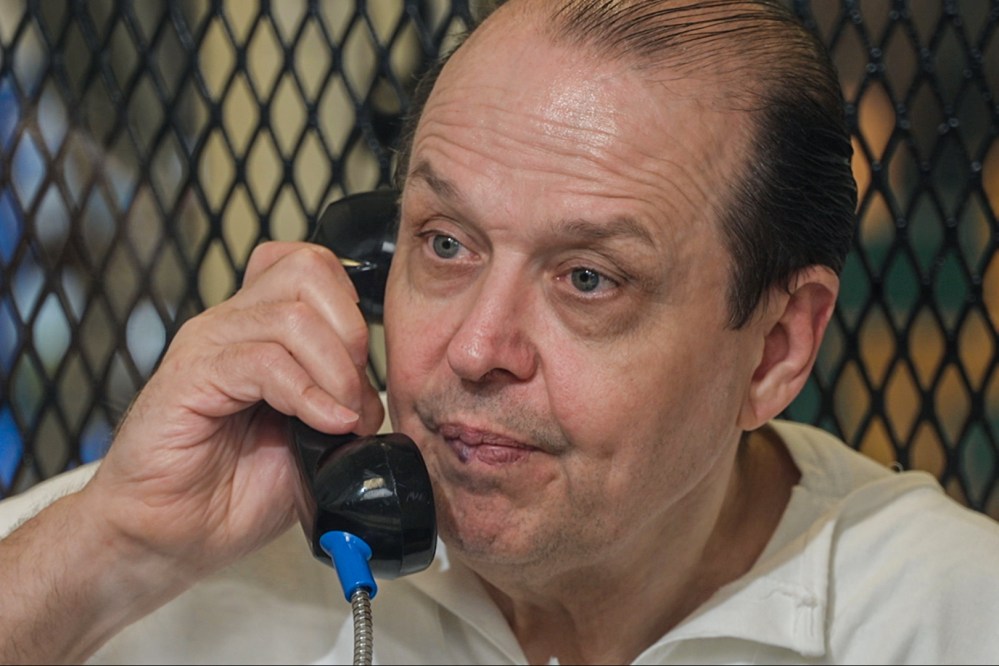
UPDATE (Oct. 17, 2024, 6:27 p.m. ET): A Travis County state district court judge on Thursday afternoon blocked Roberson’s scheduled execution, arguing that the state lacks the authority to put him to death before he’s able to comply with a legislative subpoena. The state’s attorney general’s office will appeal the ruling.
Barring an unlikely intervention from an appeals court or the governor, Texas will execute Robert Roberson on Thursday. Roberson was convicted in 2002 of killing his 2-year-old daughter in most part because of a diagnosis of shaken baby syndrome (SBS), which posits that only intensely vigorous shaking can produce three particular symptoms in young children — bleeding in the retina, brain disorder and bleeding in the brain. The diagnosis also suggests these injuries could have been inflicted only shortly before death.
It’s a convenient diagnosis for prosecutors, because it provides motive (the “vigorous” shaking implies anger at the child), cause of death (vigorous shaking), manner of death (homicide) and a suspect (the caretaker who was with the child while the child was still alive).
The problem is that numerous experts and studies have since found that these symptoms can occur in children who haven’t been shaken. They can occur after short falls, for example, or they can be produced by a number of medical conditions. Roberson’s attorneys argue that his daughter had such a medical condition — sepsis, brought on by a bout with pneumonia. The Texas Court of Criminal Appeals, which has rejected Roberson’s petitions, recently granted a petition filed by another prisoner also convicted under an SBS diagnosis, and, in fact, the same expert witness testified for the state in both cases.
The problem is that numerous experts and studies have since found that these symptoms can occur in children who haven’t been shaken.
The DNA technology revolution of the 1990s allowed us to start learning the “ground truth” in cases in which testable biological material was determinative of guilt. The results were sobering. In about 1 in 4 of the resulting wave of DNA exonerations, forensic evidence contributed to wrongful convictions. We learned that entire fields of forensics, like hair and fiber analysis, bite mark analysis and other “pattern matching” specialties, weren’t nearly as foolproof as practitioners had claimed. DNA has now cleared more than 200 people who had once been sentenced to death, and by one estimate, as many as 4% of death row prisoners may be innocent.
In Mississippi, for example, the bite mark charlatanism of Michael West and Stephen Hayne resulted in the wrongful conviction of Levon Brooks for the murder of a young girl. Brooks’ conviction allowed the killer to remain free to kill again, after which Hayne and West helped prosecutors win a second wrongful conviction, that of Kennedy Brewer, who was sentenced to death. DNA testing exonerated Brewer in 2000, but his prosecutor argued to the courts that West’s bite mark identification meant Brewer must have bitten the victim, even if someone else had raped her. Brewer remained in prison eight more years before the state found a match in a criminal database for both crimes. That man confessed, and Brewer and Brooks were released.

According to the National Database of Exonerations, at least 23 people convicted with bite mark evidence have been exonerated. At least 29 exonerees were convicted with disproven arson expertise, and at least 35 were cleared after being convicted with SBS evidence. Overall, more than 1,000 people convicted at least partly because of faulty forensic evidence have been exonerated.
DNA testing should have provided a wakeup call that our method of evaluating the reliability of expertise in criminal trials was irredeemably flawed. The wave of exonerations should have prompted not just a review of every forensic specialty that had contributed to a wrongful conviction, but also a review of the process by which the courts decide what expertise is scientifically sound enough for juries to consider.
Instead, relief came only to those prisoners in the very small subset of cases for which DNA testing could be determinative of guilt — and who were also fortunate enough to find pro bono attorneys or nonprofit groups like the Innocence Project to test DNA evidence. Most of the rest were out of luck.
If Robert Roberson had been convicted in New Jersey or Michigan, his conviction would most likely have been overturned by now.
That’s because, incredibly, even as DNA began to demonstrate just how badly flawed the system really is in the 1990s, state legislatures began passing laws making it much more difficult for prisoners to get courts to reopen their cases, and Congress passed a law making it nearly impossible for federal courts to review state convictions.
The result has been a patchwork of laws that treat the wrongly convicted very differently depending on the states in which they were convicted. If Robert Roberson had been convicted in New Jersey or Michigan, for example, his conviction would most likely have been overturned by now. Both states’ supreme courts have thrown out convictions based on SBS.
In other dubious areas of forensics, the courts have been even slower to respond. To date, every scientific study of bite mark analysis has found there is no scientific validity to the idea that marks in human skin can be matched to the teeth of one person. Yet to date, only a couple of appellate courts have granted prisoners’ requests to overturn convictions based on testimony from bite mark experts. Studies have also consistently shown that forensic firearms analysts — the people who match particular bullets to particular guns — have shockingly high error rates when given competency tests. Yet only a few courts have put restrictions on how those experts testify. Texas was supposed to be different. It has been 15 years since a groundbreaking investigation in The New Yorker brought widespread attention to the case of Cameron Todd Willingham, a man executed by Texas in 2004 who was most likely innocent. He was convicted based on discredited arson “science.” In response to the revelations in Willingham’s case, the state passed a “junk science writ” — a way for prisoners who have exhausted their appeals to get around restrictions that make it so difficult to reopen cases. But the writ has largely failed, mostly because the state’s appellate court judges haven’t been receptive to arguments about bad forensics. The alarm bells set off by DNA testing should have prompted massive, comprehensive reviews of tens of thousands of cases. Instead, it has been left to the comparatively small staffs of law school clinics, Innocence Projects and pro bono attorneys to correct these injustices. That Texas — one of the few states whose lawmakers took forensic junk science seriously — is nevertheless on the cusp of executing a man who is most likely innocent, based on a diagnosis that has been largely disproven, speaks volumes about our failure to heed the DNA call to action. When pressed as to why they’ve refused to order comprehensive investigations — whether into suspect forensic fields like firearms analysis or fiber analysis or after revelations about corrupt analysts in places like Mississippi and Virginia — state officials have cited the importance of maintaining the integrity of the system and likened such investigations to “opening Pandora’s Box.” It’s a revealing excuse. It isn’t something you say when you’re confident that the system is fair. It’s what you say when you’re worried about what a comprehensive investigation might reveal — when you’re more worried about the perception that the system has integrity than the actual integrity of the system. Whatever that is, it isn’t justice.
Radley Balko
Radley Balko is a writer and investigative journalist who publishes the newsletter The Watch. 


