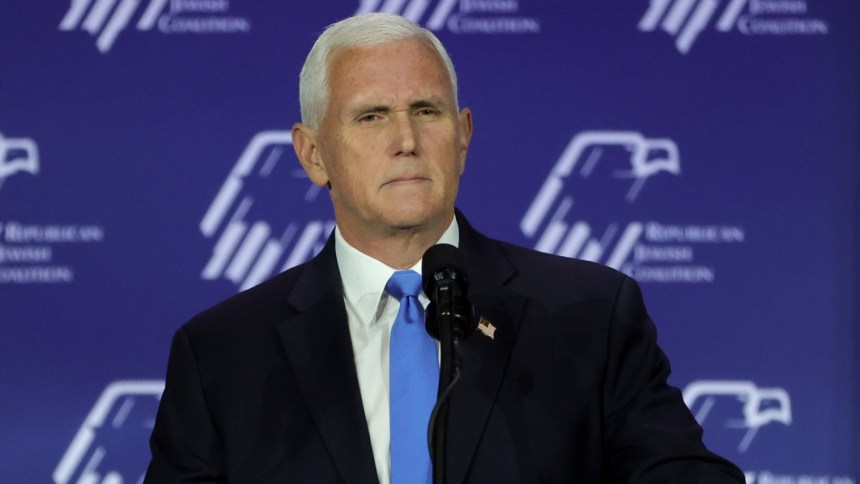
Mike Pence isn’t the first former vice president to fail to become president. He isn’t even the first to fail to win his party’s nomination, as he acknowledged when he suspended his campaign on Saturday, or to challenge his former boss in the process. The history books are rarely kind to such men. Posterity treats them as afterthoughts and also-rans, with little to define them outside the shadow of the presidents they served.
It feels fitting that this fate should befall Pence, even though he spent the last few years trying to reclaim his narrative. Unfortunately, in deciding to be Donald Trump’s running mate in 2016, he inextricably tied their futures together. Even the one standout moment for Pence, his refusal to play along with the plot to overturn the 2020 election, the thing he hinged his campaign on, was still a reaction. Pence cannot unwind his story from Trump’s — but he can help write the ending.
In signing on to Trump’s 2016 campaign, there was a clear transaction at work. Pence, then the governor of Indiana, would bring a gravitas and respectability to the chaos that had surrounded Trump’s run. His conservative bona fides were unquestionable, he sat at the nexus between old-school corporate-friendly Republicans and evangelical Christians, and he would offset the latter’s questions about the irreligious man at the top of the ticket. In exchange, Pence could duck out of his struggling re-election campaign and stake his claim as the heir to the party — a former vice-presidential candidate who had been tested on the trail and would be ready for the nomination in 2020.
In signing on to Trump’s 2016 campaign, there was a clear transaction at work.
Then, against all expectations, Pence found himself living in the Naval Observatory. Though he spent the following four years working plenty behind the scenes, publicly Pence did little to distinguish himself beyond fawning over Trump. For most of his term, Pence was purposefully kept in the background, and unlike most of his modern counterparts, he held no specific portfolio or area of expertise. He was made the point person of the White House coronavirus task force early in the pandemic, but held little authority as the crisis dragged on.
When Trump lost in 2020, Pence did little to help turn off the ensuing firehose of lies about mass election fraud. His 2022 memoir emphasized that he was all-in on the legal challenges to the voting and shared the “concerns” about supposed irregularities in the process. It was only when there was no other choice that he did the right thing, correctly telling Trump that he had no power to unilaterally throw the election on Jan. 6, 2021. The mob that ransacked the Capitol and called for his hanging that day thought otherwise.
When he launched his 2024 campaign, Pence clearly hoped that there was space in the party for someone who pushed classic red meat for Republican voters — lower taxes, religious freedom and an unwavering opposition to abortion — but would also be counted on to follow the rule of law. He told supporters at the launch of his campaign that Trump “demanded I choose between him and the Constitution. Now voters will be faced with the same choice. I chose the Constitution, and I always will.” But the base wants what it wants — and it wants Trump. But the base wants what it wants — and it wants Trump. Where the former president once needed Pence as a gateway to evangelicals, Trump is now their choice despite his many, many sins. Pence’s phase of the culture war, which he fought even as LGBTQ rights were on the rise, has given way to a new Trumpist version, louder and social media-driven in a way the soft-spoken Pence can’t match. And the base especially doesn’t want someone who they see as having betrayed Trump by refusing to “stop the steal.” “This is not my time,” Pence acknowledged on Saturday. But now he is effectively free for the first time in seven years. He no longer has to worry about what Trump does or says and how it affects his political ambitions. The choice he has now is what to do with that freedom. If he truly believes in the Constitution, in the rule of law, in all those things that Trump opposes, he will take this chance to speak out even more forcefully. He’ll agree to testify fully in the federal election interference case in which Trump faces four criminal charges. He’ll not just refuse to endorse Trump, as his now former rival has tauntingly suggested, but promise to spend whatever little political capital he has on helping keep Trump from returning to power. But then again, those are things that a leader would do. And if Mike Pence has proven anything during his political career, it’s that he makes a much better follower than a leader.
Hayes Brown is a writer and editor for MS NOW Daily.