








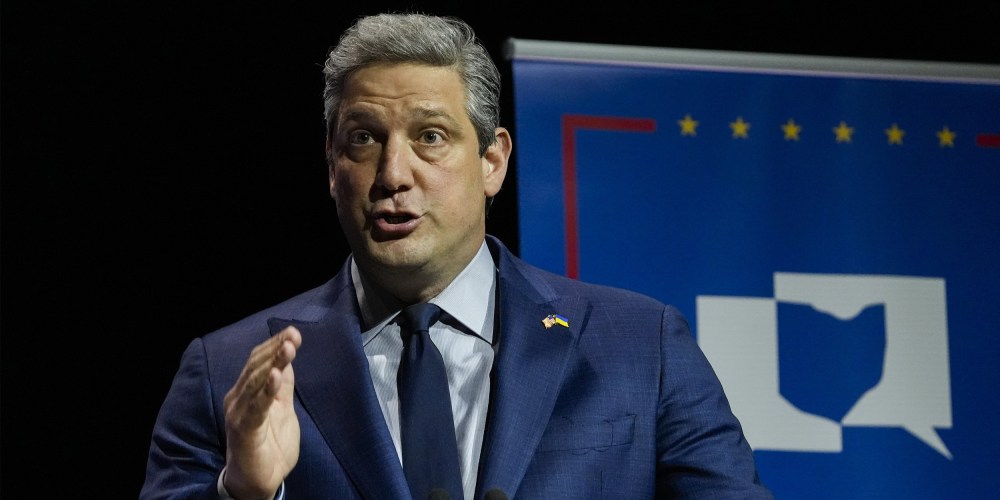
“Ohio needs an a– kicker. Not an a– kisser.” It was a heavy blow that Rep. Tim Ryan landed on J.D. Vance, his Republican opponent in the race for Ohio’s open Senate seat, in their debate Monday night. “Well-rehearsed line, Tim,” Vance retorted in the sort of lame reply one utters when a heavy blow is also an accurate one.
Here’s why Ryan’s barb was so well-aimed: While Vance once was a proud critic of former President Donald Trump, since he entered the Senate race he has scraped and bowed to Trump and the MAGA crowd. (Ryan’s line directly referred to Trump’s recent boast that “J.D. is kissing my a–.”) The contest remains close even as Ohio otherwise leaves behind its swing-state status. A big reason the race is close is Ryan himself. Born and raised in the state’s Mahoning Valley, he has spent his career campaigning in the old factory towns that national pundits and out-of-state consultants treat like quaint curiosities. He has used that experience to appeal to independents and even Republicans who won’t consider other Democrats.
While outside Republican groups have boosted J.D. Vance with $30 million, national Democratic groups have been miserly by comparison.
The result: Polls indicate the two are neck and neck, and Ryan has even managed to outraise Vance. But while outside Republican groups have boosted Vance with $30 million, national Democratic groups have been miserly by comparison. “If we lose this race by a few points and the Senate majority,” a Democratic strategist told NBC News’ Henry J. Gomez, “blame should squarely fall on the D.C. forces who unfairly wrote off Ohio.”
Not so long ago, either political party’s staying out of the Buckeye State, even in midterm elections, would have seemed unthinkable. Perhaps Democratic leaders fear that, as in several recent elections, polls are once again overestimating Democratic support. Or perhaps those leaders are still unhappy Ryan challenged Nancy Pelosi for House speaker six years ago. Whatever the reason, the sooner Democrats reverse course the better. That October is crunch time for campaign spending is even truer than many people suspect: TV advertising, for example, has a strong but short-lived effect. Even a big boost in just the final week could be the difference between Ryan’s winning and losing.

Yes, it’s true that more funding may not be enough for Ryan. You don’t have to visit a steel city diner to know that Ohio’s Republican lean has grown by the year. Barack Obama won by 4 percentage points in 2008 and 3 percentage points in 2012; Trump won by 8 percentage points in 2016 and 2020. And, as previously mentioned, public polls could be overestimating Ryan’s support.
But unlike some other longer Democratic shots — more on that in a moment — Ryan is worth the time and expense. A victory in Ohio would all but ensure a Democratic Senate for two more years. Republicans would have to run the table everywhere else to flip the chamber. A Democratic Senate wouldn’t just strengthen President Joe Biden’s hand in negotiations with a Republican House. It would also keep the gates open for Biden’s appointments to his administration and — most important — the federal bench. A victory in Ohio would all but ensure a Democratic Senate for two more years. Republicans would have to run the table everywhere else to flip the chamber. If Democratic leaders don’t want to do their part to help Ryan, Democratic donors can step up even more than they already have by rerouting contributions from less well-positioned candidates. Every campaign season seems to have one or two Democrats who pull in millions of dollars despite having no realistic chance of winning — think Jaime Harrison’s raising an eye-popping $109 million in 2020, only to lose by 10 points to Republican Sen. Lindsey Graham in South Carolina. The most obvious case this year is Beto O’Rourke, who’s raking in tens of millions — including large donations from celebrities like Sarah Jessica Parker — even as he has remained 7 to 9 points behind Texas Gov. Greg Abbott. Would-be donors may want to reconsider whether Ryan (or Senate candidate Cheri Beasley in North Carolina) might be a better recipient of their money. Monday’s debate was perhaps the first time this year that Ohio’s Senate race has really broken through on national airwaves. As Democrats make their final moves before Election Day, this race can’t be forgotten. With such high stakes, they have to take every shot.
James Downie is an opinion editor for MS NOW Daily. 

