








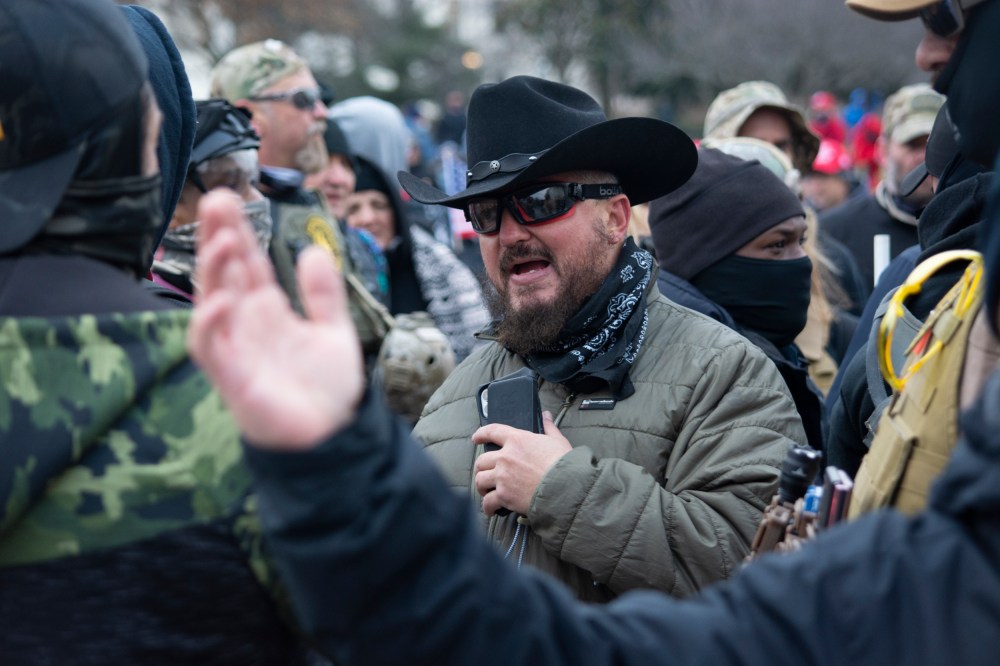
After nearly eight weeks of trial, a federal jury in Washington needed only three days of deliberations to decide that five members of the Oath Keepers organization attempted to stop the certification of Joe Biden’s 2020 election win by any means necessary, including violence.
The jury convicted the head of the Oath Keepers, Stewart Rhodes, and one of his top lieutenants, Kelly Meggs, of seditious conspiracy and convicted all five defendants of obstructing official proceedings and other offenses. The result was a victory for the health of the republic.
First of all, the guilty verdicts will likely affect other defendants who are facing their own seditious conspiracy trials. There is still another contingent of Oath Keepers scheduled to be tried in the near future. Additionally, several members of the Proud Boys organization are also pending trial, charged with seditious conspiracy and other offenses.
The guilty verdicts will likely affect other defendants who are facing their own seditious conspiracy trials.
Video footage introduced at this trial captured the Oath Keepers as they advanced on the Capitol, dressed as wannabe soldiers and moving in a military-style stack formation, each faux soldier with a hand on the shoulder of the person in front. The evidence at trial established that, once inside the Capitol, the stack split in half — with seven Oath Keepers heading one way toward the House chamber and the other seven heading toward the Senate chamber.
Given that this jury embraced the government’s contention that the conduct of at least some of the defendants constituted an attempt to violently stop the transfer of presidential power, it seems likely that defendants currently facing trial for similar offenses may seek to reopen plea negotiations with the prosecutors. Given that the two defendants’ convictions for seditious conspiracy carry a sentence of up to 20 years in prison, others facing those charges may want to cut their losses and try to limit their exposure. Some defendants may even agree to plead guilty with cooperation, meaning they would assist the government in seeking to hold others accountable as well — usually those further up the militia ladder.

The second takeaway from the verdict is that, even in this polarized age, our trial-by-jury system has not been derailed by politics. Criminal trials are supposed to be apolitical affairs. The job of a juror is to decide whether the evidence introduced at trial proves, beyond a reasonable doubt, the crimes charged in the indictment. Political ideology or affiliation should not enter the courtroom, the jury box or the deliberation room.
As I sat through the weekslong trial, I couldn’t help but notice that the prosecutors almost never uttered the name of Donald Trump. It was a wise tactical decision. Whether these defendants were guilty of the crimes with which they were charged had nothing to do with anything Trump did or did not do. Moreover, because there is no way to know all the political views or ideological preferences of 12 jurors, inserting political issues into a criminal trial always risks alienating one or more jurors — and it only takes one juror to hang a trial.
The defendants peddled themselves to the jurors as patriots, but the jury sent an unmistakable message: “You are not patriots. You’re traitors.”
Conversely, it was clear from the trial’s beginning that the defendants had not left their politics at the courthouse door. For example, when Rhodes testified in his own defense, he went all in on the lie that the 2020 presidential election was “unlawful and unconstitutional.” Rhodes, a disbarred lawyer, also told the jury, self-importantly, “I am a constitutional expert.”
It’s unclear who anointed Rhodes the arbiter of the constitutionality of American elections. But he tried to convince the jury that because (he maintained) the election was unconstitutional, his act of opposing the certification of Biden’s win arose from a love for the country. Indeed, all five defendants painted their Jan. 6 actions as patriotic, and offered the jury some version of the big lie — that the election was stolen — to justify why they decided they had to act in the run-up to and on Jan. 6, 2021. Because the defendants, not the prosecutors, injected politics into the trial, the jury’s verdict can be read as more than just an affirmation that the evidence proved the defendants’ guilt beyond a reasonable doubt. In a symbolic sense, the jury’s verdicts also repudiate the big lie. The defendants peddled themselves to the jurors as patriots, but the jury sent an unmistakable message: “You are not patriots. You’re traitors.” Will that message deter and perhaps even help disband groups such as the Oath Keepers and the Proud Boys, organizations which seem held together by hate and prejudice? Or will it simply lead those who cling to the “rigged election” narrative to double down, letting it fuel their sense of perceived wrongs perpetrated by the so-called deep state? It’s hard to know. But regardless, at a time when the country can feel hopelessly divided, 12 jurors came together to declare that insurrection was simply a bridge too far. And in doing so, they may have assisted prosecutors’ efforts to move from the “boots” of the insurrection — those who attacked the Capitol — to the “suits” — those who planned, organized, funded and incited the insurrection. All in all, the verdict was a promising sign for the future of the country.
Glenn Kirschner
Glenn Kirschner, a former assistant U.S. attorney for Washington, D.C., is an NBC News and MSNBC legal analyst. 


