








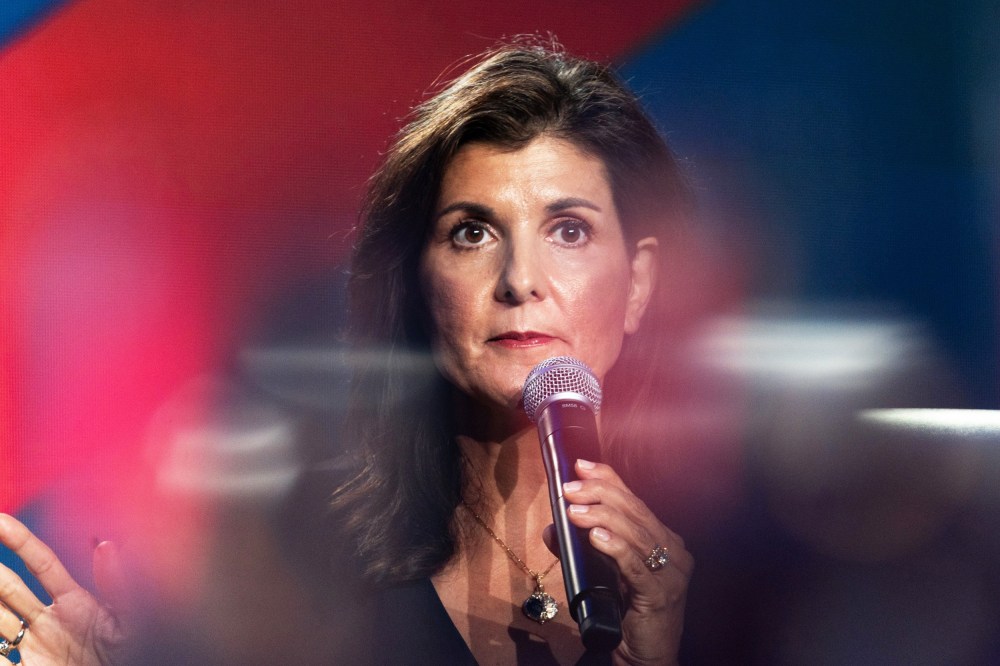
Former South Carolina Gov. Nikki Haley had a good night at the first Republican presidential debate Wednesday, outperforming expectations and even winning the night in the eyes of a significant chunk of Republican voters. The next day, though, it seems she was intent on obliterating any momentum she had achieved.
Speaking Thursday to Bloomberg News, Haley criticized most of her competitors for refusing to talk about cutting social services like Social Security in the name of fiscal responsibility. As an example of the kind of reform she favored, she suggested raising the retirement age for receiving Social Security benefits “to reflect life expectancy.” Then came the big swing and a miss: Asked to specify a new retirement age, Haley declined to get specific but said “65 is way too low.”
It was a strange position to take. The age to receive full retirement benefits through Social Security today is 67 for people born in 1960 or later; it was raised from 65 to 67 during the Reagan era. When Republicans talk about raising the age, they’re typically talking about raising it to 69 or older. But it seems that Haley’s claim that the current retirement age is “way too low” is an argument for it to be a lot higher than the status quo.
Fortunately for those of us who don’t thrill at the idea of working until we die, Haley’s suggestion is so politically unpopular that it has little chance to become policy. Maybe that’s why most of her competitors haven’t joined her in arguing for a higher retirement age. They know arguing for it doesn’t make sense.
Poll after poll shows that, across the political spectrum, the overwhelming majority of Americans don’t want the government to raise the retirement age. A Quinnipiac University survey released in March found that 77% of Republicans, 81% of Democrats and 75% of independents objected to raising the retirement age.
Privatizing Social Security — another way of reducing Social Security benefits— was a hobbyhorse for Republicans in the neoliberal era. But they couldn’t sell it. George W. Bush’s 2005 push to partially privatize Social Security was unpopular, and polling revealed that the more he lobbied for it, the more the public disapproved.
While Haley, a former ambassador to the United Nations, served in the Trump administration, she rose to power in South Carolina in the pre-Trump GOP and came up at a time when the party had a fiercer commitment to arguing for cutting social services to reduce debt. That worldview has lost a lot of traction among Republicans in recent years. According to Fox News polling, in 2013 40% of Americans believed reducing the national deficit was more important than continuing to fund programs like Social Security and Medicare at current levels. In 2023, that number had fallen to 26%. That outlook fell from unpopular to very unpopular. On its face, raising the retirement age to track with a rise in life expectancy might sound prudent. But the framing veils a policy that would be brutal and unnecessary: reducing the availability of a social service that helps keep millions of vulnerable Americans’ heads above water. Teresa Ghilarducci, an economics professor at the New School for Social Research, has calculated that a recent Republican proposal in the House to raise the retirement age to 70 would effectively act as a “benefit cut of about 13% to 15% for people forced out of work and into retirement way before age 70.” She points out that most older people already retire earlier than they want to because of layoffs, physical and mental challenges, or the need to take care of sick spouses. And as many retirement researchers point out, most Americans already take retirement benefits before they reach full retirement age, meaning they take reduced benefits because they need or want financial assistance sooner. Raising the retirement age would cut off a huge number of older Americans who are acutely vulnerable to poverty and desperate for a reprieve from punishing work. Instead of paring back Social Security to rob the recipients who need it most, we should fund Social Security for the future by lifting the payroll tax cap and making sure the taxation for the program is truly progressive. Haley might think calling for trimming Social Security and other social services is a way to distinguish herself in a crowded field of candidates. But it’s more likely to secure her notoriety than popularity. All signs indicate that most Americans want to be able to retire at a reasonable age and can see raising the retirement age for what it is: an attempt to strip them of a vital resource for living with dignity.
Zeeshan Aleem is a writer for MS NOW. Sign up for his newsletter. 

