








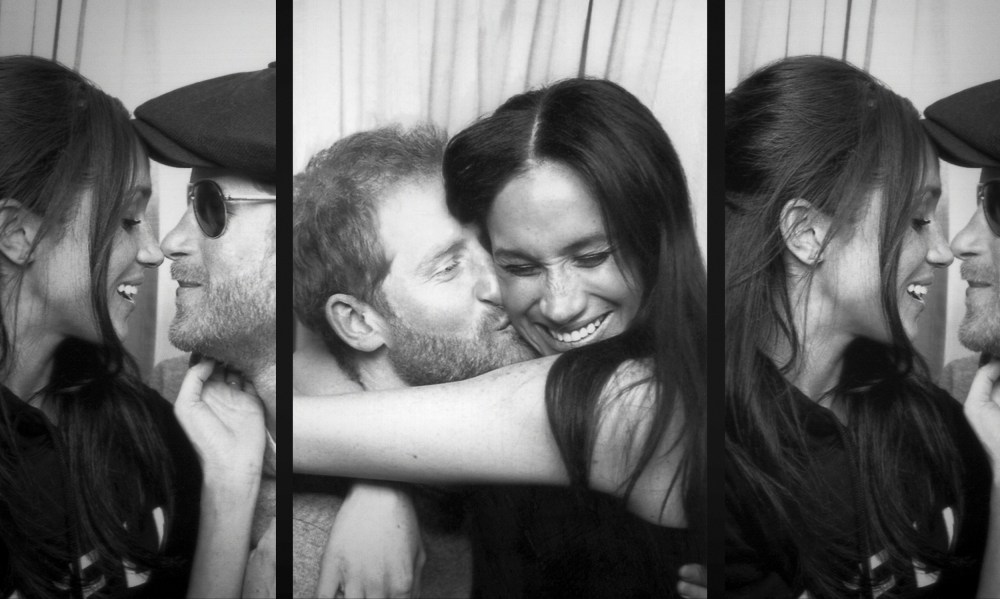
The last three episodes of the six-part eponymous documentary series “Harry & Meghan,” about the Sussexes and their departure from the monarchy, dropped on Thursday, capturing headlines for its unprecedented details about the inner workings of the royal family.
It is important for issues like breaking intergenerational cycles of trauma and abuse to enter the public consciousness, and that is perhaps the only value I can find in this otherwise insipid docuseries.
“It was terrifying to have my brother scream and shout at me and my father say things that just simply weren’t true, and my grandmother, you know, quietly sit there,” Prince Harry said of the closed-door but highly publicized meeting with his family at Sandringham House when the Sussexes made the decision to step back from the monarchy in 2020.
Of course, we don’t know exactly what transpired. This is but one truth of many, as I wrote about in my review of the first three episodes. And the series does unequivocally have a propagandist, revisionist feel to it in which Harry and Meghan are painted as saintly and the monarchy as unscrupulous.
But whatever one believes in terms of its veracity, this last batch of episodes raises some important questions about intergenerational trauma. And whether you believe the couple or not is almost beside the point if you look at it from this lens. It is important for issues like breaking intergenerational cycles of trauma and abuse to enter the public consciousness, and that is perhaps the only value I can find in this otherwise insipid docuseries.
The show operates this angle on all levels. It constantly draws links between Princess Diana — how the institution and her existence within it resulted in her abuse and abandonment — and Meghan, who, until the couple broke the cycle, endured a similar fate.

While we cannot verify many dimensions of Harry and Meghan’s narrative, we can, from having watched the family closely over the centuries, confidently apply the following adjectives to the institution: dysfunctional, repressive, hostile, ruthless, racist, monolithic, conservative. This, in turn, lends at least some credence to the narrative that the system is deeply toxic and is not kind to those who challenge it, even if some of the details here are distorted to favor the couple. (Look no further than the likes of Princess Diana, Princess Margaret or Edward VIII, who was compelled to abdicate the throne to marry the woman he loved.)
According to Harry, the offices of senior members of the royal family, including his brother and father, exploited their corrupt relationship with the press to plant stories (whether true or fabricated) about the couple and sometimes, specifically, Meghan. This, he contends, was fueled by jealousy over the couple’s higher approval ratings with the public and, relatedly, a desire to keep the Harry and Meghan in line and involved with the institution on the terms dictated by those who were in charge (i.e., supporting acts aren’t supposed to supercede the main acts, as Harry explains).
In the series, Harry alleges that King Charles’ office, at the behest of his father, kept leaking details to the media of the couple’s proposed terms under which they would step back from their royal duties. His father did so, in the couple’s estimation, in order to make it a point of public debate and therefore undermine the proposals, effectively keeping them hostage in the system. King Charles, who controlled the couple’s income and the institution, and more broadly, the couple’s access to resources, used these as tools for manipulation, according to the documentary.
There was the gaslighting, the icing out, the hostility, the verbal assault and countless other forms of emotional abuse documented by Harry.
“I saw my mother be abused for years; I knew the symptoms. I knew what it was like,” actor, writer and producer Tyler Perry (who is godfather to Harry and Meghan’s daughter, Lilibet) said. His sentiment parallels some of Harry’s recollections of his mother’s experience. “I could hear the fear. It was palpable,” Perry said of a conversation he had with Meghan around the time of the couple’s fraught breakaway. “I mean I could hear it. So I asked her, what was she afraid of? And she took a deep breath, and she started listing the things, ‘I’m afraid of …’ And I said to her, ‘Every one of your fears are valid. …’ She was afraid of them destroying her or going crazy or them making her think she was crazy.”
Then there was the gaslighting, the icing out, the hostility, the verbal assault and countless other forms of emotional abuse documented by Harry. This was a painful cycle endured by every other member of the family, to some degree or another, and so, according to the prince, the general attitude among its members was one of “Suck it up — I suffered, too.” It is rather apt that the royal mantra is purportedly “Never complain, never explain.”
In characteristic dramatic flair, Beyoncé is quoted in a text she sent to Meghan after the famed Oprah interview, saying she was “selected to break generational curses that needed to be healed.” One can’t help but roll one’s eyes at the theatrics of some of it. But the substance shouldn’t be discounted because of the form. These themes of intergenerational trauma and abuse — withholding as a punitive measure, verbal assaults, manipulation through purse strings, et cetera — are near-universal. And while they’re gaining increasing import and attention in therapeutic settings, there remains a considerable amount of shame and fear around challenging family status quos and airing grievances. While it may pain me somewhat, I reluctantly credit the documentary with bringing these issues to the fore and demonstrating that a cycle of abuse will only stop when someone says “enough.” World-renowned physician and author Gabor Maté, whose work focuses on trauma, explored this very theme on the Lewis Howes’ podcast, “The School of Greatness.” Mate paraphrased one of the ancient gospels when discussing how to heal from trauma: “What you shall bring out of you will save you, and what you don’t bring out of you will doom you.” Social worker Elizabeth Dixon wrote a paper for Psychology Today in which she discussed ending the cycle: “Trauma survivors can either repeat the cycle or generate a solution by creating a new narrative. This happens when family members speak up and work through any hurt, pain, or abuse from the past.” She added, “Open and honest communication can open up channels of healing and foster resilience amidst family adversity.” At least in the way Harry and Meghan portray their lives, given the absence of toxic individuals and institutions being willing to bend or amend their ways or to have open channels of communication, breaking away appeared to be, for them, the only option for the restoration of sanity. “I came here [to California] because I was changed,” Harry says in the final moments of the docuseries. “I changed to the point that I’d outgrown my environment.” Sure, we can debate the details of how and why that happened. But we should also collectively normalize and even encourage these kinds of decisions. Family doesn’t have to be defined as the people who raised you.
Noor Noman is a writer focused on culture, race and LGBTQ issues. 


