









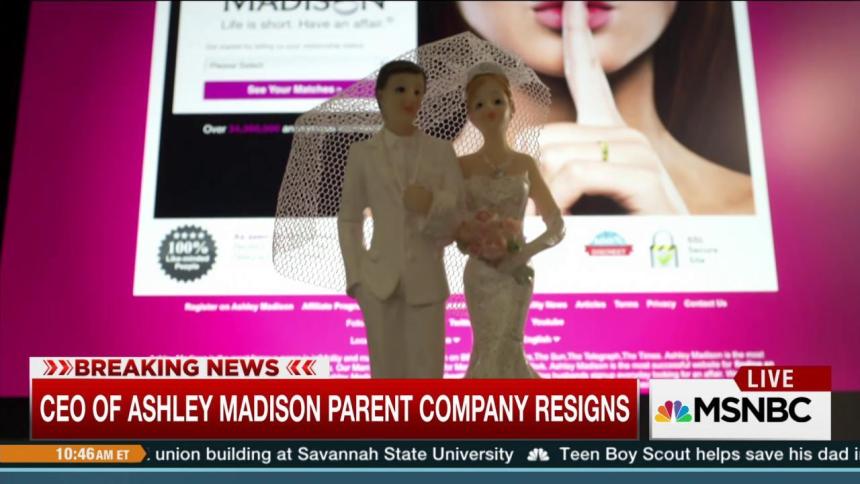
It was hard to feel bad for the victims of the Ashley Madison hack when the news dominated headlines in 2015. From its inception, the website — launched in 2002 with the express purpose of making it easier for married people to cheat on their partners — always seemed to push up against the boundaries of bad taste. With controversial billboards featuring unauthorized images of everyone from Hillary Clinton to Mitt Romney, the site never shied away from negative publicity or outright hate. For years, Avid Life Media, Ashley Madison’s parent company, was plagued by rumors of unscrupulous and exploitative business practices.
Mere affiliation with the site was enough to brand you with a bright scarlet A.
And when a group of hackers calling themselves the Impact Team compromised the site’s databases, they framed their work as a kind of vigilante justice: an assault both on the unprincipled Avid Life Media and the users themselves, whom the Impact Team dismissed as “cheating dirtbags and deserve no such discretion” — a characterization that was largely met with a shrug.
Nearly a decade later, as Netflix releases a documentary on the fallout from the hack, it seems worth revisiting the broad lack of empathy for Ashley Madison’s users. Not because there’s anything particularly commendable about their actions, or because they had a right to commit adultery in private. But because the sense of digital vigilantism that underscored the Impact Team’s hacktivism has become more common than ever, with little benefit for anyone.

The morning that the site’s 37 million users woke up to find that their personal information leaked online, their misery was mostly seen as a cautionary tale about expecting privacy on the internet. The Washington Post framed the story as a reminder that “no ‘secrets’ are safe online;” WIRED took the opportunity to do a deep dive on data security. The data breach was seen as fair game for journalists — like the Gawker writers who used it to out Josh Duggar as an Ashley Madison customer — as well as wronged spouses, blackmailers and online vigilantes, all of whom were able to easily access the database and search for the names of friends, family or total strangers. It did not matter that having an Ashley Madison account was not inherently the same as actively being a cheater, or that some of the people whose names appeared in the database had almost definitely signed up out of curiosity rather than an intent to cheat: Mere affiliation with the site was enough to brand you with a bright scarlet A.
Over the past nine years, the internet landscape has been dramatically reshaped. As major media companies have crumbled and social media sites have bloomed, the content we consume has become increasingly decentralized — and the sense that anyone can go viral, especially for something like infidelity, has become inescapable. On TikTok, a cottage industry has cropped up around “exposing cheaters;” men like Josh the Tabi thief can quickly go from TikTok viral to headline news largely on the basis of their loose attitude toward monogamy (although, to be fair, Josh also stole a woman’s shoes). One doesn’t even have to cheat to gain widespread infamy: consider the story of West Elm Caleb, a man who garnered media attention largely for being a careless casual dater in his mid-20s.
There is something chilling about the idea that our private missteps are inherently deserving of public attention. This isn’t to say that any of the people who’ve been exposed — whether by the Impact Team or TikTok’s dedicated cheater catchers — have behaved admirably, or that they deserve anyone’s respect. Cheating on a partner is, at a bare minimum, a gross violation of someone’s trust. But that someone is the person who has been cheated on, not the world at large. And there is something chilling about the idea that our private missteps are inherently deserving of public attention; that one’s decision to violate the norms of monogamous relationships automatically means one has voided their right to privacy. After all, the Ashley Madison hack didn’t just expose cheaters or help wronged people leave their spouses: at least two suicides were presumed to be connected to the hack. It’s hard to see death as a fair or just punishment for even the most vile forms of infidelity. Interestingly enough, there were already the seeds of a backlash forming in the midst of the Ashley Madison hack. That same week, a meltdown fomented at Gawker Media when several staffers objected to a post about a relatively unknown, and apparently closeted, media executive’s dalliances with a male sex worker, arguing that the subject was just a private individual whose sex life wasn’t in the public interest. In a missive explaining his decision to remove the post, Gawker founder Nick Denton wrote that “I was ashamed to have my name and Gawker’s associated with a story on the private life of a closeted gay man who some felt had done nothing to warrant the attention.” It is, perhaps, a sentiment more of us should take to heart. Hopefully, those who tune into Netflix this week in search of a salacious scandal will come away with something deeper: an appreciation for the fact that many of the victims of the Ashley Madison hack weren’t conniving sociopaths or cartoon monsters, but simply flawed human beings who made harmful choices that hurt the people around them — a label that could easily be applied to most of us.
Lux Alptraum
Lux Alptraum is a writer and producer who served as development producer for Fusion’s Peabody-nominated show "Sex.Right.Now.” Her first book, "Faking It: The Lies Women Tell About Sex — And the Truths They Reveal,” explores our cultural obsession with feminine deceit. She is the co-host of the “Say You’re Sorry” podcast. 

