








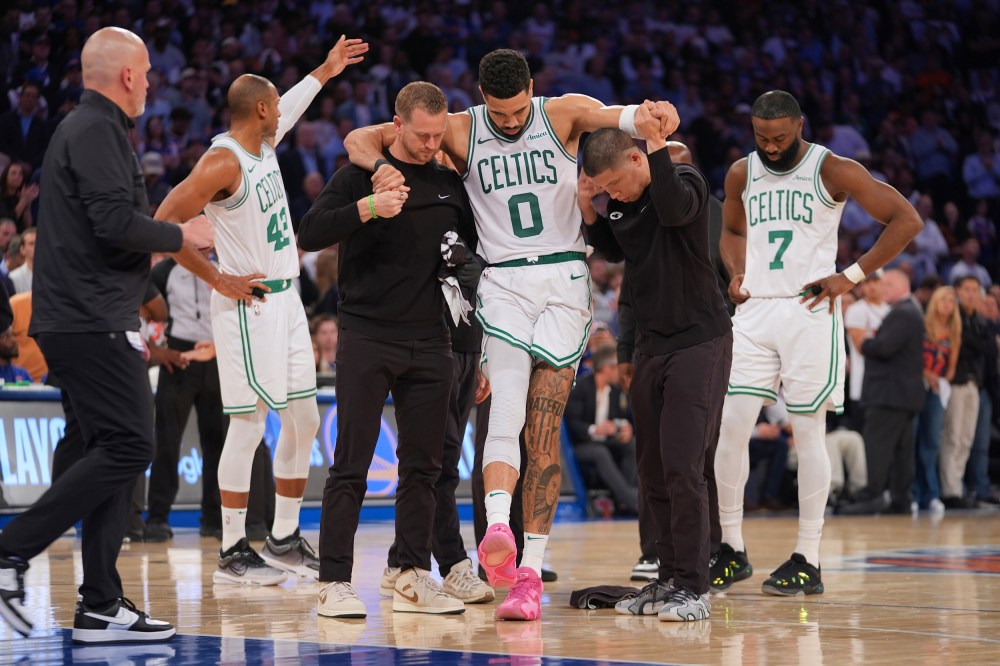
The incidence of significant and sometimes catastrophic injuries to star players has become one of the stories of this year’s NBA playoffs. The Boston Celtics, who play the New York Knicks at Madison Square Garden in Game 6 on Friday evening, lost power forward Jayson Tatum to an Achilles tear on Monday in Game 4. Damian Lillard, the Milwaukee Bucks’ starting point guard, ruptured his Achilles tendon in Game 4 of the Bucks’ first-round exit to the Indiana Pacers. Because such injuries are so serious and so slow to heal, both stars will likely be out for most of next year’s NBA season.
Warriors Coach Steve Kerr believes his team’s loss came down to one thing: Curry’s hamstring.
The Celtics clawed their way back into the Knicks series and avoided elimination on Wednesday without Tatum. The Golden State Warriors won the game that Stephon Curry exited with a hamstring injury last week, but Warriors Coach Steve Kerr said after his team had been eliminated, 4-1, by the Minnesota Timberwolves on Wednesday night that he believes his team’s loss came down to one thing: Curry’s hamstring.
Kerr told reporters that the Warriors, who’ve won four championships since 2015, could have won another if not for the grade 1 strain his point guard suffered in Game One of their series with the Minnesota Timberwolves. Maybe he’s right; Curry, the most prolific 3-point shooter in NBA history, is lethal in the postseason. There’s no doubt losing him seriously hurt the Warriors’ chances, even with stars like Jimmy Butler and Draymond Green still healthy.
The spate of season-ending injuries to megastar players is agonizing for them, but it’s also awful for business in the NBA. The league markets its playoff matchups not so much as games between teams but as duels between individual players. In the Celtics-Knicks series, for example, we were promised a battle between Tatum and Knicks star Jalen Brunson, and neither disappointed. Brunson has averaged 27 points in his five games against the Celtics, and Tatum, thanks in part to the 42 points he scored in the game when his Achilles tore, had averaged 25 points in that series.
With multiple beloved players sidelined during this year’s title chase, frustrated fans will likely look for a link between them all. My money’s on more than a few fans blaming load management — or the absence of it.
With multiple beloved players sidelined during this year’s title chase, frustrated fans will likely look for a link between them all.
Load management is the careful curation of the minutes a player spends on the court throughout the NBA’s grueling 82-game regular season in the belief that benching a player for certain regular season games can help keep him healthy when he’s really needed. It’s been a flashpoint among fans and media, primarily because fans hate being robbed of the opportunity to watch their favorite players, especially on visiting teams. Imagine being a Giannis Antetokounmpo fan in Denver, for example, who shells out a few hundred bucks on tickets to see the Bucks take on the Nuggets and then arrives at the arena to see a healthy Antetokounmpo sitting on the bench wearing street clothes.
Complaints had reached such a fever pitch that the NBA, before the 2023-2024 season began, implemented a new “Player Participation Policy.” Those rules limit healthy nights off to one per team for All-Stars (or those who’ve been All-NBA players in the prior three seasons), outright banned healthy nights off for those players during the league’s in-season tournament and nationally televised games and encourages teams to rest players for home games, not on road trips. Teams face fines of $100,000 to $1 million depending on the frequency of violations.
It was a pretty stiff smackdown, and a policy that fans who abhor healthy scratches applauded. The question is, especially at this moment, might it have come back to bite the league by putting some of its marquee names out of action at the worst possible time?
The answer is, “probably not.” In the first year of the new load management restrictions, the league released a study that, based on a decade’s worth of player injury data, said the evidence didn’t prove or disprove a correlation between load management and their likelihood of being injured. As far as the NBA can tell, if they are or aren’t load managed, Curry, Tatum, Lillard and every other player has the same chance of a bad injury. As if to prove the point, Tatum has said that for the fans’ sake, he dislikes load management. In his eight-year career, he’s never started fewer than 64 games, and he averages 34.5 minutes playing time per night. Despite that heavy load, Monday’s was his first season-ending injury. Those prone to fits of nostalgia should acknowledge that serious injuries have routinely dashed playoff hopes. Those prone to fits of nostalgia should acknowledge that serious injuries have routinely dashed playoff hopes. Magic Johnson’s ascendance for the Lakers began when Kareem Abdul-Jabbar, then the Lakers’ biggest star, sprained his ankle, leaving him unable to play in Game 6 of the 1980 NBA Finals. (The rookie Magic filled in with 42 points, 15 rebounds and 7 assists.) Lakers forward James Worthy fractured his leg in Game 6 of the 1983 Finals, a series that his team lost to the Philadelphia 76ers. In more recent years, injuries to Kevin Durant, Klay Thompson and Derrick Rose came during the heat of the playoffs. Lilliard and Tatum have long recoveries ahead of them, and their teams and fans are left with a bag of what-ifs and a lot of time to ask, “Why?” The only solid answer is likely the least satisfying one: Injuries in sports can be as random as they are brutal, and trying to find a systematic explanation for them is pointless.
Keith Reed
Keith Reed is an award-winning journalist and a past senior editor at ESPN. His work has appeared in The Boston Globe, The Root, Vibe, Essence and elsewhere. 

