








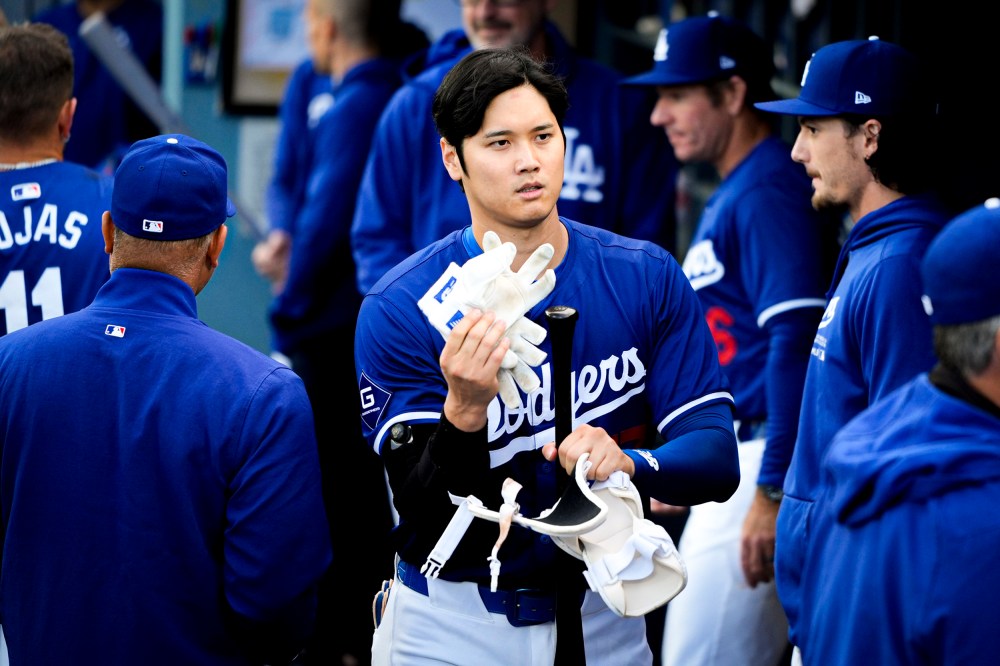
It is Opening Day 2024, and while Major League Baseball would rather fans focus on the annual hope that a new season brings, the gambling scandal involving the recently fired interpreter for Shohei Ohtani, the Japanese Los Angeles Dodgers superstar, won’t let us.
On Monday, Ohtani, arguably the sport’s greatest player, said Ippei Mizuhara, his former interpreter, had lied and stolen money from his account. The money reportedly went to a bookmaking operation, a source familiar with interactions between Ohtani and Mizuhara told NBC News. Ohtani’s statement — in which he said he did not bet on any sports, did not ask anyone to do it for him, and he said he “never went through a bookmaker to bet on sports” — was his first since the Los Angeles Times and ESPN published stories about the controversy last week.
While Major League Baseball would rather fans focus on the annual hope that a new season brings, the gambling scandal involving the recently fired interpreter for Shohei Ohtani won’t let us.
“Ippei has been stealing money from my account and has told lies,” Ohtani said in Japanese with the help of a different interpreter. His attorneys have used the phrase “massive theft” to describe what they say happened to him.
A person familiar with Ohtani and Mizuhara’s interactions told NBC News that the allegations against Mizuhara centered specifically on wire transfers from Ohtani’s account — totaling at least $4.5 million, made in at least nine payments of $500,000 — to a bookmaking operation in Southern California that is currently under federal investigation and that was allegedly run by Matthew Bowyer of Orange County, California.
That person familiar with their interactions told NBC News that initially Mizuhara told Ohtani’s representatives that he’d accrued a large gambling debt and had asked Ohtani to bail him out. Ohtani said Monday that there’d been no such conversation. He said, “Up until a couple days ago, I didn’t know that this was happening.”
According to multiple reports, Mizuhara, who’d initially claimed Ohtani gave him the money to pay off his debts, later admitted to Ohtani’s agent and representatives that he’d lied. This raises questions about whether Ohtani was ever aware of any gambling debts.
The IRS is conducting a criminal investigation of Mizuhara, and Major League Baseball is conducting its own internal probe. Mizuhara did not respond to a request for comment after Ohtani’s news conference Monday and has not answered past NBC News requests.
Ohtani said he never bet on baseball or any other sport. Baseball’s current gambling policy allows for players to bet legally on other sports, but there is also Rule 21, which specifically prohibits betting on baseball games and also gives the MLB commissioner the right to issue a penalty “in light of the facts and circumstances of the conduct” to anyone “who places bets with illegal book makers, or agents for illegal book makers.” Mizuhara has said he never bet on baseball.

Again, Ohtani said Monday that he hasn’t bet on any sports. He said he will fully cooperate with federal and MLB investigators. He has baseball to play and a World Series to win this season, his first of what he hopes will be many with the “superteam” Dodgers, one of the league’s most marketable and popular teams. The Dodgers signed Ohtani to a record $700 million contract during the offseason.
The investigations haven’t happened yet. So it’s too soon to say what Ohtani knew and didn’t know about the money that was allegedly taken out of his account and used to pay sports bookies. But it would be disastrous for baseball if Ohtani, the most transformational player we’ve seen since Babe Ruth, were found to be involved somehow. The future of MLB is outside the U.S., and Ohtani is an international marketing dream.
Yes, there will be skeptics. And for good reason. This is baseball. The sport’s tension with gambling is part of American sporting lore.
“Shohei Ohtani is not accused of doing anything wrong, and he just gave a press conference where he said he was the victim of a crime committed by a trusted former employee,” Los Angeles Times columnist Gustavo Arellano told me Tuesday via email. Arellano was one of the four Times staffers who broke the story of Mizuhara’s being fired. “Fans are accepting so far. What they won’t accept is Ohtani failing to perform on the baseball diamond after signing the richest contract in North American sports.”
Yes, there will be skeptics. And for good reason. This is baseball. The sport’s tension with gambling is part of American sporting lore. Baseball fans can recite the most egregious gambling examples, like the 1919 Black Sox throwing the World Series, Brooklyn Dodgers manager Leo Durocher’s being suspended in 1947 for associating with gamblers, Detroit Tigers pitcher Denny McLain’s 1970 suspension for allegedly being a partner in a bookmaking ring or the banning of Pete Rose for betting on baseball — Rose, the league’s all-time hits leader, who is trolling Ohtani now.

Then there’s the hypocrisy of it all. MLB, just like every other professional sports league in the U.S., is all in on gambling. In 2018, the Supreme Court allowed the states to legalize sports betting, but in California, where Ohtani resides, most sports betting remains illegal. By 2023, Americans had already wagered $220 billion in legal sports bets, and the industry was breaking revenue records yearly. The sports gambling culture is here, and it is never going back to the time that used to be: when gambling was rampant, perhaps, but when the sports leagues described it as a stain on America.
As Jemele Hill wrote this week for The Atlantic about Ohtani and sports betting, “Rose’s punishment, and the opprobrium he faced, once served as a deterrent for athletes tempted to wager on sports, but now even the stigma around gambling seems to have disappeared.”
The sports gambling culture is here, and it is never going back to the time that used to be: when gambling was rampant, perhaps, but when the sports leagues described it as a stain on America.
She’s right. That’s why Ohtani needs to use this moment to not just shrug off what he says happened to him and talk about how he felt betrayed by someone in his inner circle. Mizuhara told ESPN that Ohtani thinks gambling is “terrible.” Assuming that’s true, Ohtani needs to become an outspoken critic of the practice.
Already, the scandal is being used by two Democratic lawmakers as a way to amplify attention on gambling addiction, which has also grown as a tragic consequence of more legal sports betting. “This situation clearly demonstrates the impact and harm that gambling addiction can inflict,” Rep. Paul Tonko, D-N.Y., told NBC News. The SAFE Bet Act, introduced in Congress this month, aims to be “the first comprehensive legislation that would address the public health implications inherent in the widespread legalization of sports betting.” Imagine if Ohtani were to speak in favor of the proposed law. He could show that MLB’s deep dive into sports betting isn’t good for younger fans and that, in many cases, it is harmful. There is no greater global star in baseball than Ohtani. Speaking out against gambling addiction and pushing for critical legislation that could help reduce its dangers would prove that Ohtani does indeed think gambling is “terrible.” Yet he probably won’t, because, in the end, too much money is involved, and the staggering growth of the legal sports betting industry will just make sports like baseball more popular and more profitable. Gambling is already entrenched in sports. It’s too late to detangle what has already happened. We might all be crying foul (no Opening Day pun here), but if anything can be learned from what happened to Ohtani, there is no looking back. Scandals like these will just become the norm, and the integrity of the game will once again be put at risk. “That major sports leagues have let the fox inside the proverbial legal henhouse means they’re asking for scandals that will destroy their leagues and fan trust in them,” Arellano told me. Ohtani has a chance to do more in this moment. He should know that gambling never left baseball, and it most certainly won’t leave it now, until superstars like him speak out regularly. This is obviously not the way MLB would have chosen this season to start. It’s about the teams and players on the field, but now it’s about the plight of its greatest player. Sadly, the 2024 season begins not just with questions about individual teams’ chances of winning it all but also with harder questions about the legitimacy of the league.
Julio Ricardo Varela is the founder of The Latino Newsletter. 


