








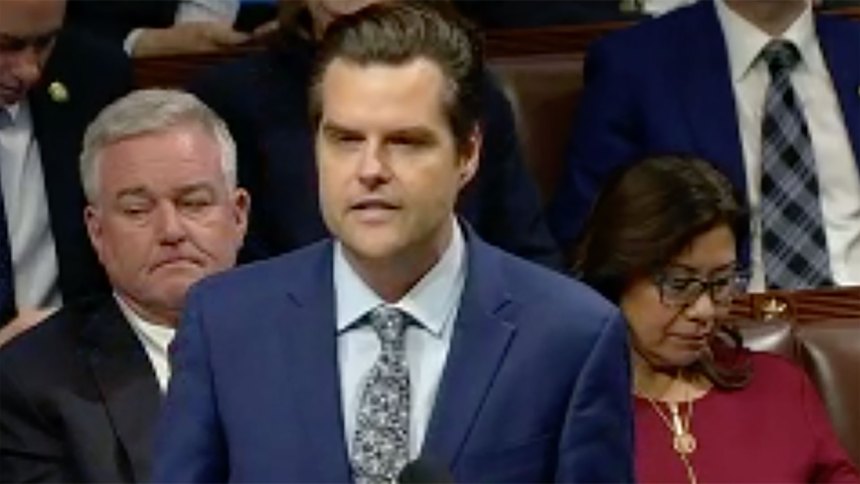
Rep. Matt Gaetz, R-Fla., promised to call as many votes as it took to overthrow Kevin McCarthy, R-Calif., from his perch as speaker. In the end, it only took one — 14 less than the marathon of votes that won McCarthy the speaker’s gavel in January. Gaetz has been a thorn in McCarthy’s side ever since, using the threat of a motion to vacate the chair to bully and batter the speaker for daring to consider any compromise with Democrats. Now, days after McCarthy averted a shutdown with mostly Democratic votes, he’s been removed from power.
But Gaetz and his allies on the far right have never been the most strategic, long-term thinkers. The question of “what happens next” is one that has two answers, one for the near term and another for the rest of this Congress. Neither of them may be the one that Gaetz was hoping to get.
After spending most of the last nine months trying to appease the far-right faction of his caucus, McCarthy had finally had enough earlier this month. He reportedly dared the rebels to “file the f—ing motion” during a closed-door meeting after they’d tanked a vote on a defense spending bill. Then, after last weekend’s vote to keep the government open, McCarthy told reporters, “If somebody wants to make a motion against me, bring it. There has to be an adult in the room.”
Gaetz and his allies on the far right have never been the most strategic, long-term thinkers
Well, Gaetz finally brought it, formally introducing his privileged resolution on Tuesday, fast-tracking it for a vote. Democrats had no reason to step in to save McCarthy, and the caucus voted as a bloc against tabling Gaetz’s resolution, which would have essentially killed it. And while Gaetz’s allies castigated McCarthy’s willingness to compromise, Democrats stayed silent throughout the debate as Republicans tore into one another, then remained united in the final vote.
Now that McCarthy is no longer speaker, though, there isn’t a total power vacuum in the House. Instead, with the speakership vacant, they have a speaker pro tempore, or “for a time.” Usually, it’s a position that’s taken up for a few hours at a time by another House member, as Rep. Steve Womack, R-Ark., did while moderating the debate over McCarthy’s potential ouster. For now, House Financial Services Committee chair Patrick McHenry, R-N.C., will take up that role until the House votes on a new speaker.

How does someone land that gig, you ask? Well, in the aftermath of the 2001 terrorist attacks, the House changed its rules to require that the speaker “shall deliver to the Clerk a list of Members in the order in which each shall act as Speaker pro tempore” during a vacancy. This secret list of speakers-in-waiting was meant to allow for continuity of government in case of an emergency that caused mass casualties in Congress. And as a trusted ally of McCarthy’s, it’s clear that McHenry was his top choice to be his successor if he was ever sidelined.
It’s unclear right now who even knew McHenry was on the list or who McCarthy may have listed further down the ranks. Nor is it clear how long McHenry is going to hold the position. The rules indicate it will be “until the election of a Speaker or a Speaker pro tempore,” and until that election happens, they “may exercise such authorities of the Office of Speaker as may be necessary and appropriate to that end.” McHenry put the House into a recess to allow members to talk about what the heck just happened ahead of kicking off the election process.
Now bear in mind, none of this has ever been put to the test. The last threat to vacate the chair was in 2015, when members of the House Freedom Caucus attempted to oust then-speaker John Boehner of Ohio. The last time a motion to vacate was actually voted on was in 1910, almost 100 years before the acting speaker pro tempore rule was written — and that one failed anyway.
A House paralyzed because it lacks a speaker isn’t functionally different than one paralyzed by GOP infighting. Looking to the longer term, it’s entirely uncertain how the next speaker election will go. Several potential names have been floated out there, including members of McCarthy’s leadership team: House Republican Conference chair Elise Stefanik of New York, Majority Whip Tom Emmer of Minnesota, and Majority Leader Steve Scalise of Louisiana. But part of the reason why the motion to vacate lingered as a threat for so long is that there’s no clear candidate who could unify the splintered GOP caucus. Tellingly, the conservative Republicans who engineered McCarthy’s removal haven’t come together to put forward a name they’d all support. That leaves open the idea that Democrats could still, ironically, see themselves becoming kingmakers as the House attempts to bring itself back into some semblance of order. Until Minority Leader Hakeem Jeffries, D-N.Y., made the call that the caucus would vote to remove McCarthy, there was talk about a potential power-sharing deal with Democrats that gave him some power. McCarthy made clear that wasn’t happening ahead of Tuesday’s vote, even if Democrats were to trust him to keep his word. The idea that moderate Republicans could offer up a potential speaker who would be open to some kind of coalition government with Democrats feels like something out of a particularly corny episode of “The West Wing.” But one big factor looming over the House may spark members to make a choice sooner rather than later. The government is due to run out of money (again) on Nov. 17, triggering the postponed shutdown that led to McCarthy’s removal. That might make Democrats feel especially ready to cut a deal — but how many Republicans would actually support such a deal without retribution (including kicking that candidate out of the GOP caucus entirely) is a major question. A House paralyzed because it lacks a speaker isn’t functionally different than one paralyzed by GOP infighting. When the Republicans who backed McCarthy warned about chaos if he were removed, they failed to understand that the chaos was already there. We don’t know whether McHenry will run to wield the speaker’s gavel, whether Gaetz will find any eventual speaker sufficiently pure enough, or whether Democrats will have to get involved. But one thing is very apparent: It’s going to be a very weird, messy, frustrating time for the House.
Hayes Brown is a writer and editor for MS NOW Daily. 

