








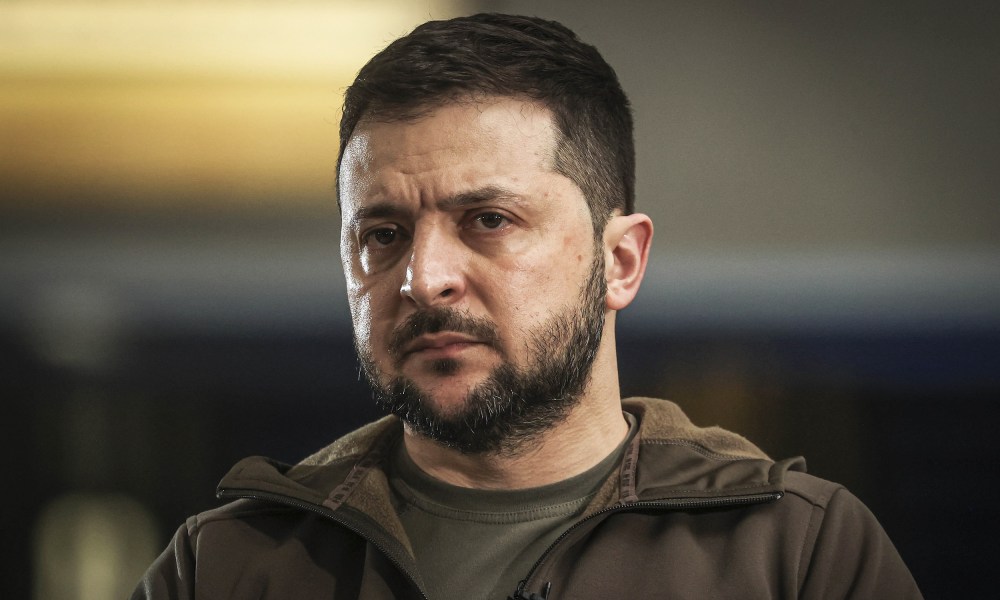
Shortly after drone strikes hit military sites deep in Russia for the first time, it was announced that Ukrainian President Volodymyr Zelenskyy had been chosen as Time Person of the Year. Along with “the spirit of Ukraine,” the magazine awarded Zelenskyy “for proving that courage can be as contagious as fear” and “for reminding the world of the fragility of democracy.”
Zelenskyy’s charisma and storytelling genius has allowed American leaders and civilians alike to participate in the existential survival of democracy.
This narrative — that Ukraine is bearing the cost of defending democracy for the rest of us — is essential to Ukraine’s mission of maintaining popular support. Zelenskyy’s charisma and storytelling genius has allowed American leaders and civilians alike to participate in the existential survival of democracy. Zelenskyy allows the United States to reap the benefits of battling Russia without ever putting a U.S. soldier in harm’s way.
So far, it’s been successful. The Zelenskyy spirit inspired a full-throated American and European defense after the Russian army invaded Ukraine in late February 2022. A joint session of Congress quickly followed, along with U.S. military support worth $68 billion (and counting). Early intelligence assessments and Russian propaganda had the world expecting the invading army would swiftly topple Zelenskyy’s government in Kyiv, leaving Russian President Vladimir Putin to install a puppet regime that would answer directly to him while maintaining the fiction of democracy. Since the 2014 invasion of Crimea resulted in minor sanctions and the world continued on its way, Putin had reason to believe the 2022 invasion would be equally easy.

Now the war enters its 10th month. Putin may have been a victim of his own spin, only this week admitting his war with Ukraine could be a “lengthy process.” The Russian army never had morale on its side, nor does it have the equipment and training to match the allied might of NATO and Ukrainians hell-bent on defending their homeland. A dozen Russian generals, forced to take the field, have lost their lives. For the first time in decades, Russian men were conscripted off the street under the guise of patriotism. Combined with sanctions that nearly shut down the Russian central bank and restrictions on Russia’s oil economy, the full cost of Putin’s imperial ambition hits home for everyday Russians.
But until something shifts in Putin’s psyche — until he decides he is done — all sides in this war will escalate their actions in order to gain the upper hand. After sending U.S. military trainers to Poland, shipping 1,400 anti-aircraft Stinger missiles to the front, and providing more than one million rounds of artillery, a bipartisan group of American legislators now wants to send more advanced drones to expand Ukrainian abilities. The drones would give Ukraine the “potential to drive the strategic course of the war” in its favor. Since Russia uses drones gifted by Iran against civilians, the Ukrainians want American drones capable of hitting warships in the Black Sea and flying 30 hours into Russian territory.
With Republicans poised to take over the House next month, support for Ukraine dropped by 30%.
But this unequivocal American support for Ukraine may change next month. Republican legislators are already circulating language to audit the Pentagon’s spending for Ukraine, which will slow down U.S. military support at a pivotal moment in the war. The top Republican on the House Foreign Affairs Committee, Rep. Michael McCaul of Texas, warned, “The era of writing blank checks is over.”
At the start of the war, 80% of Republicans supported Ukraine; with Republicans poised to take over the House next month, support for Ukraine dropped by 30%. This should not be a surprise; protecting democracy as we know it and preserving the post-World War II liberal world order were never high on the Trumpist agenda. The previous president escalated his own attacks on democracy just this week, calling for the suspension of the U.S. Constitution. The next Congress may no longer use taxpayer dollars in the defense of democracy, whether at home or abroad. The official committee investigation into the Jan. 6 insurrection will come to an end; any new committee discussion of that day could focus on casting rioters as victims of law enforcement overreach. House Republicans also plan to pivot to investigating “Hunter Biden’s laptop,” the same conspiracy Donald Trump used to try to coerce Zelenskyy into meddling in U.S. election politics. Three years ago, Zelenskyy found himself on a similar Time magazine cover, portrayed as “The Man in the Middle … Caught Between Putin and Trump.” Back then, his staff said, “Zelenskyy will never get mixed up in the internal politics of the United States of America.” This was before Russia deployed its largest force since the Cold War into his country, leveling cities and cutting Ukrainians off from the world. Zelenskyy has no choice but to continue his campaign of convincing Americans — and their politicians — that fighting Russia by proxy is worth the price. Zelenskyy is now stuck in the unenviable position of selling democracy to American leaders who no longer want it.
Nayyera Haq is a global affairs journalist. 

