








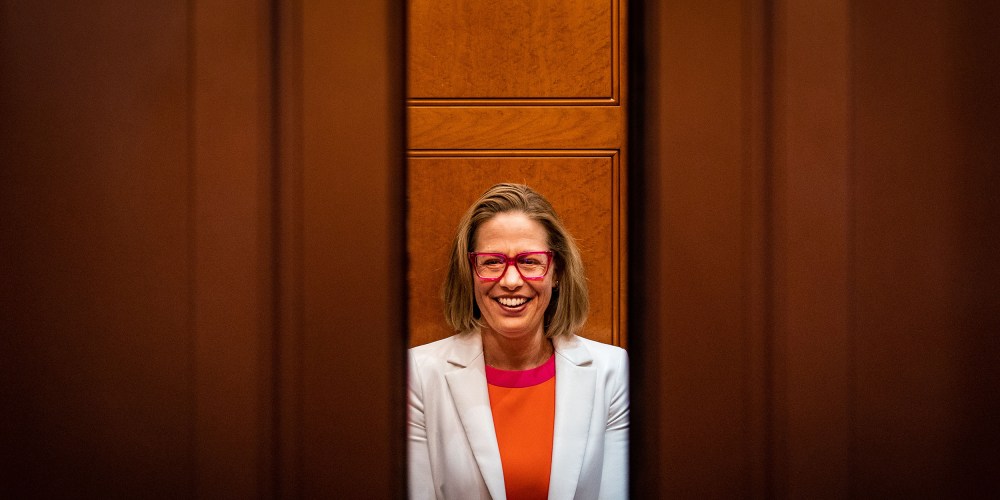
After years of bucking the Democratic Party establishment, Sen. Kyrsten Sinema of Arizona has announced that she is leaving the party and registering as an independent. She insists that “nothing will change about my values or my behavior.” Maybe so. But the reality is the move is likely to incentivize her to become more conservative and beholden to corporate interests.
Sinema’s move to official independence from the Democratic Party is a shocking-but-not-surprising development in American politics. During the Biden administration, Sinema’s often enigmatic objections to the president’s legislative agenda have played a key role in derailing or watering down progressive Democratic policy goals, which have required her sign-off in a 50-50 Senate. Now just days after Democrats had secured a slightly more comfortable 51-seat majority in the Senate with Sen. Raphael Warnock’s runoff victory in Georgia, it is both dismaying and entirely apropos that she’s chosen to bid farewell to the Democrats; she remains a thorn in the side of a party desperate for cooperation.
By exiting the party, Sinema can avoid being ousted from within the party.
Some left-leaning commentators have ascribed Sinema’s move to leave the party to yet another bid for attention, given her tendency to deliberately draw scrutiny to herself through her sartorial choices, dramatic rejection of Democratic legislation, and hard-to-pin-down ideological commitments. But there’s a more tangible explanation for why she’s chosen to make this move: her path to re-election if she runs again in 2024.
As my colleague Steve Benen noted, Sinema was aware that she was facing a serious potential challenge from her left in a Democratic primary. She was censured by her state party this year for refusing to change filibuster rules to pass voting rights legislation. And Democratic Rep. Ruben Gallego, who has been gaining buzz as a challenger who could topple her, has already been polling much higher than her in hypothetical match-ups. By exiting the party, Sinema can avoid being ousted from within the party. And if she does run for re-election, she’ll be putting the Democrats in a hard position: If they run a candidate against her, they know it’s likely that her candidacy would split the left-of-center vote and ensure that a Republican wins.

There’s a leave-me-alone-and-nobody-gets-hurt vibe emerging. In her writing and interviews about her decision, Sinema seems to be signaling that she plans on acting the same way as before — an unpredictable, corporate-friendly Democrat who can help the party advance most of its goals, even if more incrementally than they’d like, with her unique stamp of approval. Theoretically, if she does run for re-election in 2024 with the hope that Democrats stand down, she’s making a case for how everything could stay the same as it is now without her having to leave the Senate.
But in reality Sinema’s decision to go independent raises questions about whether she’ll actually remain the same. Without the messaging and fundraising apparatuses of the Democratic Party, Sinema will have to lean more on independent outside funding, and it seems all too likely that funding will come from deep-pocketed corporate donors. In recent years, Sinema’s objections to policies like higher corporate tax rates and her defense of Big Pharma profits resulted in her getting showered with money from the corporate beneficiaries of her conservative arguments. Last year, despite being a Democrat, she was the third-biggest recipient of money from financial services and pharmaceutical sectors in the Senate. If Sinema wants to run again and scare off a potential Democratic candidate, she may find it financially rewarding to lean harder into her corporate-friendly sensibilities as a lawmaker to make sure she has a fearsome war chest. The best way to ensure that is by becoming even more conservative in her positioning and policy views. Sinema may also feel compelled to lean further to the right if she views Republicans as a part of her possible re-election coalition as an independent. The more noise she makes in the next two years as a candidate who sides with Republicans on high-profile legislation, the more likely she could be to attract moderate Republican voters in 2024, at least in theory. I doubt whether Sinema knows exactly how she’s going approach the next two years. She’s made a savvy strategic move for neutralizing a threat from her left, but the way forward is still unclear. Yet however it plays out, there will be all kinds of reasons for her to start to lean further to the right. And that in turn could make life harder for the Democrats as they operate with a razor thin majority in the Senate.
Zeeshan Aleem is a writer for MS NOW. Sign up for his newsletter. 

