








As the old expression goes, “It was the best of times, it was the worst of times,” but for Joe Biden this year, there was a heck of a lot more of the former than the latter. In modern political history, few presidents have had a better second year than Biden did in 2022.
When the year began, few would have imagined that these words would be written in December. Biden’s approval ratings were at 43% — a seven-point drop from August 2021. Increasing inflation suggested that Democrats would be heading into the crucial midterm elections with a faltering economy and rising prices (particularly at the gas pumps).
The president’s signature legislation, the Build Back Better agenda, was going nowhere in Congress, blocked not just by Republicans, but rather by a recalcitrant Democratic senator from West Virginia. Meanwhile, Democratic plans to scrap the filibuster on voting rights reform was stalling out in the Senate with an assist from the aforementioned Joe Manchin and Arizona’s Kyrsten Sinema. Finally, House Democrats — many in safe districts — were sprinting to the exits and announcing their intention not to seek re-election. Quite simply, 2022 was shaping up to be a dumpster fire for Democrats.
In modern political history, few presidents have had a better second year than Biden did in 2022.
Yet, as we near New Year’s Eve, Biden is in an envious position for a first-term president. Sure, his approval ratings remain mediocre — amazingly, they are practically at the same point they stood one year ago — but Democrats just came through the midterms with one additional seat in the Senate, well below expected losses in the House, and crucial gains at the state level. Moreover, rather than languishing in the Senate, much of Biden’s legislative agenda became law — including a massive spending package that will lower prescription drug prices, strengthen former President Barack Obama’s health care law, and pump close to $370 billion into the fight against climate change.
Perhaps most important for Biden’s hopes of re-election, he has largely consolidated Democratic support behind him. There is little prospect of a looming primary challenge to him, as Democrats — both liberals and moderates — appear to be fairly content to go into 2024 with the president leading the charge. Traditionally, incumbents who have strong support within their own party and don’t face a primary challenge are a strong bet for re-election (Donald Trump in 2020 is the exception).
So what turned Biden’s fortunes upward? It was a combination of luck, Republican extremism and an incumbent president who is better at politics than many political observers are inclined to acknowledge.

Often in politics (and life), it’s better to be lucky than good, and 2022 is an object lesson in that phenomenon. When the Supreme Court decided in June to scrap 50 years of legal precedent and overturn the constitutional protection for abortion rights, it was a disaster for American women — but politically, it threw the Democratic Party a lifeline. The issue boosted Democratic prospects in a handful of crucial states, particularly Michigan and Pennsylvania. More broadly, it was a reliable cause to rally Democratic activists, and for Biden, it undoubtedly will be a crucial element of his re-election campaign.
An even bigger break for Democrats came from their opponents. Republicans picked one Trump-loving, MAGA-embracing, election-denying extremist/political neophyte after another — from Kari Lake, Doug Mastriano and Blake Masters to Mehmet Oz, Don Bolduc and Herschel Walker — with predictable results. Nor is this problem going away for the Republicans, as demonstrated by Kevin McCarthy’s so-far ineffectual efforts to persuade the most extreme House Republicans to back his bid for speaker. Indeed, as House Republicans likely pursue investigations of Biden’s son Hunter, hold the debt limit hostage to demanding cuts to popular social insurance programs, such as Social Security or Medicare, or open impeachment proceedings of White House officials (including possibly Biden himself), the president can spend the next two years providing a stark, adult contrast.
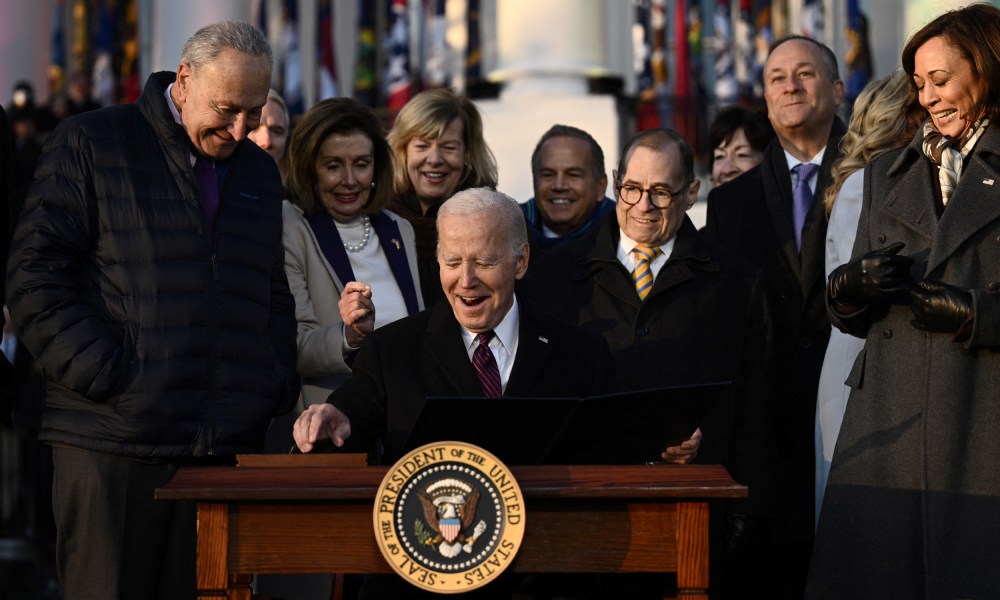
Biden has threaded the needle of appeasing, even thrilling his liberal supporters while at the same time playing to the persuadable middle of the American electorate. It’s the latter that is likely Biden’s strongest political asset. Outside the conservative fever swamp, Biden is not a polarizing figure. Over the past two years, he has followed through repeatedly on his pledge to work across the aisle with Republicans. First, there was last year’s infrastructure bill. This year brought even more bipartisan achievements on gun control, same-sex marriage, veterans health care, investments in the U.S. semiconductor industry and military aid to Ukraine. Yet, at the same time, Biden has kept his liberal base content. The decision this August to forgive tens of thousands of dollars in student debt was a priority of the party’s liberal wing. He has also aggressively moved to stock federal courts with judges, including the historic appointment of the Supreme Court’s first Black female justice (another 2020 campaign promise). And earlier this fall, he issued a blanket pardon for thousands of people prosecuted for possessing marijuana. In short, Biden has threaded the needle of appeasing, even thrilling his liberal supporters while at the same time playing to the persuadable middle of the American electorate. Republicans will continue to attack him as an extremist beholden to his liberal supporters, but there’s good reason to think that political strategy won’t work. Quite simply, it doesn’t mesh with Biden’s first two years in office, and Republicans, in general, are going to have a hard time making the case that another party is more extreme than them. Heading into 2024, that might be the best thing going for Biden. For all the anger directed at Trump by Republican leaders, the former president remains the favorite to emerge from a crowded Republican field. But it’s very hard to imagine a scenario in which Trump, as the GOP nominee, can overcome his deep and abiding unpopularity with non-MAGA Americans in a general election. His main rival, Ron DeSantis, is spending his time trying to win over the GOP’s increasingly prominent anti-vaccine wing — and lest we forget, the Florida governor’s midterm endorsements didn’t fare much better than Trump’s. One has to squint very hard to look at the 2022 midterms and the electorate’s rejection of election denialism, anti-trans and anti-LGBTQ attacks, and anti-woke messaging and conclude that the country is clamoring for a DeSantis presidency. Of course, a lot can happen in the next two years. But one thing is clear, Biden’s deft 2022 — and the glaring shortcomings of his political rivals — put him squarely in the catbird seat to win in 2024.
Michael Cohen is an MSNBC columnist. He is also the publisher of the newsletter Truth and Consequences and hosts the weekly podcast That ‘70s Movie Podcast. 


