








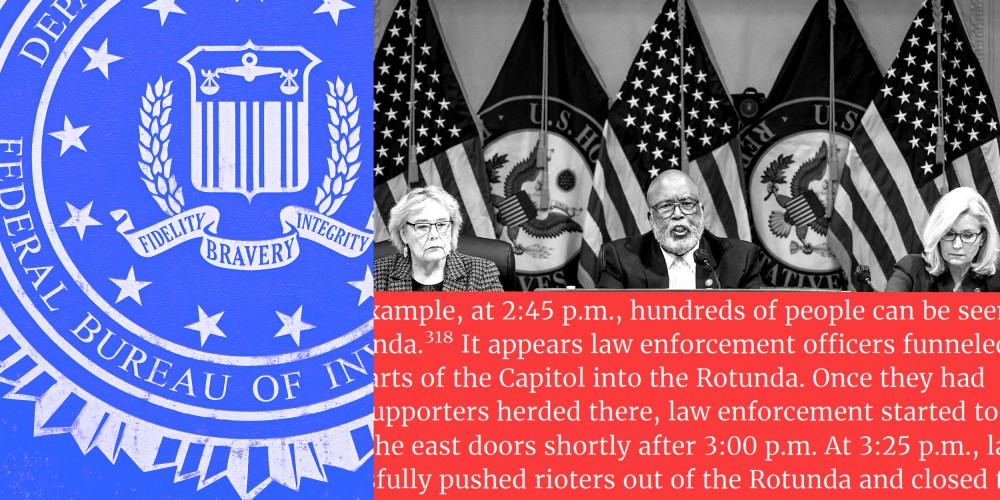
If you haven’t yet read the final report of the House Select Committee to Investigate the January 6th Attack on the United States Capitol, let me issue this spoiler alert: It was all Trump’s fault. In more than 800 pages of painstakingly assembled evidence, the committee convincingly makes the case that former President Donald J. Trump was the catalyst behind the violence at the Capitol and the attempts to overturn a valid 2020 presidential election. The committee’s investigation is compelling, and its findings are damning. Yet, what the committee chose not to fully investigate, and not to find, leaves a gaping hole in its otherwise impressive work.
The committee’s report failed to fully address the law enforcement and intelligence-related failures that could have prevented or mitigated the Jan. 6, 2021, violence at our nation’s Capitol.
The committee’s report failed to fully address the law enforcement and intelligence-related failures that could have prevented or mitigated the Jan. 6, 2021, violence at our nation’s Capitol. That missing piece makes it more likely than not that the domestic terrorism we saw that day could happen again. By deciding to make “Trump did it” its mantra, the committee let that message, albeit a legitimate one, get in the way of its larger mission.
The House resolution that established the Jan. 6 committee stated that the committee’s purpose would include investigating “facts and causes relating to the preparedness and response of the United States Capitol Police and other Federal, State, and local law enforcement agencies in the National Capital Region and other instrumentalities of government, as well as the influencing factors that fomented such an attack on American representative democracy while engaged in a constitutional process.”
The committee was also given the task to “examine and evaluate evidence developed by relevant Federal, State, and Local governmental agencies regarding the facts and circumstances surrounding the domestic terrorist attack on the Capitol and targeted violence and domestic terrorism relevant to such terrorist attack.” And the committee was ordered to “issue a final report” containing “findings, conclusions, and recommendations for corrective measures.”
Those “causes” and “corrective measures” analyses are desperately needed regarding the law enforcement and intel agencies, but they are sorely lacking in the report. That doesn’t mean the committee didn’t gather the evidence needed to address these issues. Apparently, the committee members chose not to show us their work. NBC News reported in November that the committee had decided not to focus on law enforcement failures but rather, to make Trump its main theme. Indeed, the committee relegated its law enforcement component to an appendix that starts on page 693 of the report and runs for only 18 pages of narrative. The Cheesecake Factory’s menu has more pages than that.
What the American public deserved was a deep dive into how laws, policies and guidelines may have precluded fulsome intelligence collection and response across federal agencies and, after that, recommendations on how to fix the things that are broken. What we got from the Jan. 6 committee was clear evidence that those agencies possessed intel that screamed about coming violence on Jan. 6 and evidence that the intelligence was passed around but that no one seemed to know what to do with it. Worse yet, the committee found that no one was in charge or even wanted to be in charge. Distressingly, we still don’t know if those law enforcement and intelligence failures were the result of an inability to view fellow Americans as domestic threats, operating guidelines that need to be changed, orders from the White House to ignore threats — or all of the above.

The committee refused to place blame on any agency for its clearly inadequate response before and during Jan. 6, but chose instead to simply blame Trump and make the claim that no agency could have predicted a president would be so corrupt.
From page 6 of the report: “Such agencies apparently did not (and potentially could not) anticipate the provocation President Trump would offer the crowd in his Ellipse speech, that President Trump would ‘spontaneously’ instruct the crowd to march to the Capitol, that President Trump would exacerbate the violent riot by sending his 2:24 p.m. tweet condemning Vice President Pence, or the full scale of the violence and lawlessness that would ensue. Nor did law enforcement anticipate that President Trump would refuse to direct his supporters to leave the Capitol once the violence began. No intelligence community advance analysis predicted exactly how President Trump would behave; no such analysis recognized the full scale and extent of the threat to the Capitol on January 6th.”
The committee is right to blame Trump but wrong to conclude that our law enforcement and intelligence agencies were helpless to do anything in response to his provocations. That’s like saying Osama bin Laden was responsible for the acts of terror on Sept. 11, 2001 — which is true — but that the U.S. intelligence community was blameless and incapable of stopping his plot — which is false. Before 9/11, there was growing and deeply troubling intelligence that Al Qaeda was planning a massive attack. President George W. Bush was briefed. FBI field offices reported that Saudi nationals were taking flying lessons but with no interest in learning how to land. Similarly, before Jan. 6, 2021, there were signs and cues out there that signaled big trouble was coming. The committee is right to blame Trump but wrong to conclude that our law enforcement and intelligence agencies were helpless to do anything. After 9/11 the U.S. government stood up an entire institution: the Department of Homeland Security. Congress passed the Patriot Act and created the Transportation Security Administration, which changed the way we board aircraft. The Federal Aviation Administration allowed pilots to be armed. Yet, the Jan. 6 committee failed to make a single recommendation to improve the response of our law enforcement and intelligence community to domestic terrorism. In her forward to the committee’s report, Nancy Pelosi, as House speaker at the time, wrote, “Above all, the work of the Select Committee underscores that our democratic institutions are only as strong as the commitment of those who are entrusted with their care.” Well, the FBI, the DHS, the U.S. Secret Service, the Capitol Police and other agencies are entrusted with caring for and protecting our democracy. The Jan. 6 committee, by choosing not to fully address what failed within law enforcement on Jan. 6 and blaming everything on a former president, has made mistakes similar to the mistakes those agencies made. It has spotted the trouble and spread the news about it but stopped short of creating a plan to prevent that trouble from happening again.

