








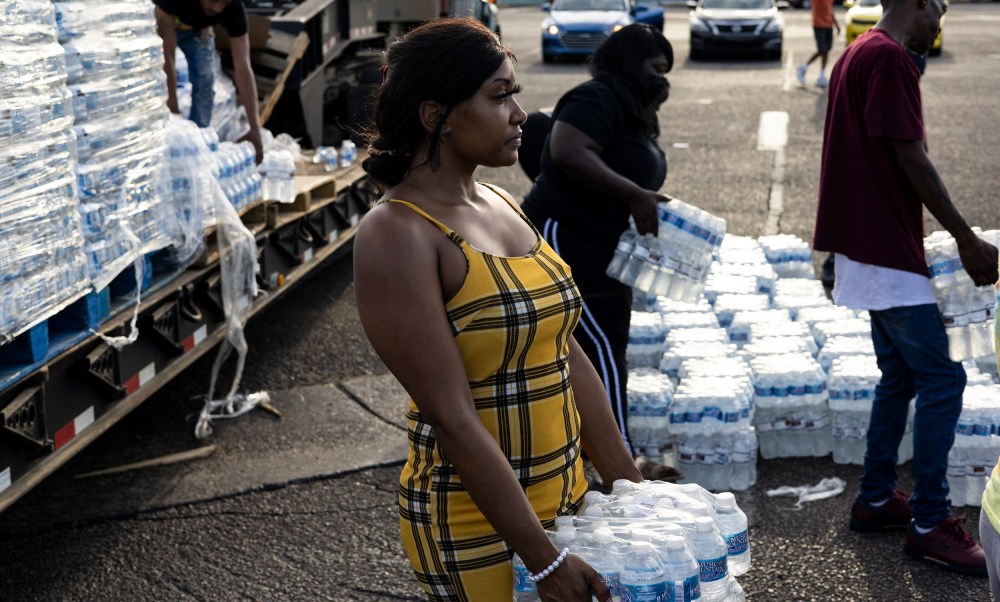
In April, the mayor of Jackson, Mississippi, Chokwe Antar Lumumba, called the Mississippi Legislature “paternalistic” and “racist” for continuing to ignore its majority Black capital city’s infrastructure needs. His comments echo those he made during a re-election debate last year, when Lumumba accused the state of offering a ridiculously small amount of cash for infrastructure help but only if Jackson relinquished control of Jackson-Medgar Wiley Evers International Airport (a charge a state official denied). Today, the water emergency in Jackson has grabbed the nation’s attention. But this crisis is not just emblematic of the crumbling of America’s cities; it doubles as a hostage situation.
I can’t remember the last time I visited family in Jackson and was served tap water.
I can’t remember the last time I visited family in Jackson and was served tap water. Every glass is poured from a plastic bottle. But when the Pearl River overflowed its banks Monday and took out the city’s decrepit water system, it meant that Jackson residents who could get water from their taps were encouraged to keep their mouths shut while showering.
Triggered by racist white flight, Jackson’s population fell more than 25% between 1980 and 2020. It’s now left with fewer than 150,000 people, 83% of whom are Black, a 2021-22 budget of $400 million and a $2 billion bill to fix its water and sewer system problem.
There’s no way Jackson can foot that bill alone. Like so many shrinking municipalities, its residents are too few and too poor. In recognition of a broader crisis, last year President Joe Biden proposed $111 billion to improve the nation’s drinking water systems. But Congress included only $55 billion for drinking water help in November’s $555 billion bipartisan infrastructure bill.

Jackson not only needs a commitment from Washington; it needs a commitment from state legislators. Unfortunately, too often those lawmakers seem more interested in putting the city in its place than doing their jobs. In a 2016 move that Jackson’s residents have rightly called racist, Mississippi lawmakers voted to effectively take away that asset (named for the city’s most famous civil rights martyr, no less) and put it under regional, i.e., white, control. Jackson continues to fight that takeover in federal court.
Here’s what Lumumba said in that re-election debate last year: “I sat down with the lieutenant governor to talk about Jackson’s infrastructure problem. We had a conversation that lasted for about an hour and a half, and he asked everyone to leave the room only to say, ‘Mayor, I need you to give me my airport, and I look at it for about $30 million. So not only am I supposed to be dumb, I’m supposed to be cheap, right?”
Lt. Gov. Delbert Hosemann told Mississippi Today at the time that Lumumba’s assertion was “completely inaccurate.” But was it? “In regards to pending litigation between the city and state over the airport, I did speak about that with the mayor and said I would like to settle that case,” Hosemann said. “But there is not a quid pro quo here.”
It wasn’t until Thursday that Republican Gov. Tate Reeves and Lumumba, a Democrat, appeared together in public to jointly address the crisis.
Jackson’s latest water emergency began Monday morning. It wasn’t until Thursday, though, that Republican Gov. Tate Reeves and Lumumba, a Democrat, appeared together in public to jointly address the crisis. In the same interview where the mayor called the Legislature “paternalistic,” he said he’d met with former Republican Gov. Phil Bryant 10 times as often as he’d met with Reeves. But in their joint appearance Thursday, Lumumba said, “I believe that my representation here is a symbol of the unity that is taking place, a symbol of a coalition that is working arm in arm to ensure that we keep the most primary focus on the residents of Jackson,” he said.
But how do the leaders of a Black city work with white officials who find it politically advantageous to run against Jackson and decry its “mismanagement?” “Jackson” and even “Hinds County” are code words for what and where white people don’t want to be. How do those Black leaders cooperate without giving up all their power?
Ironically, it was on a three-week march from Memphis, Tenn., to Jackson in 1966 that the phrase “Black Power” was first given utterance. At the start of the march, Martin Luther King Jr. had marchers shouting back “Freedom Now!” when asked “What do we want?” But by the end, Stokely Carmichael of the Student Nonviolent Coordinating Committee had them yelling back “Black Power!”
When I was growing up in the ‘80s and ‘90s, Black Mississippians expressed pride at how quickly we had progressed from a state where voting was nearly impossible to the state with the highest number of Black elected officials. That was a kind of freedom attributed to the likes of King. But this side of Reconstruction, not a single Black person in Mississippi has ever been elected statewide, a fact that’s even more outrageous when one considers that the state has the country’s highest concentration of Black people. The scattered Black school board members, aldermen, mayors, county supervisors or even state representatives and senators haven’t amassed power that white adversaries can’t easily subdue. What better illustration is there than a city that is more than 80% Black defending its airport, and a Legislature that’s about 70% white voting to forcibly take it? It’s a favorite tactic of Republicans to complain about the prevalence of problems in what they like to call “Democrat-run cities.” But the cities they describe are often islands inside Republican-controlled states that disregard those cities’ needs and ordinances, and may even punish them seemingly for sport. It’s a favorite tactic of Republicans to complain about the prevalence of problems in what they like to call “Democrat-run cities.” New Orleans, another predominantly Black city, floods even more than Jackson, and officials there have put the cost of fixing its water and flood control system at about $3 billion over 10 years. But after the New Orleans City Council passed a nonbinding resolution urging city officials not to investigate any reports of abortion, Louisiana Attorney General Jeff Landry, a likely Republican gubernatorial candidate in 2023, leaned on the Louisiana Bond Commission to delay consideration of the $39 million in financing the city needs for flood-control fixes. Giving voice to the same kind of paternalism Lumumba called out in Mississippi, Landry said that “we should not defer the ability to use the tools at our disposal to bring them to heel.” That specific plantation mentality remains prevalent across the South. And it serves to needlessly amplify suffering. Rivers flood. Water systems leak and break. But human beings make budgets and laws. What’s happening in Jackson isn’t inevitable. It’s a consequence of choices. Not the choices of those who live there but of those who meet there and govern unfairly.
Jarvis DeBerry is an opinion editor for MS NOW Daily. 


