








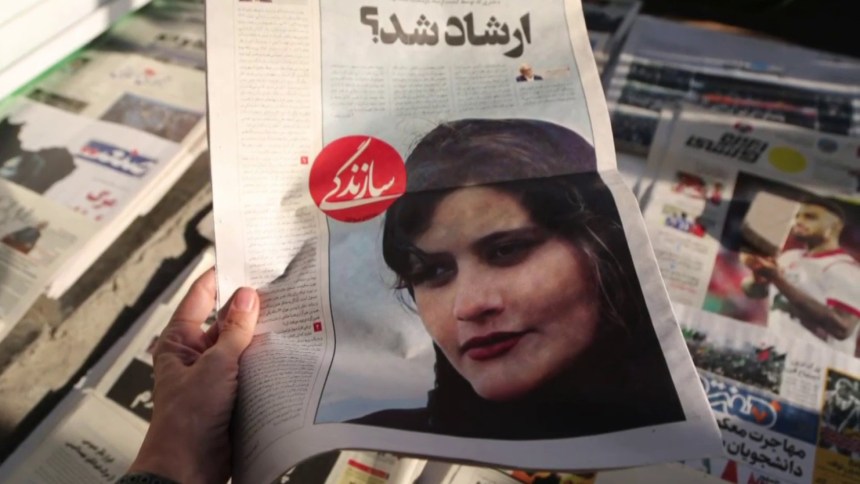
For over a week now, protests have raged across Iran, spurred by anger over the death of 22-year-old Mahsa Amini, who was arrested by the country’s “morality police” for not complying with the state dress code and who later died in their custody.
The government has said Amini died from a heart attack due to pre-existing conditions and say an investigation is underway. Amini’s family has said she had no pre-existing heart conditions. The hospital where she was treated said she fell into a coma and died from brain trauma, Iran International reported, and a top Iranian health official verified the cause of death as trauma to the head.
Eyewitnesses report Amini being severely beaten by the police with batons and smashing her head against the side of the van, which many suspect was the cause of her death.
Due to economic interests, we might not see a lot more from Western governments other than performative remarks condemning human rights violations.
The fact that so many of the demonstrations are being led by women makes the tenor of the civil unrest feel different from past protests, which have largely been led by men. But one thing is certain: In order for these protests to result in meaningful change, they must be accompanied by international solidarity and pressure. One significant potential roadblock is that at the moment, the disruption of oil supplies following Russia’s war on Ukraine — and the West’s insistence on involving itself by sanctioning Russia (a moral imperative that seems markedly absent when victims of violence are brown and not white) — may make the U.S. and the West soft on Iran in the hopes of opening up the country’s oil to the rest of the world.
In other words, due to economic interests, we might not see much more from Western governments other than performative remarks condemning human rights violations. (Case in point: the U.S. Treasury Department on Tuesday announced sanctions against Iran’s morality police and some state officials in response to the anti-government protests; but the move is largely symbolic, and comes with no consequential terms or actions.)

Some experts anticipated that restoring the Iran nuclear deal (and therefore lifting sanctions) might still be a diplomatic priority with Iran, despite the civil uprising: “It’s a Gordian knot that some Western diplomats may try to tackle on the sidelines of this week’s UN General Assembly,” Golnar Motevalli, Bloomberg’s Iran correspondent, reported.
Many Iranian activists have identified the necessity of international pressure to succeed with this movement, drawing parallels with the international outcry over George Floyd’s death and imploring the world to offer the same kind of solidarity. “This is Iran’s George Floyd moment … and I hope we keep pushing and the whole world continues to support this, so finally we have change,” British-Iranian actor Omid Djalili said in a video shared on Twitter.
Omid Djalili calls #Mahsa_Amini ‘murder a George Floyd moment’s of Iran… #مهسا_امینی #اعتراضات_سراسری pic.twitter.com/BqZbsiCN3b
— Sima Sabet | سیما ثابت (@Sima_Sabet) September 21, 2022
“Women supporting any movement like #metoo, if you are not aware of what is happening in Iran or if you are aware but not giving it enough importance, I don’t know how can you call yourself a feminist,” Iranian actress Golshifteh Farahani said on Instagram. “Please be the voice,” she said earlier in the post.
These protests are some of the largest and most disruptive Iran has seen in recent years, so much so that WhatsApp and Instagram, two of the platforms available there, have been restricted, according to NetBlocks, an internet watchdog that measures network data. It also identified “a near-total disruption to internet service in parts of Kurdistan province,” which is where Amini was from. NetBlocks describes this as “the most severe internet restrictions since the November 2019 massacre,” when more than 200 people were reportedly killed during anti-government protests over state gasoline prices.
Social media footage of the current protests has shown women tearing off their hijabs and burning them, some cutting their hair. Reports indicate that between 17 and 31 people have died, with hundreds injured, as protesters demand an end to the Islamic Republic, which emerged victorious during the 1979 revolution.
The revolution, which also included liberal and secular factions, sought to overthrow the American-backed regime (the CIA had been instrumental in installing and maintaining the regime, which is in part what produced such a strong backlash at the time). Present-day activists have evoked the pre-revolution era, sharing old pictures of Iranian women without hijabs, uncovered, or on the beach in bathing suits. “I think in this moment in history, we need to remember that when George Floyd was killed by police in America, there was global solidarity,” Nazanin Boniadi, another British-Iranian actor and a vocal advocate for human rights, said on PBS NewsHour. “You saw images from inside Iran, from inside Syria — places where they, themselves, are in dire straits — showing solidarity. The least we can do in the West is to show solidarity for the people inside Iran.” But the West’s untiring solidarity with Ukraine — which comes in part in the form of sanctions on Russia, one of the world’s largest oil producers — has yielded unending ramifications. Sanctions have made Russian President Vladimir Putin increasingly desperate, which will lead to more bloodshed, and has led to hikes in inflation and growing global inequality, a breeding ground for populist and fascist forces, to name a few. And now Iran has been drawn into the shifting balance of power. “To punish Russia for invading Ukraine, the U.S. and E.U. are hurriedly searching for coherent long-term strategies to reduce Russia’s geoeconomic sway in Eurasia,” the Carnegie Endowment for International Peace explains. This, in turn, has given some urgency to the lifting of U.S. sanctions on Iran. “The EU has long desired an Iranian role in its energy supplies … but sanctions have thus far come in the way.” Suffice it to say, supporting protesters’ end goal of overthrowing Iran’s current regime — and a potentially ensuing power vacuum — could upend many of these countries’ hopes of an oil deal with Iran. There would be a perverse irony in the West claiming moral superiority in its approach to Russia and Ukraine if part of that calculation involves tacit support of a regime which kills its citizens for being gay and, reportedly, for not covering their hair. But then again, the valuation of human life is very different when it is not white — and when economic interests are potentially threatened. So perhaps we shouldn’t be surprised if Ukraine becomes part of the West’s calculation in whether or how much to support the protests in Iran. We should be watching closely and demand the sort of international solidarity we’ve offered Ukrainians. To truly honor Amini and the protesters, we should insist on nothing less.
Noor Noman is a writer focused on culture, race and LGBTQ issues. 


