








Update (Aug. 8, 2022, 8:04 p.m. ET): Former president Donald Trump said Monday that his Mar-a-Lago home was “raided” by the FBI. Watch MSNBC for the latest.
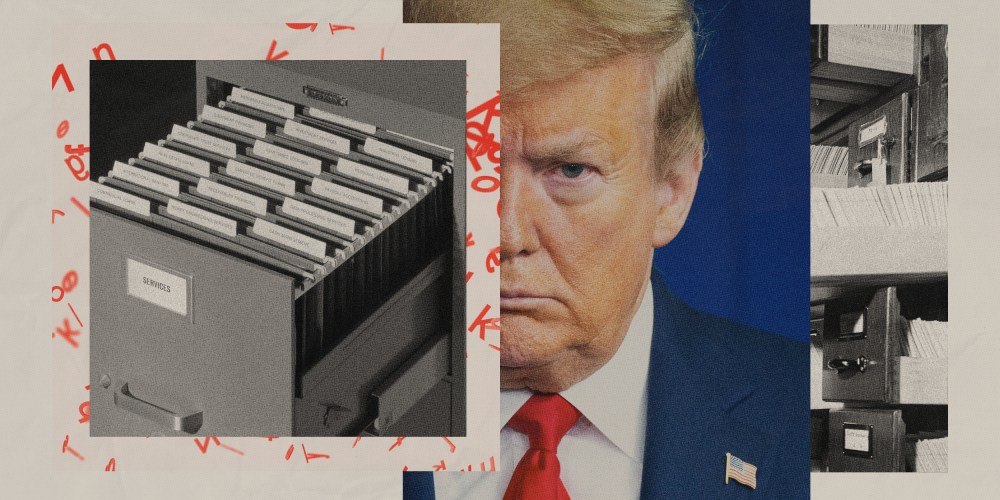
The New York Times, citing two people who’d been briefed on the matter, reported Thursday the convening of a federal grand jury that is investigating the handling of 15 boxes of classified White House documents that were squirreled away at Mar-a-Lago, Donald Trump’s Florida home. It’s easy to understand why this reporting didn’t lead most newscasts that day given the more dramatic story of the decision by the House committee investigating the Jan. 6, 2021, attack on the U.S. Capitol to subpoena five sitting members of Congress. But that story shouldn’t distract us from the big news that a grand jury has reportedly been impaneled to find out how and why national secrets were packed up in Washington and parked in Palm Beach.
While some pundits have asserted that convening the grand jury is part of a routine damage assessment, that’s a misleading explanation.
To borrow a concept from the world of classified information access, here’s what you “need to know” to process this development. First, a grand jury means the Justice Department believes a crime may have been committed. While some pundits have asserted that convening the grand jury is part of a routine damage assessment to explore the national security aspects of what the intelligence community calls a “spill” of classified documents, that’s a misleading explanation.
To be sure, every agency that has a piece of the intelligence reporting in the boxed documents will have to be notified, will have to conduct analyses of the threat that could be posed if their reporting gets into the wrong hands and will have to determine what steps can be taken to prevent a recurrence. But that kind of routine cleanup of a spill doesn’t require a grand jury. A grand jury investigates potential crimes.
When The Washington Post reported Feb. 10 that classified documents, including some marked “top secret,” had been discovered at Trump’s Florida residence, Trump spokesperson Taylor Budowich, in a written statement to the newspaper, said: “It is clear that a normal and routine process is being weaponized by anonymous, politically motivated government sources to peddle Fake News. The only entity with the ability to credibly dispute this false reporting, the National Archives, is providing no comment.”

In a letter dated Feb. 18 to Rep. Carolyn Maloney, D-N.Y., chair of the Committee on Oversight and Reform, David S. Ferriero, the archivist of the United States, said the National Archives and Records Administration “has identified items marked as classified national security information within the boxes” and “identified certain social media records that were not captured and preserved by the Trump Administration” and that it has “learned that some White House staff conducted official business using nonofficial electronic messaging accounts that were not copied or forwarded into their official electronic messaging accounts.”
Also in that letter, Ferriero wrote, “Because NARA [National Archives and Records] identified classified information in the boxes, NARA staff has been in communication with the Department of Justice.”
When The New York Times asked Budowich for comment for its story that a grand jury was being convened, he said: “President Trump consistently handled all documents in accordance with applicable law and regulations. Belated attempts to second-guess that clear fact are politically motivated and misguided.”
I think this case, as prosecutors say, “has legs.” Meaning it can go places we may not even envision.
While mishandling classified material is often addressed with administrative sanctions, including reprimands, suspensions without pay, removal or terminations of security clearances, mishandling classified information can be a federal violation with criminal penalties. As a primer from the Brennan Center for Justice explains, federal law “imposes penalties for knowingly removing classified material without authority and with the intent to keep it in an unauthorized location.”
“This charge is available only for knowing and intentional mishandling, such as occurred in the cases of former National Security Advisor Sandy Berger and former CIA Director John Deutch,” it says.
Second, I think this case, as prosecutors say, “has legs.” Meaning it can go places we may not even envision, because it’s unlikely the Justice Department would convene a grand jury if officials there didn’t think they had some evidence that could overcome Trump’s likeliest defenses. Trump may assert that as president he had the authority to classify and declassify information as he saw fit, which, with certain caveats, is correct. Or he could claim he didn’t know the content of the boxes and that some low-level staffer mistakenly included the documents — which purportedly contained some “top secret“-level data — in Trump’s move from the White House. Those defenses are difficult to disprove. So why would the Justice Department go to the trouble of opening a criminal case and convening a grand jury unless prosecutors believed they could effectively counter them? A sentence in The New York Times story may shed some light on what the Justice Department may have: “The documents in question are believed to have been kept in the residence of the White House before they were boxed up and sent to Mar-a-Lago.” Fifteen boxes of classified documents sitting in the residential wing of the White House doesn’t sound like a mistake to me. That sounds deliberate and less like an error that could be attributed to staff. Virtually every day during my 25 years with the FBI, I handled classified information. It was my experience that staffers, whose job is to know and comply with the rules and regulations for handling such data, don’t deliberately break those rules unless someone at a high level makes them break those rules. That’s why I don’t believe this grand jury is targeting low-level staffers. Third, perhaps this is bigger than just a mishandling case. As Justice Department investigators examine the documents, they’ll be able to see whether the contents held some value to Trump or those around him and possibly determine whether Trump could benefit from whatever’s in those documents. We mustn’t forget that during Trump’s term, his family members parlayed their relationship with him into personal profit and that while he was president, Trump’s own businesses reportedly raked in $2.4 billion. The first step to solving the Mar-a-Lago mystery is to get those documents into the hands of federal prosecutors and agents. The convening of a grand jury suggests that may have already happened. Now, we wait for the mystery to be solved. CORRECTION (May 23, 2022, 5:41 p.m. ET): A previous version of this article misstated the year of the Jan 6 attack on the U.S. Capitol. It was 2021, not 2001


