








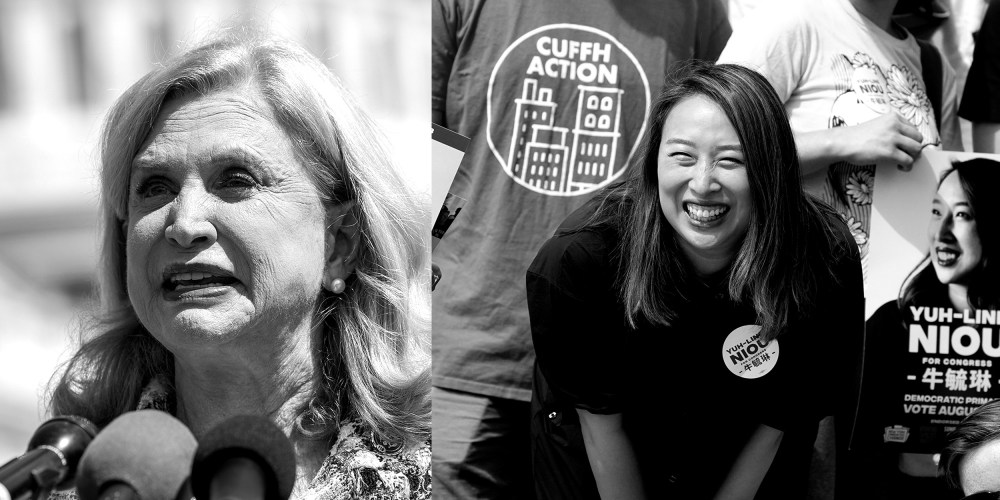
In New York’s congressional primaries Tuesday, two races could serve as a weather vane about the future of autism politics. In New York’s 12th District, Rep. Carolyn Maloney, who has come under intense scrutiny for previously suggesting that vaccines may cause autism, is facing fellow Rep. Jerry Nadler and challenger Suraj Patel. In New York’s nearby 10th District, State Assemblymember Yuh-Line Niou, who already made history as the first openly autistic state legislator in the country, is running for the Democratic nomination in a large field.
The fear-based and medicalized model of autism sees the disability as a social problem to be solved.
Maloney has previously represented the fear-based and medicalized model of autism, which sees the disability as a social problem to be solved, whereas Niou wants to include autistic voices in politics.
When asked in a recent interview about her past comments linking vaccines to autism, Maloney said, “I regret any statement I ever made asking a question about vaccines.” She downplayed her past positions with the claim that there “were two bills that I co-sponsored that studied them. I regret asking to study vaccines.”
But Maloney did more than that. In 2007, she sponsored legislation to compel the secretary of health and human services to “compare total health outcomes, including the risk of autism, between vaccinated and unvaccinated U.S. populations” as a way to “determine whether vaccines or vaccine components play a role in the development of autism spectrum or other neurological conditions.” In 2008, she appeared at a rally with former Playboy model and ur-anti-vaccine crank Jenny McCarthy for “greener vaccines.”
On top of that, during a 2012 congressional hearing, while talking about an increase in autism diagnoses, she said, “And I don’t want to hear that we have better detection. We have better detection, but detection would not account for a job from 1 in 10,000 to 1 in 88. That is a huge, huge, huge jump.”
Had Maloney read any literature on the increase of autism diagnoses, she would have known that better detection was, indeed, the main reason for the increase. She would have known that the Diagnostic and Statistical Manual of Mental Disorders expanded its diagnostic criteria throughout the 1980s and ‘90s, that autism didn’t even get its own diagnosis separate from schizophrenia until 1980, and that it wasn’t categorized as a spectrum until 1994.
Moreover, 1990’s Individuals With Disabilities Education Act specifically listed autism as one of the disabilities eligible to receive services. Public policy and scientific consensus converged in the 1990s, meaning that more students’ autism was detected, allowing them to receive more services.

Maloney was far from alone on this. Anti-vaccine rhetoric was always a bipartisan affair. Senators and presidential candidates Barack Obama and John McCain talked about a potential link between vaccines and autism in their 2008 campaigns.
Perhaps one the most discouraging aspects about the vaccine panic of yore was that it prevented the public from seeing increased autism diagnoses as a public policy success. That success is especially visible now that the first generation of autistic students who received services in the 1980s and the 1990s has grown up. In my book “We’re Not Broken,” I call this generation, of which I’m a part, “The Spectrum Generation.” Even though the IDEA and the Americans With Disabilities Act didn’t provide the windfall we needed, they still offered some modicum of liberty and self-understanding as an identity. As Niou’s candidacy illustrates, many of these autistic people have become politically active. These two approaches to autism could not be starker. Like many women and people of color, she was diagnosed with autism as an adult, but there were always indicators that she was autistic. An example of how media coverage of autism has changed is that Niou spoke about being autistic with my friend and fellow autistic journalist Sara Luterman. Like many people her age, she said she has “been shaped by being autistic.” These two approaches to autism from one woman who has been in Congress nearly 30 years versus a would-be member of Congress could not be starker: Maloney’s comments show that she and many other anti-vaxxers sought to blame immunization for autism because autism itself was a problem. Conversely, Niou’s existence in public life shows how giving autistic people access to society not only allows them to live better lives but also shape the policies that affect them.
Eric Garcia is an author and senior correspondent for The Independent. 

