








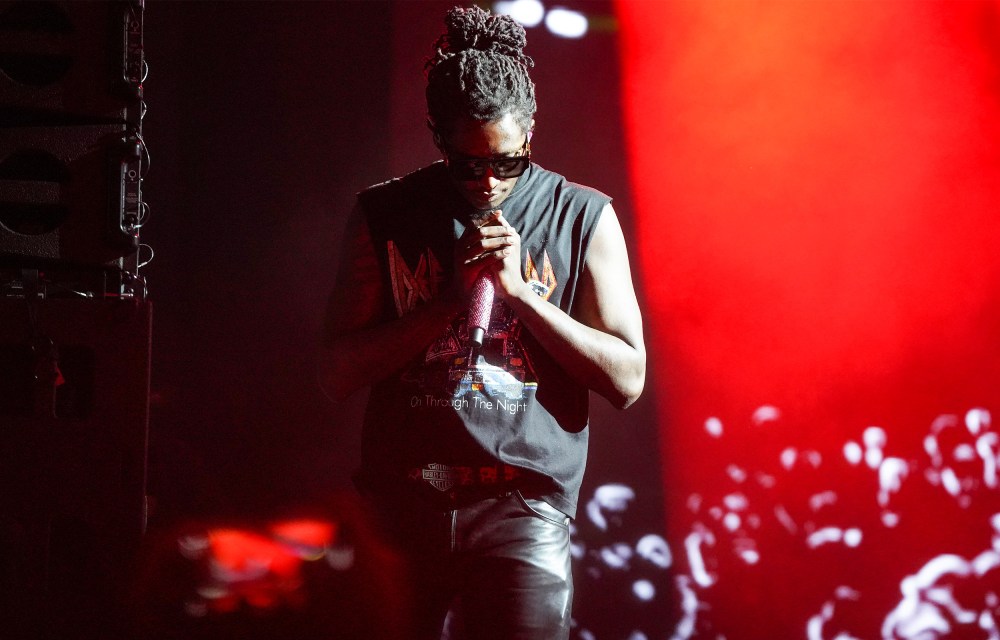
In early January, Atlanta-based rapper Gunna’s third studio album, “DS4Ever,” debuted at the top of the Billboard 200 chart after selling 150,000 copies in its first week. It was the seeming culmination of Gunna’s rap ascension: He has hit songs (“Pushin P,” the first single from “DS4Ever,” spawned a viral TikTok trend), an enviable label situation with rap superstar Young Thug, and a much-rumored but never confirmed relationship with pop star Chlöe. But it all came crashing down last week when Fulton County District Attorney Fani Willis unveiled a sweeping 56-count indictment that accuses Gunna, Young Thug and 26 of their associates of using their music label, Young Slime Life, as a cover to participate in criminal activities.
It’s nearly impossible to prove that a rapper’s content can be directly linked to real-world crime, but that hasn’t stopped prosecutors from attempting to use the strategy to bury them.
The indictment alleges that since 2012, YSL has “conspired to associate together and with others for the common purposes of illegally obtaining money and property through a pattern of racketeering activity and conducting and participating in the enterprise through a pattern of racketeering activity.” In other words, some of rap music’s brightest stars are being accused of conspiring to violate Georgia’s RICO Act — and, on the surface, it isn’t looking good. Both Gunna and Young Thug will await trial in the Fulton County jail after being denied bail and the indictment, itself, seems airtight. In fact, it’s full of troubling allegations. For instance, Young Thug is accused of renting the car used during the murder of Donovan Thomas Jr. and attempting to orchestrate a hit on fellow rapper YFN Lucci.
This isn’t the first time we’ve witnessed a promising rap career being decimated by a RICO case: In 2020, the City of New York charged rapper and 17 alleged members of the Untouchable Gorilla Stone Nation “gang” with conspiracy to commit racketeering among other crimes. Casanova recently pled guilty to one count of trafficking marijuana and one count of participating in a robbery, making him eligible for a 60-year sentence. If he’s sentenced as he’s expected to be, his career may very well be over. Perhaps, most famously, rapper Bobby Shmurda and more than 15 members of his crew, GS9, were arrested in 2014 on a wide-ranging conspiracy indictment. Shmurda was released in 2021 after serving seven years, and though he resumed his career, there will always be the question of what his career could’ve been if he’d been able to capitalize on the buzz he’d begun building before he was incarcerated.

While there’s nothing new about law enforcement targeting rappers — New York’s “hip-hop police,” now known as the enterprise operations unit, surveilled the game’s biggest players through the ’90s and early 2000s — these specific indictments are notable because they weaponize the RICO Act to stamp the “gang” label on rap crews. Everyone associated with the rapper, including those unaffiliated with the crimes allegedly committed, are lumped into the “gang,” and held responsible for activities they may have no knowledge of. Childhood friends, many of whom are Black and Latinx and grew up in impoverished neighborhoods, are treated as if they’re a crime syndicate like the mob. While this tenuous legal strategy has proven effective, particularly as it pertains to the hip-hop community, it also uses the lyrics of the most famous member of the alleged “gang” as evidence of their crimes. District Attorney Wilis’ indictment claims that Young Thug’s lyrics in specific songs, including “F— the judge, YSL, this that mob life” from “Slime S—,” were “an overt act in furtherance of a conspiracy.”
It’s nearly impossible to prove that a rapper’s content can be directly linked to real-world crime, but that hasn’t stopped prosecutors from attempting to use the strategy to bury them. Shmurda’s 2014 hit song “Hot N*gga” was heavily scrutinized and treated as if it were evidence. The same was done to Boosie and Drakeo the Ruler when they were on trial for murder. And it’s only expected to increase after the State of Maryland declared it legal to enter rap lyrics as evidence in murder trials. By treating rap music as more than mere expression, America’s legal system is putting an entire genre on trial, as if the world’s most popular gene is a scourge that must be eradicated.
There’s nothing inherently new about state and federal governments criminalizing Black men. But insisting that the music they’ve created is evidence of their criminality is a self-fulfilling cycle that leaves little room for rappers to paint a picture about their upbringing and experiences.
But here’s the thing: Rap originates in urban communities populated primarily by Black and Latinx folks deprived of resources. It becomes, for those who are successful, a means of escaping their environment — but just because they’re no longer forced to reside in their communities doesn’t mean that they can’t create music about their experiences. It doesn’t mean they have to leave their friends who haven’t gotten the same breaks behind because that’s what prosecutors consider respectable. Or, as Shmurda told Vulture in 2014, “I’m guilty for where I live. I was never part of no gang.”
There’s nothing inherently new about state and federal governments criminalizing Black men. But insisting that the music they’ve created is evidence of their criminality is a self-fulfilling cycle that leaves little room for rappers to paint a picture about their upbringing and experiences. That doesn’t mean there isn’t space to critique hip-hop, particularly as it relates to its depictions of women — C. Delores Tucker was right — but intracommunal policing doesn’t look like censorship or incarceration. Instead, it protects a rapper’s right to the free speech afforded to them in the First Amendment while also engaging in rigorous debate about the merits of the music and the harm it might evoke. Those are different aims than incarcerating rappers for the hell of it, sometimes charging them for crimes their affiliates committed. There’s some hope on the horizon: Senate Bill S7527, also known as the “Rap Music on Trial” bill, would eliminate the possibility of an artist’s music being entered as evidence in criminal trials. The proposed legislation, which is being supported by Jay-Z, Meek Mill, Killer Mike, Fat Joe, and other prominent rappers, would “acknowledge rap music as a form of artistic expression,” similar to poetry, rather than allow it to be interpreted literally. As the bill’s sponsor New York State Sen. Brad Hoylman told Fox 5 NY, no other genres are subjected to such literalism when their art is being engaged. “No one ever thought that Johnny Cash was going to shoot a man in Reno just to watch him die, or Bob Marley shot a sheriff but spared a deputy,” Hoylman said. “That’s exactly what prosecutors are trying to convince juries about across the country.” Alex Spiro, Jay-Z’s attorney, and Erik Nielson, a professor at the University of Richmond, who wrote the 2019 book “Rap on Trial: Race, Lyrics, and Guilt in America,” argued in the statement that this tactic “gives prosecutors a dangerous advantage in the courtroom: By presenting rap lyrics as rhymed confessions of illegal behavior, they are often able to obtain convictions even when other evidence is lacking.” In other words, rap would be treated as the expression it is rather than an autobiography chronicling current events. While the bill has passed a New York State committee, it might not become law in enough time to set a precedent that can change Gunna and Young Thug’s fate. But no matter what happens in their individual case, the question remains: Who gets access to free speech? Apparently, not rappers. It’s 2022, but it might as well be 1996 all over again.


