








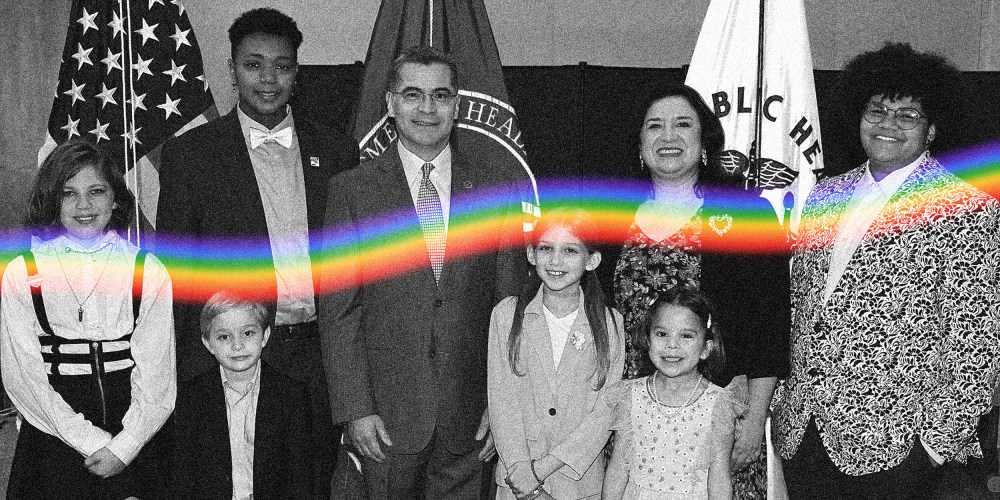
Jaime Jara, a 43-year-old mother of three, told me that some politicians in her home state of Florida have physically hidden from her and her 10-year-old daughter, Dempsey, when they tried to approach them to advocate against the state’s anti-trans bills. Jara was part of a group of parents and trans kids who gathered Monday outside the U.S. Department of Health and Human Services administrative building in Washington, D.C., just a stone’s throw from the Capitol. They had just met with one of the most powerful government officials in the country, HHS Secretary Xavier Becerra.
“We’ve been reported to child protective services in Florida multiple times. Strangers report my husband and I for child abuse simply for affirming her for who she is.”
As we talked, Dempsey, who is trans, rested her iPad against a stone security pillar and faced it. Upbeat music started to play, and the young girl broke into a well-coordinated TikTok dance as a group of parents and young kids looked on.
“My daughter is going into fifth grade. There’s already a law that says when she goes into sixth, she can’t run on her sports team in Florida,” Jara told me.
I was given the exclusive chance to sit in on the meeting in what can only be described as an increasingly desperate political moment for trans kids and their families. Over the last several years, 18 states have taken action to ban trans girls from girls’ sports teams, even in middle school.
“Next week, they’re talking about banning transgender care for youth,” she said. “They’ve already put in place a Florida Department of Health directive saying children shouldn’t socially transition. She socially transitioned between kindergarten and first grade. If we had followed that advice, I don’t know if she’d be here.”
Today, I met with transgender youth & their families to discuss how HHS can best support them. I’m grateful to these children & their families for coming and sharing their stories.
— Secretary Xavier Becerra (@SecBecerra) June 27, 2022
I’ll quote my new friend, Dempsey from FL: “You deserve to be you. Kids should be themselves.” pic.twitter.com/6q5462Zxie
About 13 parents and kids attended the meeting with Becerra, along with January Contreras, the assistant secretary for the Administration for Children and Families, and representatives from several LGBTQ rights groups who helped organize the roundtable discussion. Dr. Rachel Levine, who as HHS’s assistant secretary for health is the highest-ranking openly trans government official in U.S. history, also joined by video, calling in from Florida.
“What we want America to know is that our kids deserve to be themselves,” Becerra told me after the meeting. “I so appreciate the parents who were willing to bring their kids here today to be able to share their stories, because I know they’ve gone through a lot, but they’re letting their children be themselves. We want them to know that HHS is a safe place, it’s a home for them, and we’re going to do everything we can to be a member of the family and let those kids be themselves.”
The families, who traveled to Washington from Massachusetts, Virginia, Texas, California, Georgia and Florida, all expressed concern over state-level political attacks on their kids’ lives. Three state legislatures have already banned gender-affirming care for trans adolescents, along with dozens of sports bans. Texas Gov. Greg Abbott instructed the state’s Department of Child and Family Protective Services to investigate parents who give puberty blockers or hormones to younger teens for child abuse.
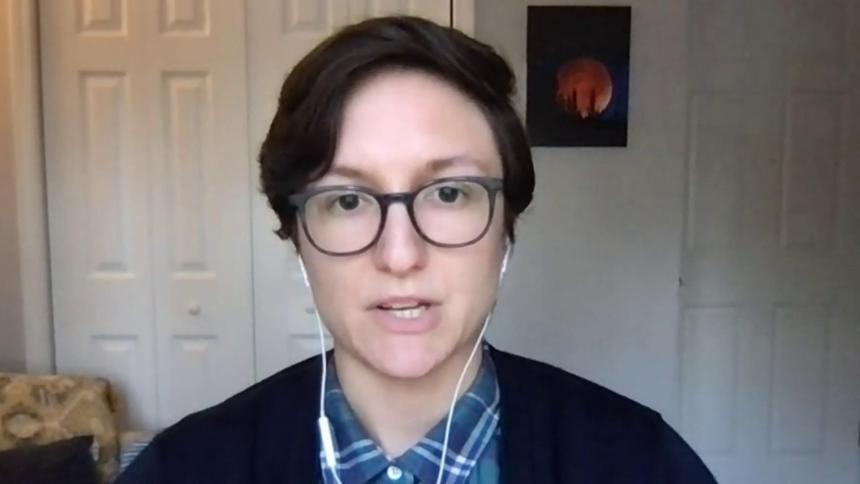
Becerra reassured families that his department was using what power it has as a federal agency to push back against those state-level attacks. Responding to one parent concerned over how foster care systems treat trans youths, he said, “We have provided guidance to the child welfare agencies that let them know that providing gender-affirming care is part of the process of doing child welfare.” He added: “We don’t control those agencies, but we can provide them with guidance. And since they ask us for money, we can watch what they do.”
Jara related her experience as an 11-grade history teacher in Central Florida and as a parent of a young trans kid to the secretary. She expressed worry over a coming meeting by the Florida Health Department over whether to ban gender-affirming care from coverage in the state’s Medicaid system. “My husband and I are a bit concerned, because we don’t use Medicaid but we’re afraid that that will then extend to private insurance,” she said. “We’ve already had issues finding affirming care in Florida.” Her family had to move from Miami to Central Florida to find such care.
She worries that further political attacks could force her to flee the state or even the country. “Let’s call it what it is: It’s not moving; it’s fleeing,” she said. “We’ve been reported to child protective services in Florida multiple times. Strangers report my husband and I for child abuse simply for affirming her for who she is.”
“They shouldn’t have to be out and proud in Washington, D.C., advocating for their rights at the age of 5 or 11. It’s just wild to me and absurd.” Becerra tried to reassure Jara. “I can’t tell you how far we’ll be able to take it. We can’t tell you where the courts will let us go, but I will tell you that if any state wants Medicaid money from the federal government and we have federal laws that require people to be free of discrimination that we’re going to be doing everything we can for you family to make sure that they abide by federal laws.” Several of the youths, ages 5 to 17, also had the chance to share their stories directly with the secretary. One recalled how when they were younger, their mom made them cry when she sat them down in a Georgia Cracker Barrel restaurant and told them they should stop shopping in the girls’ section in clothing stores. The mom, sitting next to them, admitted that this happened before she came around to being supportive of her child’s gender identity. Now the two found themselves advocating in front of a Cabinet member. Each family expressed relief that at least someone in the government was taking the time to listen to them as they battled ever more intrusive state government intrusions on their private lives. “It makes me really happy” that younger kids were there, “because when I was that age, I was alone in the world and didn’t really have the voice to express myself,” said Ashton Mota, a 17-year-old trans boy from Lowell, Massachusetts. “At the same time, I recognize that they shouldn’t have to be out and proud in Washington, D.C., advocating for their rights at the age of 5 or 11. It’s just wild to me and absurd.” Ashton’s words stuck with me as the group grabbed an elevator from the top floor of the HHS building to head out front for some group photos, which were taken in front of a Progress Pride flag hanging underneath the American flag. I thought of these kids, whose young lives have become ground zero in the conservative culture war. Adult politicians are seeking to control these kids and their bodies, sometimes even threatening to rip loving families apart in pursuit of their political ideology. With so many attacks nationwide, it feels weird to highlight a single, if historic, meeting with a Cabinet-level secretary. Becerra emphasized that he was on these kids’ sides in the fight. But we don’t know how effective the federal government can be in pushing back against these state-level attacks. And what happens to these families the next time Republicans take over the federal government and the federal lifeline evaporates? After the photos, we chatted among ourselves while the younger kids broke off from the adults, running around the stone security pillars that pockmark the plaza in front of the concrete building. They took turns racing up and down some decorative steps, some breaking into singing and dancing at different points. The right is often fond of saying “let kids be kids,” and I agree. These kids are just kids, in the end. But because of the adults in charge of their states, they’re forced to go out and advocate for themselves before they’re even old enough to vote. It’s long past time that these kids shouldn’t have to fly to Washington to meet with the most important leaders of the country. At least someone is finally listening. But how much of a difference that will make remains to be seen.
Katelyn Burns is a freelance journalist based in New England. 


