








UPDATE: (Aug. 12, 2022, 3:15 p.m. ET): NBC News on Friday obtained a copy of the warrant used in the FBI’s search of former President Donald Trump’s Mar-a-Lago home in Florida, as well as the related property receipt. The FBI recovered 11 sets of classified documents in the search, according to the documents.
A legal barrier of sorts has been broken: The FBI obtained and executed a search warrant on the home of a former president of the United States. This represents the kind of maiden legal voyage by the Department of Justice that has been prompted by the conduct of Donald J. Trump.
This represents the kind of maiden legal voyage by the Department of Justice that has been prompted by the conduct of Donald J. Trump.
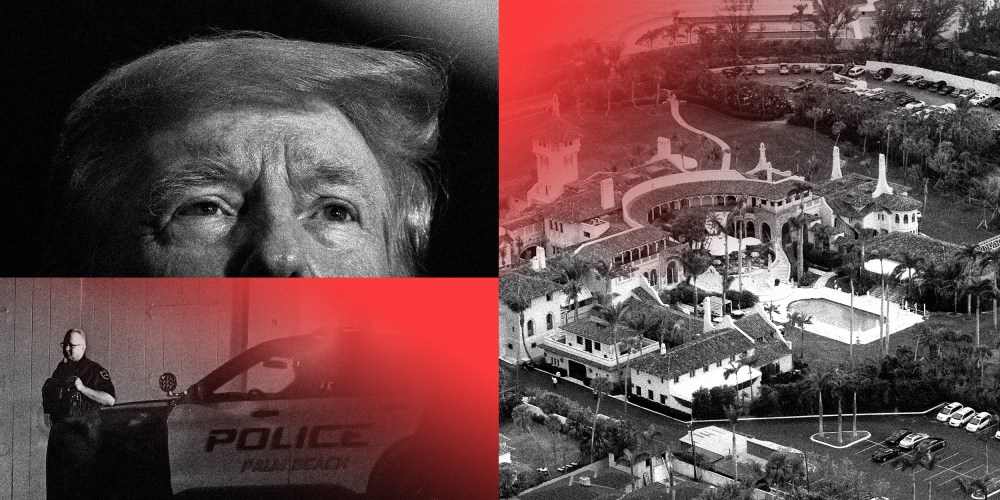
There are few things we know — and much we don’t know — about Monday’s search of Mar-a-Lago, Trump’s Florida home. Let’s start with what we do know.
First, the decision to request a search warrant was undoubtedly vetted through the uppermost ranks of the Justice Department, likely all the way through Deputy Attorney General Lisa Monaco and Attorney General Merrick Garland.
Second, a federal judge authorized this search. When the FBI, an agency within the Justice Department, decides that a search warrant should be pursued as part of a criminal investigation, agents will draft and swear to the truthfulness and accuracy of an affidavit in support of a search warrant. That sworn affidavit will include evidence the agents believe satisfies the burden of proof for warrants to be issued: probable cause.
Whereas precisely defining what evidence satisfies the probable cause standard is challenging, we know it lies somewhere between “reasonable articulable suspicion,” the standard set by the Supreme Court for an officer to “stop and frisk” an individual, and a preponderance of the evidence, that is, more likely than not. Importantly, the preponderance of the evidence standard is higher than the probable cause standard (which is the standard to issue search warrants, arrest warrants and grand jury indictments).
An FBI agent submits an affidavit in support of a search warrant to federal prosecutors for review. As the chief of the homicide section in the District of Columbia U.S. Attorney’s Office, I reviewed countless affidavits to determine whether they contained adequate evidence of probable cause. If I determined they did, I signed the search warrant application paperwork, and the agent was then permitted to meet with the judge to formally apply for the warrant. However, if I determined the affidavit contained insufficient evidence of probable cause, I would inform the agent that additional evidence would be necessary before I would authorize the warrant application. So in a very real sense, prosecutors put their names and reputations on the line when making the weighty decisions to approve applications for search warrants.
Once given the go-ahead by a federal prosecutor, the FBI agent presents the application for the search warrant to a federal judge. Judges often will ask follow-up questions about the evidence contained in the affidavit. I imagine the judge who reviewed a search warrant application for the home of a former president having more questions than usual. Although the legal standard doesn’t change based on the nature of the place to be searched, because the request was to search presidential property, I suspect the agents and prosecutors had very strong evidence, likely well above probable cause.

It’s clear that the judge agreed with the evidentiary assessments of both the agent and the prosecutor that there was reason to believe there was evidence of a crime at Mar-a-Lago. Hence, the judge authorized law enforcement agents to conduct the search.
This beat-by-beat breakdown of what goes into obtaining a search warrant is important to combat the disinformation already being put out by Trump. He issued a statement Monday, the content of which ranges from misleading to comical. He says the “raid” on his “beautiful home, Mar-a-Lago” was “unannounced.” First, it wasn’t a raid. It was a court-authorized search warrant. As for it being “unannounced,” every search warrant is unannounced, so the occupants don’t have an opportunity to move or destroy evidence. I’ll leave his assertion that his home is “beautiful” to the eye of the beholder.
Trump then absurdly compares a court-authorized search warrant to the Watergate break-in at the Democratic National Committee headquarters. Trump absurdly compares a court-authorized search warrant to the Watergate break-in. What do we not know? We don’t know what agents were looking for. There is some reporting that this search warrant is related to Trump’s unauthorized removal of government documents and records from the White House to Mar-a-Lago. This makes some intuitive sense given the location of the search. But consider: The National Archives reportedly retrieved 15 boxes of documents from Mar-a-Lago in January and had been negotiating with Trump for months before that for the return of those records. So, law enforcement authorities have known about Trump’s possible misconduct in this regard for a long time. Why seek search warrants for improperly retained documents now? It may be because the documents are classified and raise national security concerns. If the lengthy negotiations with the National Archives did not result in Trump relinquishing the documents, it seems imminently reasonable, indeed necessary, for the FBI to obtain them via a search warrant. Moreover, if a crime has been committed involving the removal, retention or concealment of government records, it could have serious consequences for those involved. There have not been any arrests or indictments of anyone regarding documents taken to Mar-a-Lago, but if anyone is charged with and convicted of concealment or removal of government records, part of the authorized punishment includes “forfeit[ing] his office and be[ing] disqualified from holding any office under the United States,” pursuant to 18 United States Code, section 2071. Some might say that it would be hard to prove beyond a reasonable doubt that Trump himself “removed” or “concealed” the documents. Indeed, it is hard to envision Trump himself packing up boxes as he was leaving the White House before Joe Biden’s inauguration. But here is where Trump’s every statement and press release is potentially useful evidence for federal prosecutors. In Trump’s Aug. 8 missive, he says of FBI agents, “They even broke into my safe!” In the event illegally concealed government documents were found in “his” safe and there’s an indictment that follows, then this Trump admission will be quite helpful at trial. In the long run, Trump may prove to be his own worst enemy. Even if the Mar-a-Lago search warrant is “only” about Trump illegally possessing government documents, if feels like a shift in the tectonic legal plates. With Garland’s Justice Department reaching the conclusion that it’s time to begin using search warrants as part of its criminal investigation of a former president, it seems that things may be snowballing in the direction of accountability, and maybe even justice.
Glenn Kirschner
Glenn Kirschner, a former assistant U.S. attorney for Washington, D.C., is an NBC News and MSNBC legal analyst. 


