








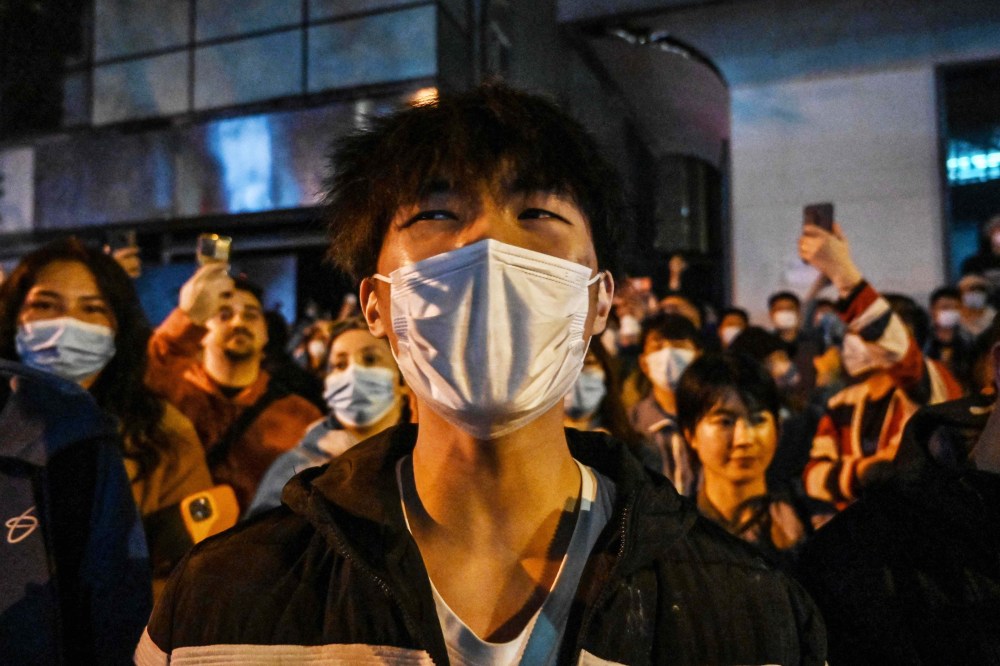
China is not known for tolerating protest. On the contrary, the ruling Communist Party is notorious for its brutal repression of even a whiff of dissent. That’s what’s so remarkable about the protests against the country’s zero-Covid policies. They’ve lasted four days and have been staged in multiple cities, including Shanghai and Beijing, and they’ve led to unprecedented concessions from President Xi Jinping.
China is not known for tolerating protest. The ruling Communist Party is notorious for its brutal repression of even a whiff of dissent.
China made the rare move to respond with changes. For example, there will be no more mass testing in Guangzhou, a Covid hot spot. Despite rising cases, there will be no more blockades in Beijing. In Urumqi, women markets will reopen and public bus service will resume this week. This is a very real recognition by local governments that people in China cannot comply anymore with such unrelenting restrictions on their daily lives.
The move to ease some of China’s draconian pandemic-related restrictions rather than immediately unleash a violent police response is not a softening of China’s no-free-speech policy. Nor is it an official admission the zero-Covid policies that effectively lock people in their homes are unsustainable. However, the easing of the rules does indicate what Xi and the Communist Party truly fear: a deep public anger that, with the right spark, could connect even more people in a conflagration that spreads across the whole country.
Protests against China’s zero-Covid policy were inevitable. Human beings will not tolerate indefinite isolation. Even so, for three years, China’s 1.4 billion people have been living with the fear that one person catching Covid will result in police locking down the entire residence, even if it’s an apartment building with hundreds of people.

According to the country’s zero-Covid policy, a single infection triggers the shutdown of nearby businesses and schools, and everybody in the area would have to test negative before anyone would even be allowed on the street. This has been the reality for tens of millions of people in areas of China that have been locked down.
Even so, there’s been a recent rise of Covid cases across the country, from transportation hub Guangzhou to the capital city, Beijing. Individual districts in those cities are home to more people than entire states in the U.S. Officials enforcing China’s zero-Covid were locking down districts just as the economy was bouncing back and residents were getting a taste of normalcy.
Then on Friday, a fire erupted in an apartment building in Urumqi, a city that had been under lockdown for more than three months. Fire trucks wasted critical time waiting for barriers erected for the lockdown to be removed. Some residents were afraid to escape out of fear the police outside would punish them for violating the Covid rules. Ten people died in the 150 minutes it took to contain the fire and conduct an evacuation. That sparked an online outrage that translated to the streets; a Shanghai candlelit vigil in memory of the fire victims had people holding up white signs, a symbol of censorship and chanting “need human rights, need freedom.” Thousands more marched in front of government buildings and tore down police barricades in nearly 20 cities across the country.
Officials enforcing China’s zero-Covid were locking down districts just as the economy was bouncing back and residents were getting a taste of normalcy.
In the world’s second largest economy, where the unemployment rate for recent college graduates is at 20%, the pandemic pain-in-the-pocketbook has been brutal, and patience has dried up. For the first time in recent memory, Chinese people protested in the capital city demanding the resignation of their leader. Protests flared up in London, Paris and Tokyo to support those in mainland China.
Xi has many tools in his toolbox for managing discontent. Brutal repression is one of them. From turning tanks against student protesters in Tiananmen Square in 1989, to the post-protest torture of Falun Gong practitioners starting in 1999, to the ongoing internment of more than 1 million Muslim Uyghars, the Communist Party of China has effectively executed a long-term strategy involving propaganda and state brutality to suppress domestic discontent with few lasting political repercussions.
But the last few days have been different. These protests were a direct rebuke to Xi, who put the power of his persona behind the country’s zero-Covid policies. Days after Xi solidified his control at the Communist Party Congress last month, China began easing restrictions as anticipated, but officials quickly put those restrictions back in place when Covid cases started rising.
The Biden administration only recently began to repair its fraught relationship with Beijing; the two presidents met for the first time at the G-20 summit earlier this month. Tensions between the leaders have been high over Taiwan, North Korea and over who gets to have military dominance in the South China Sea. Also, Biden is seeking a partner in Xi to stem a global recession. Therefore, in response to the breakout of protests across China, the White House kept its powder dry, only making generic comments about the right to protest. “Our message to peaceful protesters around the world is the same and consistent … people should be allowed the right to assemble and peacefully protest policies or laws or dictates that they take issue with,” said U.S. National Security Council spokesman John Kirby. Let’s be clear, these protests did not start as a demand for wholesale government reform. The chants for freedom that we are hearing are not for the right to vote or for new laws to recognize fundamental human rights. These chants demand the freedom to leave one’s home, freedom to work and freedom to socialize. While China has let its people vent for a hot minute, Xi and his police state are now actively working to quell the further spread of activism. Let’s also be clear that while China has let its people vent for a hot minute, Xi and his police state are now actively working to quell the further spread of activism. Protesters are being surveilled online and arrested at this moment. Students are being sent home from university to dissipate hot spots of activity. Even so, Xi has revealed that he will blink in the face of mass discontent and global attention. The question remains if the average resident of China has enough fire in the belly to stare down the regime in pursuit of deeper and more meaningful change. However remarkable a protest, however brave those individuals protesting are, a revolution requires sustained and coordinated effort. That brings the risk of an even more brutal regime response. The tragic reality of modern foreign policy is that atrocities come first, then the official documentation that may trigger international sanctions. Until then, economic concerns about inflation and supply chain issues in the United States will take precedent over the activism in China. And the Biden administration will continue to play it cool in the face of China’s ongoing human rights abuses.
Nayyera Haq is a global affairs journalist. 


