








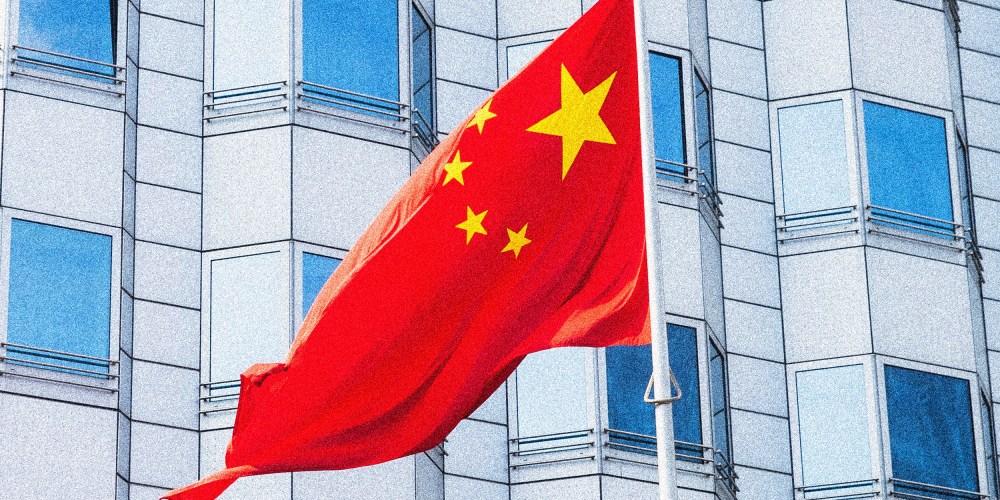
In a rare joint appearance this month, FBI Director Christopher Wray and Ken McCallum, the head of Britain’s MI5, warned the Western world of the rising threat posed by China. In doing so, they tacitly confirmed that Western efforts to deter Chinese aggression and integrate Beijing into the U.S.-dominated international environment have failed. The two law enforcement leaders detailed China’s efforts to undermine Western integrity, deplete its defensive capabilities and prepare the way for more extraordinary challenges to the global status quo.
Efforts to integrate Beijing into the U.S.-dominated international environment have failed.
Wray warned that China’s hacking program, “bigger than that of every other major country combined,” presents “an even more serious threat to Western businesses than even many sophisticated businesspeople realize” and is “set on stealing your technology, whatever it is that makes your industry tick, and using it to undercut your business and dominate your market.”
Wray and McCallum added that Beijing’s designs on Taiwan are real. Wray noted that if China seeks to forcibly reintegrate Taiwan into the People’s Republic, “it would represent one of the most horrific business disruptions the world has ever seen.” He’s right. A Chinese move across the strait, choking off free navigation of the seas in this vital part of the world, would do incalculable damage to the global economy.
“The widespread Western assumption that growing prosperity within China and increasing connectivity with the West would automatically lead to greater political freedom has, I’m afraid, been shown to be plain wrong,” McCallum concluded. “The Chinese Communist Party is interested in our democratic, media and legal systems,” he continued, “Not to emulate them, sadly, but to use them for its gain.”

This joint statement represents the end of an illusion. China is evolving from a crucial player in the global marketplace into a menace to that marketplace. The increasing recognition in the West that the People’s Republic must be confronted and deterred is, however, going to be frustrated by the limitations the West has put on itself and by its obligations elsewhere.
The Western imperative to deter Russian aggression against NATO allies and contribute to Moscow’s defeat in Ukraine is, of course, vital. But so, too, is the West’s need to hold Chinese irredentism in check. Last week, Real Clear Politics reporter Philip Wegmann asked Pentagon spokesman John Kirby about the strategy informing Joe Biden’s decision to dispatch an ever-growing number of U.S. weapons platforms, including naval destroyers, to Europe. “Shouldn’t the Italians and French patrol their own waters so we can have a free hand on the other side of the world?” Wegmann asked.
Kirby argued that the forward deployment of those destroyers doesn’t limit America’s capacity to project power elsewhere on the globe, and he said such deployments are justified because the security environment in Europe “has changed.” But the security environment there “changed” as early as 2007 when Russia engaged in cyber-attacks against NATO ally Estonia. It “changed” again in 2014 when Russia became the first nation to invade and annex territory in Europe since the Soviets did so in 1945. The security situation in Europe has been deteriorating for well over a decade even as the threat posed by China metastasized. What should be America’s priority? “You have to do both,” Kirby insisted.
China is evolving from a crucial player in the global marketplace into a menace to that marketplace.
Kirby’s right, but confronting challenges posed by two great powers in distinct theaters has not been part of America’s war-fighting doctrine since 2012, when former President Barack Obama announced that the U.S. would adopt a new “posture,” shifting to a “leaner” but more “agile, flexible” military. That meant sacrificing the Pentagon’s previous doctrine of maintaining the capability of fighting two conventional wars simultaneously on opposite sides of the globe for a “one-plus strategy.” That policy envisions a military capable of fighting one large conventional war against a peer competitor while maintaining policing or counter-insurgency operations elsewhere.
The agility and flexibility of America’s armed forces are the subject of debate, but there’s no doubt about the “leaner” part. In 2017, the number of active-duty service members was down 37% from 1990 and is roughly half what it was in 1964. Navy presence is the only deterrent in the Pacific. Ground forces are less valuable, and won’t deter China. The Navy has roughly 300 deployable, crewed ships in its blue water fleet. In 2016, it stated a need for a fleet of 355, but isn’t expected to achieve that goal until 2049. Our armed forces remain the most capable military on Earth, but that advantage can be overcome if its forces are stretched thin enough. The United States isn’t directly involved in a conflict with Russia, but Russia remains set on breaking NATO’s resolve to defend the smaller nations on its frontier. The U.S.’s forward deployments in Europe are meant to be intimidating to deter Russia from a possible incursion against such an ally. The United States would prefer to never go to war with China, but ensuring that we don’t will also involve substantial and sustained naval deployments to the Pacific. The West must credibly communicate to its adversaries that it will defend its interests. That credibility has been strained by the Pentagon’s 10-year-old doctrine. Indeed, Moscow’s miscalculations about the West’s resolve to provide sustained material support in defense of Ukraine’s sovereignty sends a worrisome signal about how well Russia understands the West. For its part, the West also misjudged the readiness and tactical acumen of the Russian military. All sides of the conflict in Europe got a lot wrong. The West must credibly communicate to its adversaries that it will defend its interests. So, what are we getting wrong about China? In the same way we misjudged Russia, have we misjudged China’s strength or its willingness to patiently wait for an age when its power rivals America’s? Because we cannot know the answers to those questions, the best insurance against our own misjudgments is to maintain a credible deterrent. Wray and McCallum’s warning to private and public entities in the West must be heeded, but counterespionage can only achieve so much. China’s strategic objective is hegemony, first in its region and then globally. Geopolitics is a zero-sum game, and China’s goals can only be achieved at the West’s expense. In 2012, it was perhaps difficult but by no means impossible to imagine the prospect of another two-front great power war. In 2022, the prospect is imminently imaginable. Because we have broadcast our unpreparedness to fight such a war, our adversaries are surely emboldened. It’s a dangerous world again, and it’s high time we started acting like it.
Noah Rothman
Noah Rothman is the associate editor of Commentary Magazine. 


